A Guide to Teaching by Modeling for K-12 Educators
Discover how teaching by modeling can transform your classroom. Our guide provides proven instructional strategies and practical examples for K-12 educators.
At its heart, teaching by modeling is exactly what it sounds like: a teacher demonstrates a skill or walks through a thought process so students can watch and learn. It’s the simple but powerful idea of showing, not just telling.
This approach moves way beyond just giving verbal instructions. It gives students a clear, real-time example of what expertise actually looks like in action.
What Teaching by Modeling Actually Means

Think about how a master carpenter teaches an apprentice. They don't just hand over a blueprint and wish them luck. The master picks up the tools, shows the apprentice exactly how to make the cuts, and talks through the "why" behind every move. It's an intuitive way to learn, and it's how humans have passed down knowledge for centuries.
The educational theory behind this is Albert Bandura's Social Learning Theory. His work showed that we learn a huge amount from each other simply through observation, imitation, and modeling. When students see a teacher—someone they trust—successfully complete a task, it builds their own confidence and gives them a mental roadmap to follow.
The Proven I Do, We Do, You Do Framework
In the classroom, this theory comes to life through a well-known instructional model: "I Do, We Do, You Do." It’s a structured way to gradually shift the responsibility from the teacher to the student, making sure learners feel supported every step of the way.
Here’s a breakdown of the cycle:
- I Do (Direct Instruction): The teacher takes center stage and demonstrates the skill. This is pure modeling. They might also use a "think-aloud" strategy, verbalizing their internal thought process to make it obvious for students.
- We Do (Guided Practice): Next, the teacher and students tackle the task together. This is a crucial collaborative step. It lets the teacher spot misunderstandings, give on-the-spot feedback, and fix mistakes in a low-pressure setting.
- You Do (Independent Practice): Finally, the students are ready to try it on their own. After watching the expert and practicing with support, they have the confidence and the know-how to apply the skill independently and really make it stick.
This structured approach makes expertise visible. It demystifies complex skills by breaking them down into observable actions and thoughts, transforming abstract concepts into concrete, achievable steps for students.
More Than Just Physical Skills
It’s easy to think modeling is just for hands-on tasks, like showing a student how to solve a multi-step math problem or properly hold a paintbrush. But its real magic is in its ability to make thinking visible. This is where cognitive modeling comes in.
Imagine an English teacher modeling how to analyze a poem. They're doing much more than just reading the words on the page. They’re verbalizing their internal monologue: "Okay, the author uses this really unusual word here... that makes me wonder what kind of mood they're trying to set. Let me reread the line before it and see if I can find any other clues."
This kind of modeling pulls back the curtain on the sophisticated mental moves that experts make without even thinking. It’s a game-changer for every subject—from figuring out a scientific hypothesis to building a persuasive historical argument—and an essential tool for developing deep, critical thinkers.
A Practical Guide to Modeling in Your Classroom
So, how do you actually do this in a real classroom? It’s more than just showing students a finished product and saying, "Do this." Great modeling is intentional and structured. The real magic happens when you pull back the curtain on your own expert thinking, making those invisible cognitive steps totally visible to your students.
At its heart, successful modeling means making your internal monologue external. This isn’t about being perfect—far from it. It's about being transparent. Students gain so much more when they see not just what you do, but how you think through a problem, make a decision, or even fix your own mistakes along the way.
Master the Art of the Think-Aloud
Your single most powerful tool for modeling is the think-aloud. This is where you literally talk through your thought process while you perform a task, giving students a live-action replay of your brain at work.
Instead of just silently solving a math problem on the board, narrate every single move. "Okay, first thing I see in this word problem is the phrase 'how many are left,' which is a big clue that this is probably a subtraction problem. I'm going to circle that phrase right now so I don't forget."
This simple technique demystifies what can feel like an impossible skill. It proves to students that expertise isn’t some kind of magic; it's just a series of deliberate, repeatable steps. And the research backs this up: when teachers model their thinking out loud, students are far more likely to absorb and use those same strategies themselves.
Break It Down and Narrate the Process
Big, complex skills can easily overwhelm students. A crucial part of modeling is to deconstruct a large task into small, manageable chunks. Think about it: you wouldn't teach someone to bake a cake by just showing them the finished dessert. You’d walk them through every single step—measuring the flour, cracking the eggs, setting the oven temp.
As you model each small step, narrate what you're doing and, more importantly, why.
- Step 1: Identify the Hook. "Okay, first up, I need a strong opening sentence to grab the reader's attention. I think I'll try starting with a surprising fact."
- Step 2: Provide Context. "Next, I'll add a sentence or two giving some background, so the reader knows what my essay is about."
- Step 3: State the Thesis. "Finally, the most important sentence: my thesis. This tells the reader exactly what I'm going to argue."
This step-by-step approach provides a clear, logical roadmap for students to follow. It builds their confidence as they master one small piece before moving on to the next.
Modeling isn’t about a flawless performance. It’s about revealing the messy, thoughtful, and strategic process behind the final product. When students see you pause, question your own choices, and revise, they learn that learning itself is a process of iteration and improvement.
Keep Students Actively Engaged
Modeling shouldn’t be a passive experience for your students. While you’re up there demonstrating, they need to be actively observing and processing what's happening. A few simple interactive elements can keep them locked in.
For instance, give them a specific job. You could say, "I'm about to choose which piece of evidence to use in this paragraph. Watch carefully and be ready to tell me why you think I picked this one." This simple prompt gives them a purpose for watching and primes them for the guided practice ("We Do") phase that comes next.
In a way, this mirrors a marketing approach where you guide your audience toward a specific action. You can discover more about these types of agile strategies for education in our detailed guide. This small shift turns passive viewing into active analysis, making the entire modeling process more effective and setting your students up for success.
Bringing Modeling to Life Across Different Subjects
The real magic of modeling happens when you see how beautifully it adapts to any subject. The content might change—from long division to literary analysis—but the core idea of making expert thinking visible stays the same.
Whether you're showing a kindergartener how to form their letters or a high school senior how to critique a historical text, you’re providing a clear, supportive path. You’re not just showing them what to do, but how an expert thinks, questions, and solves problems in that specific field.
Modeling in a Math Classroom
Picture a middle school math class staring down a word problem packed with percentages, fractions, and extra details. Just showing them the final answer won't cut it. Real modeling means pulling back the curtain on the strategic thinking that happens before anyone even touches a calculator.
A teacher might start with a think-aloud: "Okay, when I first read this, my brain feels a little cluttered with all these numbers. My first job is to figure out what they actually want me to find. I see the words 'discount' and 'percent off,' so I know I'm dealing with percentages. I'm going to highlight those."
The process continues, step by step:
- Break Down the Problem: The teacher voices how they sift through the noise to find the essential information.
- Make a Plan: They might say, "My gut tells me I need to find the discount first, then subtract it from the original price. I'll write that down as Step 1 and Step 2 so I don't get lost."
- Execute and Self-Correct: While solving, the teacher could even model a common error. "Hold on, that answer seems way too small. Let me re-read the question… ah, I see. I found the discount amount, but I forgot to subtract it from the total. Good thing I double-checked."
This shifts math from a subject about right or wrong answers to a process of logical thinking and problem-solving.
Modeling in an English Language Arts Classroom
In an English class, modeling goes way beyond grammar rules. It’s about showing students the art of digging into a text. Imagine a teacher guiding a class through a tricky poem, demonstrating how to move from a surface-level reading to a much deeper interpretation.
The teacher could read a stanza aloud and then just… pause. "The poet uses the image of a 'cracked mirror' here. That's a curious choice. A mirror is supposed to show a perfect reflection, so a cracked one makes me think of something broken, distorted, or maybe an incomplete view of the truth. I'm going to jot that thought in the margin."
By making their internal monologue external, the teacher reveals that literary analysis isn't some secret code. It's an active process of asking questions, making connections, and building an argument you can back up with evidence from the text.
Modeling in a Science Classroom
Science is all about process. Modeling is the perfect way to bring the scientific method to life, transforming it from a static diagram in a textbook to a dynamic way of thinking. A science teacher could model how to develop a truly testable hypothesis for an experiment.
They might start with an observation: "We all noticed the plants near the window are growing faster than the ones in the back of the room. Why do we think that is?" The teacher would then model brainstorming, thinking through each possibility out loud.
"My first thought is sunlight. But is 'sunlight' a testable idea? How can I turn that into a real hypothesis? Something like: 'If plants receive more hours of direct sunlight, then they will grow taller.' Now that's specific. I can actually measure that. It’s a much stronger hypothesis than just saying 'sunlight helps plants grow.'"
This shows students that science is built on curiosity, critical thinking, and precise language. The same goes for data analysis. In one study where teachers modeled how to conduct reproducible analysis, the ability of introductory students to see how data decisions change conclusions jumped from 18% to 40%. You can dig into the complete statistical pedagogy research efforts to see the full impact.
Applying Modeling Techniques Across Different K-12 Subjects
As these examples show, the specific content changes from subject to subject, but the instructional moves are remarkably consistent. The teacher always breaks the skill down, makes their thinking transparent, and keeps the focus on the process, not just the final product.
The table below breaks down how this looks in practice across different disciplines.
| Subject | Modeling Technique | Teacher Action (Think-Aloud Example) | Student Outcome |
|---|---|---|---|
| Math | Problem-Solving Deconstruction | "First, I'll circle the key numbers and phrases to understand what the question is asking me to find." | Develops strategic thinking and self-monitoring skills for complex word problems. |
| English | Textual Annotation | "This unusual word choice makes me wonder about the author's tone. I'll highlight it and write my question." | Learns to actively engage with a text and build interpretations based on evidence. |
| Science | Hypothesis Formulation | "Is my question specific enough to test? Let me revise it to make it measurable." | Understands how to translate general observations into a testable scientific question. |
| History | Analyzing Primary Sources | "I see this letter was written by a soldier. I need to consider his perspective and potential bias." | Gains the ability to evaluate sources for context, bias, and reliability. |
Ultimately, modeling provides a consistent framework for teaching the thinking skills that lie at the heart of every academic subject.
Modeling the Statistical Skills Students Need Now
In a world driven by data, knowing how to work with statistics isn't just a niche skill anymore—it's essential. But for many students, statistics can feel abstract, even a little scary. The single best way to cut through that anxiety and build real analytical skills is to teach by modeling.
Instead of just handing students formulas and definitions, modeling invites them into the process. It’s your chance to show them how a real statistician thinks, starting with a messy, real-world question and working all the way through to a conclusion. This flips statistics from a subject they just learn into a tool they can actively use.
Making the Inquiry Process Visible
The whole point is to model the complete journey of statistical thinking, not just the final calculations. This means you need to make your internal monologue a public lesson for your students by verbalizing your thought process at every single stage.
Let's say you're introducing a dataset on local weather patterns. A modeling approach would look something like this, with you thinking out loud:
- Posing a Question: "Okay, we've got this big spreadsheet of weather data. My first thought is, what's an interesting question we could ask? I'm curious if our city is actually getting warmer over time. Let's try to frame that as a question we can actually test."
- Cleaning the Data: "Before I can even start, I have to check this data for mistakes or missing info. See these blank cells here? What should we do about those? If we just ignore them, it could throw off our results. Let's talk about the options."
- Choosing a Visualization: "How can I see the answer to my question? A scatter plot seems like a good fit to show the relationship between time and temperature. A bar chart wouldn't really work here, since those are better for comparing separate categories."
This makes the hidden, often messy parts of data analysis clear and approachable. It shows students that statistics is just a series of thoughtful choices, not some kind of magic.
Meeting Modern Educational Standards
This hands-on, modeled approach isn't just a nice-to-have; it's what's required to meet today’s educational standards. The Common Core State Standards for Mathematics (CCSSM), for example, put a huge emphasis on statistics and probability.
In fact, a major 2015 report sounded the alarm about the need for teachers to be better prepared to teach statistical modeling. The report pointed out that 15-20% of all math instruction time in grades 6-12 is now dedicated to these topics under Common Core. That makes it absolutely critical for teachers to have the skills to teach them well. You can read more in the teacher preparation recommendations from the American Statistical Association.
When you model the entire statistical process, you're hitting this need head-on. You are giving students the exact analytical and critical thinking skills that these standards are designed to build, setting them up for success in college and their careers.
Using Technology and Real-World Data
You have some powerful allies in this work: dynamic software and real-world data. Forget the static, perfect examples in textbooks. You can model how to work with data that’s actually interesting and relevant to your students.
For instance, you could grab a public dataset from a site like Kaggle or a government open data portal to explore topics your students actually care about, like:
- Trends in popular music over the last 10 years.
- The nutritional info of their favorite fast foods.
- Box office numbers for the biggest movie franchises.
When you model how to pull in, clean up, and visualize this data using simple tools like Google Sheets, Code.org's data tools, or even something more advanced like RStudio, you show them how these skills work in the real world. That authentic connection is what makes learning stick. It closes the gap between abstract formulas and real insight, proving to students that statistics is a powerful way to understand the world around them.
Using Technology to Amplify Your Modeling
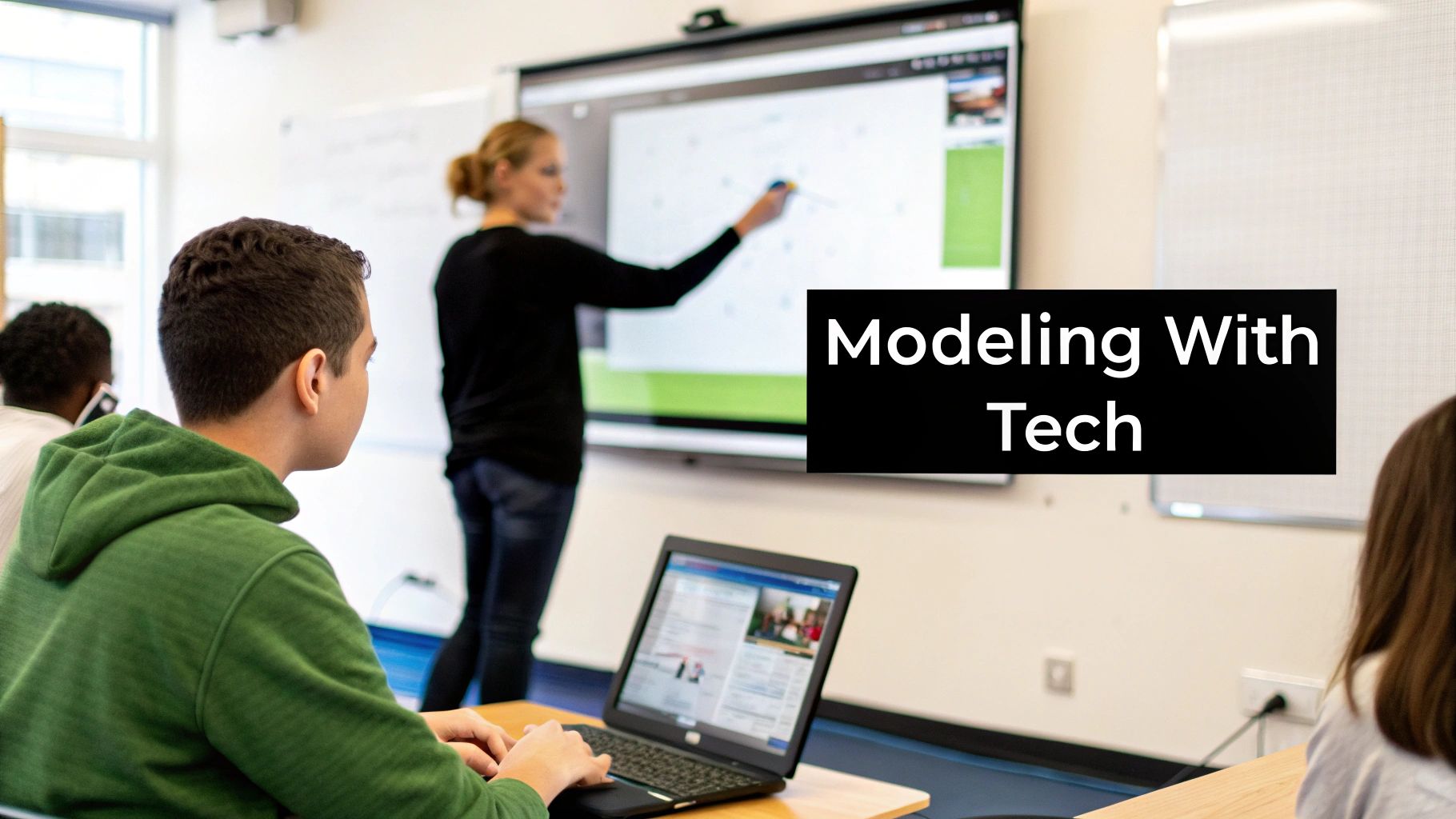
Let's be clear: technology doesn't replace great teaching. But it can absolutely be a powerful partner in modeling, acting as a force multiplier for your best practices. The right tools can expand your reach, deepen understanding, and make your expert thinking more accessible than ever before.
Imagine moving beyond a single, live demonstration that disappears the moment it's over. With technology, you can build a permanent library of modeled examples that students can tap into whenever and wherever they need it. This simple shift turns a one-time event into a lasting resource, giving students the power to review complex processes at their own pace.
Scaling Your Demonstrations with Digital Tools
One of the easiest ways to get started is with screen recording. Simple tools like Screencastify or Loom let you capture your screen and voice as you walk through a think-aloud, creating a high-quality video of your modeling process.
This opens up a ton of possibilities:
- Accessibility: A student who was absent or just needs another look can watch the lesson as many times as they need to. It’s always there for them.
- Differentiation: You can create a few different videos modeling a skill at various levels of complexity. This lets students engage with the example that fits them best.
- Flipped Learning: Why not assign a recorded think-aloud for homework? That way, you can free up precious class time for the collaborative "We Do" and independent "You Do" parts of the lesson.
Interactive whiteboards or annotation tools like Kami also bring in-class modeling to life. You can highlight key text, sketch out a scientific concept, or color-code the steps in a math problem—making your thought process visually explicit and so much easier for students to follow.
Simulating Complex and Abstract Concepts
Sometimes, the things we need to model are just too big, too small, or too abstract for a physical classroom. This is where simulations and dynamic software really shine.
A science teacher, for instance, could use a PhET Interactive Simulation to model the laws of physics without a single piece of lab equipment. They can talk through their predictions, manipulate variables on screen, and analyze the results in real-time. Suddenly, an invisible scientific process becomes visible and concrete.
Technology allows us to model the un-modelable. Whether it's a historical event, a cellular process, or a complex data set, digital tools give students a front-row seat to concepts that would otherwise remain abstract.
This is especially powerful in subjects like statistics. Research has shown that when teachers model how to use dynamic statistical software, the results are significant. One study found that middle schoolers who learned this way improved their understanding of data connections by 28% compared to students in traditional lectures. You can dig into the findings on how teacher-modeled software boosts student learning in the full report.
Choosing Tech That Supports the Modeling Cycle
Not all edtech is built to support modeling well. When you're looking at different tools, keep the “I Do, We Do, You Do” framework in mind. Does the tech actually help with that process?
Here’s a practical checklist of features to look for:
- Screen and Audio Recording: This is non-negotiable for creating reusable think-alouds and tutorials that students can review on their own time.
- Live Annotation Tools: You need software that lets you draw, highlight, and write on a shared screen to make your live modeling dynamic and clear.
- Collaborative Spaces: Tools like Google Jamboard or Miro are great for making a smooth transition from your "I Do" to the "We Do" phase, letting students practice together in a shared digital space.
- Simulation and Visualization: For STEM subjects in particular, look for platforms that offer interactive models to help demonstrate complex systems.
- Easy Sharing and Feedback: The tech should make it simple for you to share your models and for students to submit their work, closing that crucial instructional loop.
By thoughtfully picking your tools, you can elevate your teaching by modeling from a powerful classroom strategy into a scalable and deeply effective learning experience for every single student.
How to Measure Success and Avoid Common Pitfalls
So, you’ve modeled a skill for your students. How do you know if it actually worked? Great modeling isn't just a one-time performance; it’s a constant loop of showing, watching, and tweaking your approach. To make sure your demonstrations lead to real, lasting learning, you need a clear way to see the impact and know what common roadblocks to watch out for.
Measuring success doesn't have to mean a big, formal test. Your best feedback comes from simply watching your students during the "We Do" and "You Do" parts of the lesson. As they start trying it themselves, pay close attention. Are they using the same terms you did? Are they following the core steps you laid out? What you see in those moments is your most powerful, immediate data.
Assessing Student Understanding
Student work is your next best source of truth. When they’re practicing on their own, look for the fingerprints of your demonstration. If you modeled how to write a solid topic sentence, you should be able to spot that structure in their paragraphs.
Here are a few simple ways to check for understanding on the fly:
- Exit Tickets: Before they leave, ask a quick question like, "What was the very first step I showed you for solving that problem?"
- Quick Check-ins: Walk around the room and ask students to talk you through what they're thinking at a specific point in the task.
- Peer Feedback: Give students a simple checklist based on your model and have them review a partner’s work. It’s low-stakes and gets them thinking critically.
The goal isn't to get students to create a perfect carbon copy of what you did. You're looking for evidence that they've grasped the underlying process. Small creative detours are great, but if they've missed a fundamental step, you know it's time to remodel or offer more direct help.
Navigating Common Modeling Mistakes
Even veteran teachers can hit a few snags with modeling. One of the biggest is the "curse of knowledge"—that moment when you're so good at something, you forget all the tiny steps it takes to get there. Because the skill is second nature to you, you might unconsciously skip parts that are critical for a beginner. The fix? Force yourself to slow down and break the process into the smallest, most obvious pieces imaginable.
Another common slip-up is moving too fast without pausing to let students process. Your demonstration shouldn't be a monologue. Think of it more like an interactive conversation. Stop often, ask questions, and make sure they’re still with you.
Finally, teachers need to see good modeling in action, too. When professional development is built around modeling—where trainers demonstrate strategies instead of just talking about them—teachers get much better at using it in their own classrooms. One analysis found that after this kind of training, teachers saw a 35% jump in their pedagogical content knowledge and gave 2.5 times more complex feedback to students. You can dig into the findings on teacher training effectiveness for a closer look. This is exactly why a smart education marketing strategy for teacher training programs always showcases this hands-on, modeled approach. It just works.
Got Questions About Modeling? We've Got Answers.
We get it. When you're trying to bring a new strategy into your classroom, practical questions always come up. Let's tackle some of the most common ones we hear from educators about teaching by modeling.
Is Modeling Just a Fancy Word for a Demonstration?
That's a great question, and the short answer is no. While modeling always includes a demonstration, a simple demo isn't always good modeling. Think of it this way: a basic demonstration shows the what, but effective modeling reveals the how.
True modeling is about making your thinking visible. It’s about sharing that internal monologue—the questions you ask yourself, the little mistakes you catch and correct, and the decisions you make along the way. A demo might show the final, polished answer to a math problem, but modeling reveals the messy, real process of getting there.
Can You Really Model Something as Complex as Critical Thinking?
Absolutely. In fact, this is where modeling becomes a superpower. Abstract skills are notoriously hard to teach, but modeling makes them concrete.
Imagine you’re analyzing a historical document with your class. Instead of just pointing out the conclusion, you'd model your thought process out loud: "Okay, first thing I'm doing is looking at the date and author. Who wrote this and when? That context is huge because it helps me spot any potential bias right from the start." You're turning a high-level skill like "analysis" into clear, repeatable steps your students can actually see and learn.
Modeling is the bridge between seeing an expert's final product and understanding the hidden intellectual work required to create it. It demystifies expertise for novice learners.
How Does Modeling Align with Today's Educational Standards?
Modeling is more relevant than ever, especially with the big push for data literacy. Mandates like the Every Student Succeeds Act (ESSA) are all about building stronger analytical skills, and modeling is the perfect tool for the job.
Consider this: a 2022 report found that 68% of states now require statistics in their high school curriculum. This shift means schools are actively looking for effective ways to teach these complex skills. For EdTech companies, this is a massive opportunity—tools that genuinely support modeling have a clear and compelling advantage. Discover more insights about K-12 educational trends.
Are you an EdTech company looking to connect with school leaders who value evidence-based strategies like modeling? Schooleads provides the most accurate K-12 contact database, helping you reach the decision-makers ready to embrace new tools. Find Your Next School Partner.