Targeted mailing lists to unlock EdTech engagement
Learn to build targeted mailing lists to reach K-12 decision-makers and boost EdTech product engagement.
Sending a generic email blast to an entire school district is like shouting into the wind—most of your message gets lost. A targeted mailing list, on the other hand, acts like a megaphone pointed at the exact person who needs to hear you. In my experience, this precision is the only way to effectively navigate the complex K–12 purchasing cycle.
Why Mass Marketing Fails in K–12 Education

The K–12 education sector isn’t one big market. It’s a complex ecosystem of thousands of individual districts, each with its own unique needs, budgets, and decision-making structures. A one-size-fits-all approach just doesn't cut it. When you send a mass email, you’re making the dangerous assumption that a superintendent cares about the same things as a high school science teacher.
This untargeted strategy has real consequences that go beyond just low open rates. It actively damages your brand's reputation. When an IT director’s inbox is flooded with messages about a new reading curriculum, they don’t just hit delete—they learn to ignore your company entirely.
The Real Cost of Untargeted Outreach
Wasted effort is the first thing you'll notice. Your marketing and sales teams spend valuable hours crafting messages that never reach a relevant audience. This leads straight to frustrated teams, dismal campaign metrics, and a sales pipeline that runs dry before it even starts.
I’ve seen this happen countless times. An EdTech company develops an innovative math platform for middle schools. Excited to launch, they buy a generic list of "school administrators" and send out a mass email blast. The result? Near-zero engagement, a handful of unsubscribes, and not a single demo request. The campaign is a complete failure.
Why did it flop? The list was far too broad. It included high school principals, elementary superintendents, and district CFOs—none of whom were the right fit. The message, meant for a math curriculum specialist, was just noise to everyone else.
The core problem with mass marketing in education is its failure to respect the specialized roles within a school district. You wouldn't pitch a new school bus to an English teacher; the same logic applies to digital outreach.
Now, let’s imagine that same company tried a different approach. Instead of a broad blast, they used a targeted mailing list to identify curriculum directors and math department heads in districts with specific student enrollment numbers. Their new, focused campaign speaks directly to the challenges these individuals face. Almost immediately, demo requests start rolling in. This strategic shift didn't just improve results; it transformed their entire sales process by starting conversations with the right people from day one.
Precision Drives Performance
This stark contrast highlights why pinpointing the right decision-maker is absolutely essential. The data backs this up, showing that targeted outreach consistently delivers superior results.
To see just how different the outcomes can be, let's compare the two approaches side-by-side.
Targeted vs. Untargeted Outreach in K–12
| Metric | Untargeted List (Generic) | Targeted List (e.g., Schooleads) |
|---|---|---|
| Open Rate | 1-5% - Gets lost in crowded inboxes or flagged as spam. | 15-25% or higher - Relevant subject lines grab attention. |
| Response Rate | Below 1% - Message is irrelevant to most recipients. | 3-5% - Speaks directly to the recipient's role and needs. |
| Brand Perception | Viewed as spammy or unprofessional. | Seen as a knowledgeable and helpful partner. |
| Sales Pipeline | Few, if any, qualified leads. | Consistent flow of high-quality, relevant leads. |
The numbers speak for themselves. Recent industry analyses have found that campaigns using targeted lists achieve significantly higher response rates, with one study noting an average of 3.63% across various sectors. The same report revealed that about 70% of campaigns relied on such precise lists, showing they are the standard for modern marketing strategies. You can dig deeper into these direct mail stats and trends to see the full picture.
Building effective targeted mailing lists isn't just about better marketing—it's about understanding and respecting the intricate structure of the K–12 world. It’s the difference between being ignored and getting a seat at the table.
Get to Know Your K–12 Decision-Maker
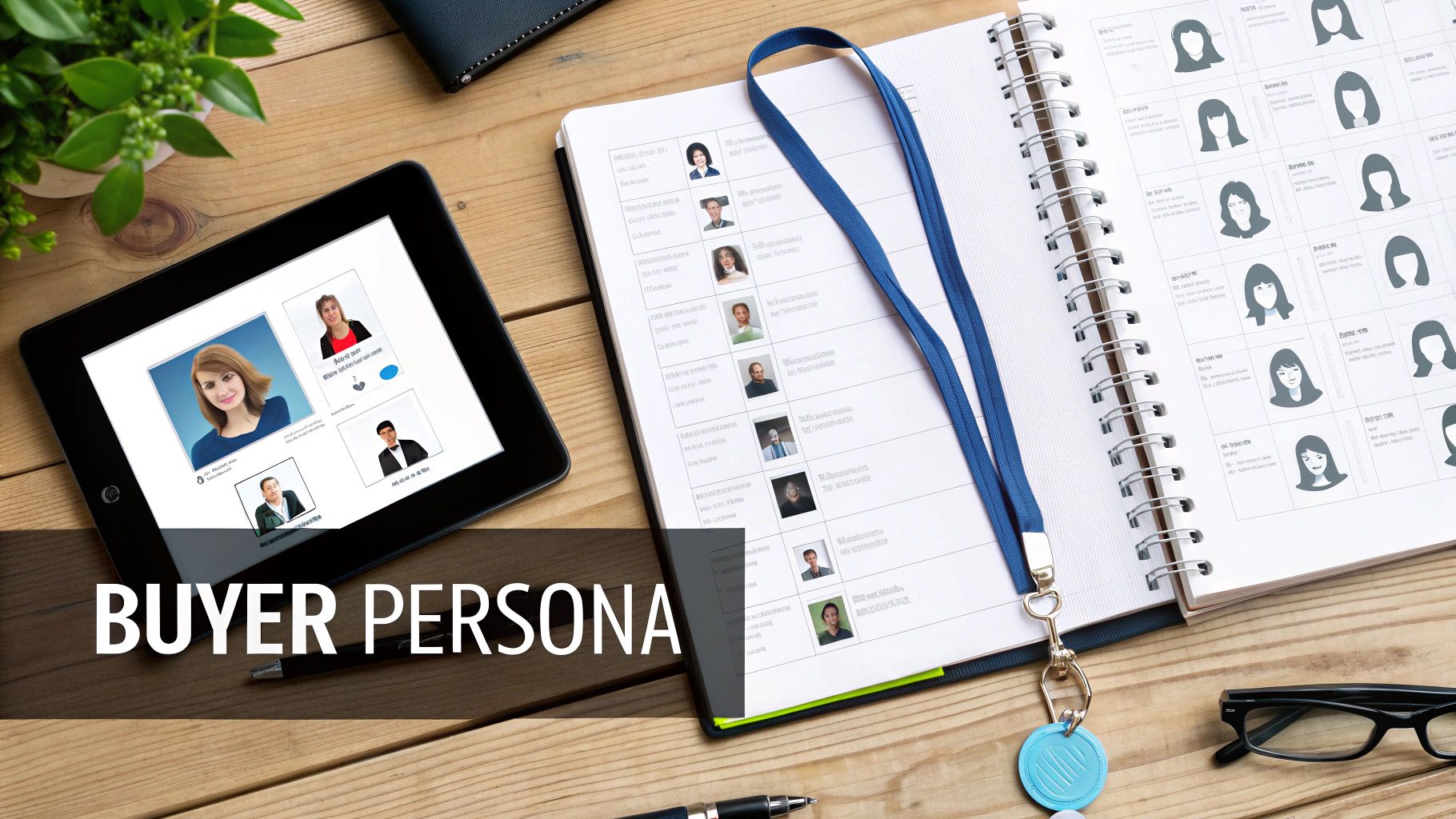
Before you even think about building a list, you have to know exactly who you’re talking to. A vague target like "principals" or "IT directors" is a recipe for a low open rate. The K-12 world is incredibly diverse, and success means going way beyond job titles to create detailed buyer personas.
You need to understand the real-world pressures, motivations, and daily headaches of these educators. What problems are keeping them up at night? Is it lagging student engagement, teacher burnout, or the constant threat of a data breach? Figuring this out is the first real step toward writing an email that actually gets a response.
More Than Just a Job Title
Building a truly effective K–12 persona is like creating a character profile for your ideal customer. A generic description is useless, but a specific one can guide your entire outreach strategy.
Think about it: a "District Technology Director" isn't a monolith. The tech director in a tiny rural district, juggling a shoestring budget and spotty broadband, has a completely different set of problems than their counterpart in a huge, well-funded urban district worried about enterprise-level cybersecurity. They’re two different buyers with two different sets of needs.
A great persona tells a story. It should detail what they do, why they do it, what pressure they’re getting from the superintendent, and what would make them look like a hero at the next board meeting.
Your aim is to create a profile so clear that you can practically hear them thinking as they read your email. This is what separates a forgettable campaign from one that consistently brings in qualified leads. If you want to dig deeper into identifying these key players, our guide on finding K-12 purchase decision-makers is a great resource.
The Building Blocks of a K–12 Persona
To make your personas genuinely useful, you have to include details specific to the education world. A standard marketing template just won’t cut it here.
Here are the key pieces of the puzzle you need to assemble:
- Role & Responsibilities: What do they actually do all day? Are they managing people, crunching numbers for a budget, or wrestling with legacy tech systems?
- Key Challenges (Pain Points): What's their biggest professional frustration? It could be anything from outdated classroom software to meeting new state curriculum standards.
- Goals & Motivations: What does a "win" look like for them? Is it all about improving student outcomes, saving the district money, or just making administrative tasks less painful?
- Reporting Structure: Who’s their boss? Knowing the chain of command is critical for navigating the often-tricky K-12 approval process.
- Tech Savviness: Are they an early adopter who loves trying new things, or are they more cautious and prefer sticking with what’s tried-and-true?
A Tale of Two Personas
Let's make this real. Imagine you're selling a new student wellness platform. You wouldn't talk to a principal and a district-level director the same way.
Persona 1: "Principal Paula" (Middle School)
- Her Main Goal: Get student absenteeism down and make the school a place kids want to be.
- Her Biggest Headache: She’s buried in disciplinary issues and trying to support teachers who are completely burnt out. She feels like she's always putting out fires.
- What Drives Her: She wants to see a real improvement in student well-being and create a school culture that top teachers want to be a part of.
- Where She Hangs Out: You'll find her at regional principal conferences and in a couple of private Facebook groups for school leaders.
Persona 2: "Director Dan" (District Level)
- His Main Goal: Make sure every school in his district is compliant with new state mental health mandates.
- His Biggest Headache: He needs a solution that works across 25 different schools, each with its own quirks and tech setup.
- What Drives Him: He needs a scalable platform that gives him clean data and clear reports he can show the superintendent and the school board.
- Where He Hangs Out: He’s reading Education Week and gets his best recommendations from other district administrators in his network.
Once you have these distinct profiles, your outreach immediately becomes smarter. Your email to Principal Paula can focus on teacher support and school culture. For Director Dan, you’ll want to highlight scalability, compliance, and reporting. This is the bedrock of any successful targeted list.
Find and Verify High-Quality Contact Data
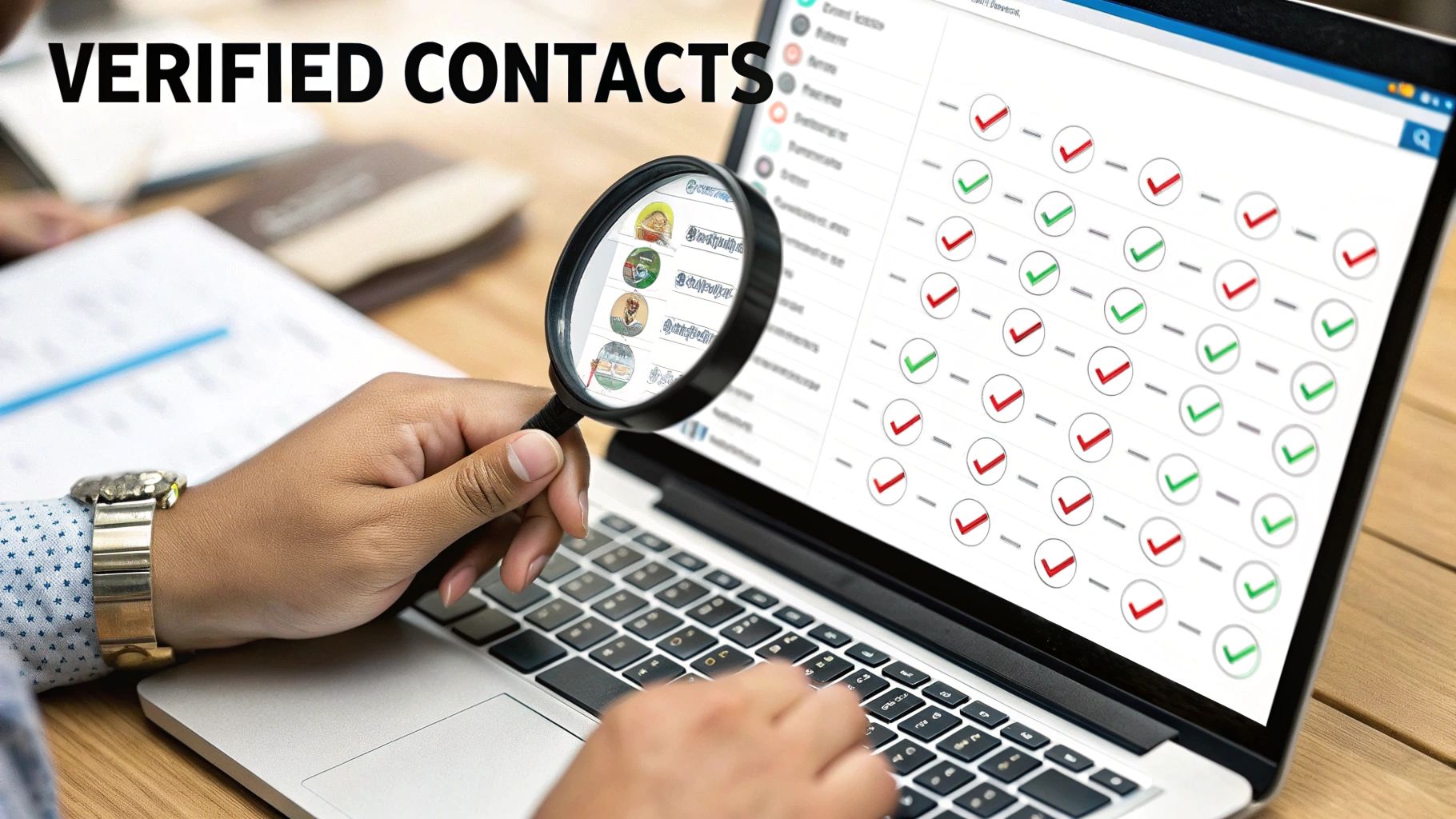
Even the most perfectly crafted buyer personas are useless without one thing: accurate contact information. This is where the real work begins, and frankly, it's often the biggest hurdle when building a targeted mailing list. Sourcing reliable data for the K–12 sector is notoriously tough, mostly because of frequent staff turnover and decentralized school information.
The success of your entire campaign rests on the quality of that data. Outdated emails and wrong job titles do more than just cause bounces. They actively damage your sender reputation, making it harder for any of your future messages to land in the inbox. A high bounce rate is a major red flag for email providers, and they'll start treating you like a spammer.
Sourcing K–12 Contact Information
When it comes to gathering contact data, you really have two main paths: the manual grind or using a specialized database. Each has its own set of pros and cons that will directly impact your team's time, budget, and the final quality of your list.
Building a list by hand means you’re painstakingly digging through individual school and district websites, LinkedIn profiles, and professional directories. This gives you a ton of control, but it's incredibly slow and almost impossible to scale. A single person could easily spend a full day just trying to verify contacts for one medium-sized school district.
The alternative is using a dedicated K–12 database like Schooleads. These platforms give you instant access to thousands of pre-verified contacts, doing all the heavy lifting of data collection and verification for you. This frees up your team to focus on strategy and outreach instead of manual research. Yes, there's a subscription cost, but it often pays for itself when you calculate the labor hours you've saved.
The Non-Negotiable Step of Data Verification
No matter how you get your initial list, you absolutely cannot skip verification. The education world is in constant motion. Principals retire, teachers switch schools, and district roles get shuffled around all the time. A contact list that was accurate just six months ago could easily have a data decay rate of 10-15% today.
Here’s a practical workflow I've used to make sure data is clean and ready for outreach:
- Initial Data Pull: Gather your preliminary list based on your personas, whether it's from a database or your own research.
- Automated Email Validation: Before you send anything, run your list through an email verification tool. These services ping servers to check if an email address is valid, which will dramatically cut down your bounce rate.
- Manual Spot-Checking: For your highest-value contacts—think key superintendents or tech directors—take a few extra minutes for a manual check. A quick search on LinkedIn or the school's staff directory can confirm their current role and title.
- Social Profile Cross-Referencing: Checking professional profiles like LinkedIn can also give you valuable context and confirm that your contact is still in the same position.
A clean mailing list is the foundation of a healthy sender reputation. Investing time in verification protects your domain and ensures your messages are actually seen by the right K–12 decision-makers, not just buried in spam filters.
A Real-World Verification Scenario
Let's walk through an example. Imagine an EdTech company is launching a new science platform and they want to reach high school science department heads in California.
Using a specialized database, they pull an initial list of 450 contacts. Before launching, they run this list through an email validation service, which immediately flags 25 emails as invalid or risky. They promptly remove those contacts.
Next, for the top 50 districts on their list, a sales rep spends an afternoon cross-referencing the department heads on LinkedIn and the district websites. In that time, they find that four have recently changed roles or retired, and they're able to identify their replacements.
After these simple adjustments, their list has a projected accuracy rate of over 98%. This quick verification process prevented nearly 30 failed deliveries, protected their sender score, and made sure their message got to the right person on the first try. This is a critical process whether you're building from scratch or using pre-compiled email lists for schools.
Good platforms like Schooleads often build this verification right into their service, which is a key thing to look for when you're evaluating vendors. That clear layout, with detailed filters for roles, states, and school types, lets you build a hyper-specific list in minutes, not days. That's the kind of granularity that turns a generic list into a powerful tool for creating targeted mailing lists that actually convert.
Segment Your List for Personalized Outreach

Alright, so you've got a clean, verified list of contacts. That’s a fantastic start, but it's just the foundation. The real magic, the part that separates the pros from the amateurs, is what you do next: segmentation. This is how you stop broadcasting and start having real conversations.
Think of it as slicing up your big list into smaller, much more focused groups based on what they have in common. I’m not just talking about basic filters like job title or state, either. To make your targeted mailing lists truly effective in the K–12 world, you have to go deeper.
Moving Beyond Basic Filters
To actually connect with an educator, you need to show you understand their world. That means segmenting your list with data that reflects the day-to-day realities of their schools and districts. It’s about getting into their headspace.
Instead of just blasting a message to all "principals," you can build a far more compelling audience by layering on specific data points.
- Financial Data: Are you talking to a district with high per-pupil spending that might be open to a premium solution? Or one with a tighter budget where you need to lead with ROI?
- Technological Readiness: It makes a huge difference if you're reaching out to a school with a mature 1:1 device program versus one just starting its digital journey.
- Curriculum & Policy: Filtering your list based on new state legislation or specific curriculum standards lets you send incredibly timely and relevant messages.
The whole point of segmentation is to create a list so specific that your message feels like it was written for one person, not a thousand. It’s the difference between shouting into a crowd and having a quiet, one-on-one chat.
When you get this detailed, you're signaling that you've done your homework. You're not just another vendor—you're a potential partner who understands their specific context.
An Example of Advanced Segmentation in Action
Let’s walk through a real-world scenario. Imagine you're selling a reading intervention program for elementary students. The rookie move is to pull a list of all elementary school principals in Texas. It's a start, but it’s lazy. We can do much better.
Using a more advanced approach, you could build a hyper-targeted list like this:
- Role: Elementary School Principal
- Location: States that recently passed new literacy legislation (like Texas or Ohio).
- School Data: Schools with reading proficiency scores that fall below the state average.
- Financials: Districts that have publicly earmarked funds for new literacy initiatives.
Now, instead of a generic email, you can send something powerful: "With the new state literacy laws and your district's recent funding, our program is designed to help schools like yours meet these exact challenges." See the difference? That message is specific, timely, and hits on a principal’s most pressing needs.
The Impact of Personalization on ROI
This isn't just about making people feel special; it's about driving real results. Personalization is a massive driver of success, whether you're sending an email or a physical mailer. In fact, some analyses show that leads from highly targeted direct mail can generate 600% more revenue than digital channels, with a potential ROI of $42 for every $1 spent.
The principle is the same one we’ve known for years in email marketing: smaller, more targeted campaigns always beat mass blasts. You can learn more about the power of targeted direct mail response rates on focus-digital.co.
So, how do you put this into practice?
Your Segmentation Workflow
Building these micro-segments is a straightforward and repeatable process once you get the hang of it.
- Define the Core Persona: Start with who you want to reach. Let’s say it’s a High School Technology Director.
- Layer on Key Filters: Now, add the details that matter. This could be student enrollment size, the district's technology budget, or even the specific Student Information System (SIS) they use.
- Tailor Your Messaging: Write a unique message for that segment. Speak directly to their pain points and goals.
- Export and Launch: Pull that segmented list into your CRM or marketing tool and launch your campaign.
By following this process, you can create a series of powerful targeted mailing lists that speak directly to the different groups within the K–12 ecosystem. This kind of precision is what gets you higher engagement, helps you build stronger relationships, and ultimately, wins more business.
Launch Your Campaign and Measure What Matters
You’ve done the hard work of building a segmented, verified list. Now it's time to put it to work. This is where your careful planning turns into actual conversations with K-12 decision-makers. The first step? Getting that pristine data into the hands of your sales and marketing teams without a hitch.
A clean export is everything. Whether you're pushing contacts into Salesforce, HubSpot, or another platform, you absolutely have to maintain the integrity of your data. Make sure those custom fields you created—like "District Tech Budget" or "Adopts New Curriculum Early"—map correctly. If they don't, you lose all the valuable intelligence you just built.
Syncing Your Lists with Your CRM
The last thing you want is a messy, disconnected data silo. Your targeted mailing lists are meant to enrich your CRM, not make it more complicated. A quality data provider like Schooleads can make this painless with direct integrations, so your records stay fresh and ready for outreach.
Here’s what a smooth workflow actually looks like:
- Export a Segment: Pull a specific list, say, "High School Principals in Districts with 1:1 Device Programs."
- Import to CRM: Use a native integration or a clean CSV file to get these contacts into your system.
- Tag the Campaign: This part is critical. Immediately tag these new leads with a unique identifier like "HS_Principal_1-to-1_Q3_Campaign."
Why is that tag so important? Because without it, you're just guessing. You have no way to trace a new contract back to the specific list that generated the lead, making it impossible to measure your ROI.
Timing Your Outreach with the Academic Calendar
In the K-12 world, when you reach out is just as crucial as what you say. The entire school year runs on a predictable rhythm, and your outreach needs to align with it. Sending a great pitch at the wrong time is a guaranteed way to get deleted.
Think of the school year in distinct buying seasons:
- Late Winter & Early Spring (Jan-Mar): This is budget season. District leaders are deciding how to spend money for the next school year. It’s the perfect time to get in front of superintendents and curriculum directors about big-ticket items.
- Late Spring & Summer (May-Aug): With the school year winding down, teachers and principals are looking for professional development and new classroom tools. This is your prime window for anything that helps an individual educator.
- Fall (Sep-Oct): The year is in full swing, and everyone is overwhelmed. Educators are focused on implementation, not new purchases. Use this time for building relationships and offering support, not hard selling.
When you align your campaigns with these windows, your message suddenly becomes much more relevant.
A well-timed email that solves a seasonal problem feels like a helpful suggestion. The exact same email sent during a chaotic time of year feels like spam. Understanding the rhythm of the school year is a competitive advantage.
Measuring the Metrics That Drive K–12 Sales
Open and click rates are fine, but they don't pay the bills. For K-12 sales, you need to tie your KPIs directly to what’s happening in your sales pipeline. Forget the vanity metrics and focus on what actually moves the needle.
Here are the KPIs that truly matter:
- Demo Request Rate by Persona: Are more principals or tech directors booking demos from this campaign? This tells you which message is landing with which audience.
- Pilot Program Adoption: This is a fantastic indicator of real interest. Tracking how many schools from a targeted list agree to a pilot is a powerful mid-funnel metric.
- New School Contracts: This is the ultimate goal. Attributing a new contract back to its original campaign list gives you a crystal-clear ROI on your data investment.
By tracking these outcomes, you stop guessing and start proving the real value of your targeted lists.
Mini Case Study: Proving the ROI
Let's imagine a company that sells a student data analytics platform. They built a list of 500 curriculum directors in districts known for being early tech adopters, tagging them "CD_EarlyAdopter_Q1" in their CRM.
Here's how it played out over six months:
- Outreach: The 500 contacts received a three-email sequence.
- Responses: They booked 42 demos, an impressive 8.4% conversion rate.
- Pilots: From those demos, 15 districts signed on for a free pilot.
- Contracts: In the end, four of those districts signed annual contracts totaling $120,000.
Because they tagged and tracked this cohort from the very beginning, they could directly attribute $120,000 in new revenue to that one hyper-targeted list. That’s the kind of data that justifies investing in quality lists and helps you double down on what works.
Your Top Questions Answered
When you're trying to connect with school leaders, a lot of questions pop up. It makes sense—getting the details right is what separates a successful campaign from one that falls flat. Let's tackle some of the most common questions I hear from teams just like yours.
How Often Should I Refresh My K–12 Mailing List?
This is a big one. People in education move around a lot. A principal retires, a curriculum director takes a job in a neighboring district, or a tech director’s role gets a new title over the summer. Your contact list can get stale faster than you think.
My rule of thumb? You should be verifying and cleaning your entire contact list at least once a quarter. If you have a critical campaign coming up—say, for budget season—it’s smart to re-verify your most important contacts right before you launch.
Honestly, this is where using a managed database really pays for itself. A good provider, like Schooleads, is constantly updating and validating their contacts. It saves you from that manual grind and makes sure your emails actually get delivered.
What Are the Big Data Privacy Rules I Need to Know?
You absolutely cannot mess around with compliance. When you're gathering and using contact information, you have to play by the rules. In the U.S., the main one for email is the CAN-SPAM Act. The big takeaway from that is you must give people a clear and easy way to opt out of your emails.
Beyond that, you've got state-level laws popping up, like the California Consumer Privacy Act (CCPA), which gives people more control over their personal data. The safest path forward is to work with a data partner who takes this stuff seriously. A reputable provider will guarantee their data is ethically sourced and fully compliant, which takes a huge legal risk off your plate.
Is It Better to Build a List Myself or Use a Service?
Ah, the classic build vs. buy question. Look, you can build a list by hand. It involves a lot of time spent digging through clunky district websites, PDF staff directories, and LinkedIn profiles. If you’re only targeting a dozen specific accounts, this can sometimes work.
But that approach just doesn't scale. The minute you try to expand, the hours your team spends on manual research will skyrocket. Frankly, the cost of their time will quickly eclipse what you'd pay for a subscription to a solid K-12 database.
Manual Build vs. Database Service
| Aspect | Manual List Building | Using a Database Service |
|---|---|---|
| Speed | Painfully slow. We're talking days or weeks. | Almost instant. Get thousands of contacts in minutes. |
| Scalability | Practically none. It's a dead end for growth. | Built to scale. Target entire states or job roles easily. |
| Data Depth | Surface-level info you can find publicly. | Rich data like budgets, tech stacks, and more. |
| Cost | High labor cost (your team's valuable time). | A predictable subscription fee. |
At the end of the day, a service gives you instant access to thousands of verified contacts. It lets your team stop being data entry clerks and start doing what they're paid to do: build relationships and close deals. Think of it as an investment in efficiency that lets you build powerful targeted mailing lists in a fraction of the time.
Ready to build a high-performing list without the headache? Schooleads provides the verified, detailed contact data you need to connect with the right K–12 decision-makers. Start finding your ideal school leads today.