A Guide to Multiplication Common Core Standards for EdTech
A clear guide to multiplication Common Core standards for EdTech. Learn the strategies, visual models, and grade-level skills needed to create aligned products.
When you hear the phrase "multiplication common core," what comes to mind? For many, it's confusing diagrams, frustrated late-night homework sessions, and a feeling of, "Why can't they just do it the old way?"
But here’s the secret: it’s not about making math harder. It’s about building a deeper, more lasting understanding of why multiplication works before drilling the how. The real goal is to develop true number sense, not just the ability to spit back memorized facts.
Decoding Common Core Multiplication
Let's clear the air. This isn't some "new math" conspiracy to replace everything we learned. The Common Core State Standards (CCSS) for multiplication are designed to build a solid foundation so that the traditional methods actually make sense when they're introduced.
Think of it like learning to cook. You could just memorize a recipe—the standard algorithm—and follow the steps perfectly. But a real chef understands what each ingredient does and how flavors work together. That's the multiplication common core approach. It gives students the mental tools to see numbers flexibly and confidently tackle problems.
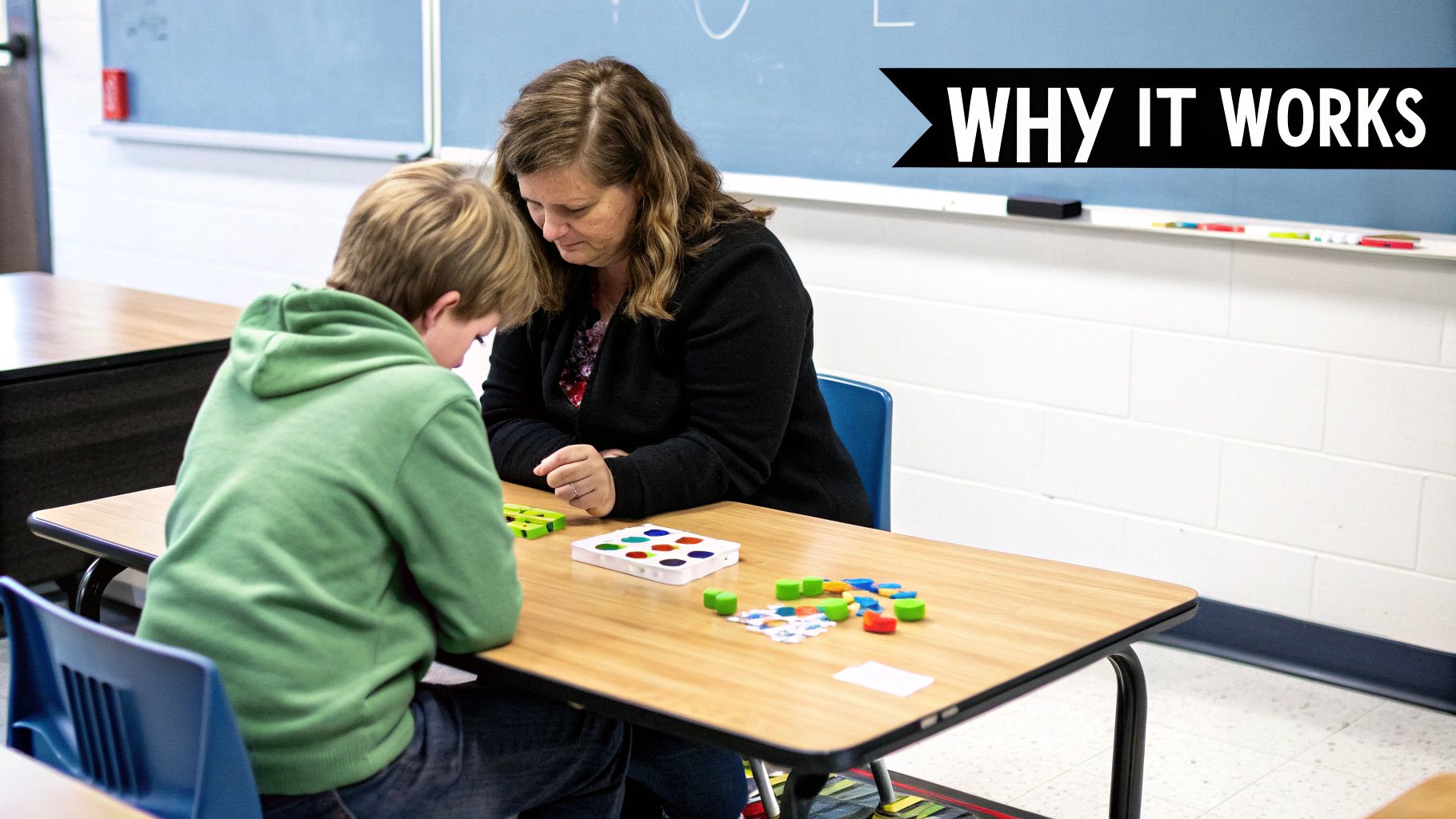
The core idea is simple: start with concrete, visual strategies and delay the abstract procedures until a student is truly ready. It’s a methodical journey that makes sure no one is just mindlessly copying steps they don’t understand.
The Philosophy Behind the Shift
So, why the change? For decades, educators noticed a troubling trend: students could often calculate an answer but completely froze when asked to apply that skill to a real-world problem. They knew how but had no idea why.
The biggest criticism of ‘old math’ was that students didn’t really understand what they were doing. They could get to the right answer, but never fully grasped the ideas behind the arithmetic.
This new approach is all about creating stronger, more adaptable problem-solvers. It boils down to a few key goals:
- Build a Concrete Foundation: Use hands-on models like arrays and number lines to let students see and feel what "3 groups of 4" actually means.
- Develop True Number Sense: Teach kids to break numbers apart in useful ways. For example, seeing 12 x 4 as (10 x 4) + (2 x 4) makes a tough problem instantly manageable.
- Connect Math to Life: Help students spot multiplication scenarios everywhere—from counting tiles on the floor to figuring out snacks for a party—not just on a worksheet.
For anyone creating EdTech tools or curriculum, this philosophy is everything. The demand isn't for more digital flashcards. It's for interactive experiences that guide students from visual understanding to procedural fluency. When your resources align with this journey, they don’t just teach math; they build confident, capable mathematicians.
The Grade-by-Grade Journey to Multiplication Fluency

The Common Core doesn't just throw multiplication at students all at once. It’s a carefully planned journey, with each new idea built on a solid foundation from the year before. Think of it like building a house—you can't put up the walls before the foundation is poured.
This step-by-step approach is what helps kids move from concrete thinking to abstract fluency without getting lost. For anyone creating EdTech tools or curriculum, understanding this progression is everything. It ensures your resources meet students exactly where they are in their learning.
The journey starts earlier than most people think, with the seeds of multiplication being planted back in second grade.
Laying the Groundwork in Grade 2
In second grade, you won't hear the word "multiplication" very often. The real goal is to get students comfortable with the core ideas that make multiplication click later on. They spend a lot of time working with equal groups of objects to lay the groundwork for repeated addition.
- Equal Groups: Kids tackle problems like, "There are 4 bags with 3 cookies in each. How many cookies in all?" This gets them used to seeing patterns in groups.
- Early Arrays: They also start arranging objects into neat rows and columns. It’s a visual way to represent those equal groups, even if they don't call it an "array" just yet.
This early, hands-on work helps students build an intuitive sense that multiplication is really just a shortcut for counting lots of equal sets.
Grade 3: The Critical Year for Mastery
Third grade is the big one for multiplication common core. This is where the concept is formally introduced and where students are expected to really dig in and build fluency. The focus shifts from simply counting groups to truly understanding multiplication as its own mathematical operation.
The Common Core standards, which launched back in 2010, set a huge benchmark for this grade. By the end of Grade 3, students are expected to "know from memory all products of two one-digit numbers." It’s a clear push for mastering those times tables up to 9x9. You can discover more insights about these educational standards and their history to get the full picture.
The goal in third grade isn't just speed—it's understanding. Students learn to use properties of operations, like the commutative property (knowing 3x7 is the same as 7x3), to make memorization feel less like a chore and more like a logical puzzle.
Grade 4: Expanding to Multi-Digit Problems
Once kids have their single-digit facts down, they’re ready for bigger challenges in fourth grade. This is where all those visual models from the earlier grades become absolute game-changers for solving multi-digit multiplication. They rely heavily on arrays and the area model to break down a scary problem like 14 x 23 into smaller, more manageable pieces based on place value.
This strategic approach is key. It makes sure students actually understand why the math works, instead of just blindly following a set of steps they can't explain.
Grade 5: Achieving Fluency with the Standard Algorithm
Finally, in fifth grade, it all comes together. After years of building a deep conceptual understanding with visual models and place value strategies, students are ready for the standard algorithm—the traditional way most of us learned to multiply.
Because they have that strong foundation, the algorithm isn't some mystifying procedure. It's the logical and efficient final step on their learning journey. This carefully paced progression from "why" to "how" is the heart of the multiplication common core philosophy, leading to true, flexible fluency.
To help you see the whole picture at a glance, here’s a breakdown of how the standards evolve.
Common Core Multiplication Standards by Grade Level
This table summarizes the core learning objectives for multiplication as students progress through elementary school, highlighting the key standard and conceptual focus for each grade.
| Grade Level | Key Standard (Code) | Core Concept Focus |
|---|---|---|
| Grade 2 | 2.OA.C.4 | Foundations of multiplication through equal groups and rectangular arrays. |
| Grade 3 | 3.OA.A.1 | Interpreting products of whole numbers (e.g., 5 x 7 as 5 groups of 7). |
| Grade 3 | 3.OA.C.7 | Fluently multiplying within 100; knowing single-digit products from memory. |
| Grade 4 | 4.NBT.B.5 | Multi-digit multiplication using place value and properties of operations. |
| Grade 5 | 5.NBT.B.5 | Fluency with the standard algorithm for multi-digit multiplication. |
As you can see, each standard is a deliberate stepping stone to the next, ensuring that by the time students leave fifth grade, they have a robust and lasting command of multiplication.
The Core Visual Models and Teaching Strategies

To really build a deep understanding of math, Common Core steers clear of just having kids memorize facts. Instead, it gives them a whole toolkit of visual models to work with. These strategies are like different lenses for looking at the same problem, helping students see the concept from all sides before they land on the quickest way to solve it.
Each model has a specific job, guiding students from counting physical objects to thinking more abstractly. For anyone creating EdTech tools or curriculum, getting a handle on these visual models is non-negotiable. It’s the only way to build digital resources that truly support how kids learn multiplication common core style.
Equal Groups: The Starting Point
The whole journey starts with the most intuitive concept out there: equal groups. This is multiplication at its most basic. Picture it this way: you're making snack bags for a party. If you have 3 bags and put 4 cookies in each one, how many cookies do you have?
Students can actually make these groups or draw them out. This reinforces the big idea that multiplication is really just a shortcut for repeated addition (4 + 4 + 4). It’s a hands-on approach that connects an abstract idea like "3 times 4" to something real and tangible that young kids get immediately.
Arrays: Organizing Groups into Rows
Once kids get the hang of scattered groups, we add a little structure. An array simply organizes those same objects into neat rows and columns. So, take those 3 bags of 4 cookies and line them up on a baking sheet. Now you have 3 rows of 4.
That simple act of organizing things is a huge leap forward. It creates a grid that doesn't just represent the problem, but also sneakily introduces the commutative property. Kids can literally see that 3 rows of 4 is the same total as 4 rows of 3. Arrays are the visual foundation for understanding area down the road.
The array is arguably the most important foundational model in Common Core multiplication. It directly connects the idea of repeated groups to the geometric concept of area, which becomes essential for multi-digit multiplication.
Number Lines: Showing Jumps
While groups and arrays are all about quantities of objects, the number line introduces movement and distance. Solving 3 x 4 on a number line means starting at zero and making 3 jumps of 4 units each. This model is a fantastic way to show that multiplication is like scaled-up counting.
It helps students visualize how big numbers are getting and reinforces that link to repeated addition, just in a straight line. This strategy really clicks for kids who think more sequentially and builds a bridge to using multiplication in measurement.
The Area Model: Bridging to the Algorithm
Finally, the area model takes the simple array and levels it up to handle bigger, more complex problems. Think of it like you're building a patio with different kinds of tiles. To find the area of a big space, say 23 feet by 14 feet, you don't have to tackle it all at once. You can break it down into smaller, easier-to-manage rectangles based on place value.
You’d multiply the parts separately:
- A 20 by 10 section
- A 20 by 4 section
- A 3 by 10 section
- A 3 by 4 section
By finding the area of each little piece and then adding them all up, students can solve 23 x 14 without getting overwhelmed. This model is the direct visual precursor to the standard algorithm—it shows exactly why every step in the old-school method actually works.
Why Common Core Holds Off on the Standard Algorithm
It’s probably the most common—and heated—question I hear from parents about Common Core math: Why on earth do they wait so long to teach the standard way to multiply? It’s a fair question. Many of us see our kids drawing complex boxes and arrays and wonder why they aren't just learning the quick, familiar method we used in school.
The answer isn't that Common Core threw out the traditional method. Not at all. It's a strategic delay, designed to build something much more durable first: a real, gut-level understanding of what multiplication actually is.
Rushing straight to the old-school algorithm is like giving someone a calculator before they understand what numbers represent. Sure, they can punch in buttons and get an answer, but they have no idea what it means or how to solve a problem that doesn't look exactly like the last one. The goal is to stop students from just blindly following steps they can't explain.
It's a Bridge, Not a Detour
When kids start with visual strategies like the area model, they're not taking a scenic detour. They're building a sturdy bridge that will eventually lead them right to the standard algorithm.
Think about it. When a student solves 14 x 23 using an area model, they physically break the numbers apart by place value (10 + 4 and 20 + 3) and multiply each piece. They see the four partial products and add them up. It’s tangible.
This process perfectly lays out the logic hiding inside the standard algorithm. It's no longer some abstract magic trick involving "carrying the one." Instead, the standard algorithm becomes the logical, super-efficient final step on their learning journey.
The delay is completely intentional. It puts deep understanding ahead of rote memorization. When students finally do learn the standard algorithm, it clicks. They see it as a powerful shortcut that makes sense, not just a random set of rules.
This shift has definitely been a source of debate. Under Common Core, fluency with the standard algorithm is a fifth-grade expectation (5.NBT.5), which can be a year or two later than many older state standards. For a closer look at the thinking behind the standards, this analysis of the Common Core math standards on Education Next is a great read.
The Opportunity for EdTech and Curriculum Creators
For anyone creating educational tools, this careful progression is a huge opportunity. The world doesn't need another app that just drills the standard algorithm with flashcards. What teachers and students desperately need are resources that guide them along this developmental path from concept to efficiency.
What does that look like in practice?
- Make it Visual: Build interactive tools where kids can physically manipulate arrays and area models. Let them play, explore, and discover the concepts for themselves.
- Connect the Dots: Create features that explicitly link the partial products in an area model to the steps in the standard algorithm, side-by-side. Make that "aha!" moment happen visually.
- Build True Fluency: Once that conceptual foundation is solid, then bring in adaptive practice to help students get fast and accurate with the algorithm.
If you lean into this "concept-first" philosophy, your product will do more than just teach a procedure. It will give students a flexible, resilient understanding of multiplication that they'll carry with them all the way to algebra. You'll be turning a common point of frustration into a real pillar of mathematical strength.
Getting Your EdTech Product Classroom-Ready

It’s one thing to understand the philosophy behind the Common Core multiplication standards. It’s another challenge entirely to build a tool that teachers will actually welcome into their classrooms.
The market is flooded with digital worksheets. What educators desperately need are tools that honor the conceptual journey—the messy, beautiful process of moving from visual models to fluent calculation.
True alignment isn’t about just marking answers right or wrong. Your product should feel like a learning partner, giving students a safe space to play, make mistakes, and see how multiplication actually works. Think of it as bottling the magic of hands-on classroom discovery and putting it on a screen.
Build a Logical Skill Progression
The best EdTech tools don't throw everything at a student at once. They carefully mirror the grade-by-grade build-up of the Common Core standards. A third grader’s brain is wired for a totally different kind of learning than a fifth grader’s, and your product has to respect that.
- Grade 2 Foundations: This is all about playful exploration. Activities should center on equal groups and simple, interactive arrays. The word "multiplication" might not even be the focus yet.
- Grade 3 Conceptual Deep Dive: Now we get formal. Introduce multiplication with dynamic tools like number lines, arrays, and area models. This is where you build that rock-solid understanding that prevents future struggles.
- Grade 4 Multi-Digit Strategies: The area model really shines here. Your tool must let students flexibly break down (or partition) bigger numbers to solve problems like 14 x 23.
- Grade 5 Procedural Fluency: This is the final connection. It's time to show how the visual models link directly to the standard algorithm. A great feature is a side-by-side view, demonstrating how partial products from the area model match up with each step of the traditional method.
Prioritize Interactive Digital Manipulatives
Static pictures of arrays just won't cut it. The whole point of the Common Core approach is doing. Your tech has to replicate that hands-on experience with digital manipulatives that students can actually move and change.
Let them build arrays, split area models, and drag groups together. This physical engagement is what cements the concepts in their minds. Think of your tool less like a digital textbook and more like a virtual box of math blocks. That interactivity is your secret weapon.
The goal is to move beyond digital flashcards. A truly aligned product provides an adaptive learning path that identifies a student's specific misconception—whether it's with place value or equal grouping—and offers targeted practice to fill that gap.
Design for Differentiated Instruction
Every classroom has a wide range of learners, and a one-size-fits-all tool is a recipe for frustration. Your platform must give teachers the power to support everyone, from the student who’s struggling to the one who’s ready for a challenge.
This starts with a teacher dashboard that provides real insights, not just scores. Teachers need to see the how behind an answer. Did the student miscalculate, or did they completely misunderstand how to set up the area model? That’s the kind of data that drives meaningful instruction.
A strong product starts with knowing your audience, and a focused education marketing strategy ensures your solution gets into the right hands. When you build a tool that provides clear data and helps teachers differentiate, you’re not just selling software—you’re creating an indispensable classroom resource.
EdTech Feature Alignment with Common Core Strategies
To make this more concrete, let's look at how specific EdTech features can directly support the instructional models we've discussed.
| Common Core Strategy | Supporting EdTech Feature | Target Grade Level |
|---|---|---|
| Equal Groups | Drag-and-drop objects, grouping tools, animated counters | Grades 2-3 |
| Arrays | Interactive grid where students can "paint" or build rows/columns | Grades 2-3 |
| Number Lines | Dynamic number line where students can make and count "jumps" | Grade 3 |
| Area Model | Partitioning tool to split rectangles, text boxes for partial products | Grades 3-5 |
| Standard Algorithm | Side-by-side view comparing area model to traditional algorithm steps | Grades 4-5 |
This table shows a clear path: a feature isn't just a cool gimmick; it's a purposeful tool designed to help students master a specific, grade-appropriate strategy. By aligning your features this way, you create a product that feels intuitive and essential to teachers following the Common Core standards.
Answering Common Questions About Multiplication Standards
The move to new math standards has definitely stirred up some questions for everyone—parents, teachers, and even the people designing educational software. A lot of the strategies we see today look nothing like the way most adults were taught, which naturally leads to some head-scratching.
Let’s clear the air and tackle some of the most common questions about the multiplication common core standards. The goal here is to get everyone on the same page, from the kitchen table to the EdTech development floor, by explaining the "why" behind it all.
Why Does Common Core Delay the Standard Algorithm?
This is, without a doubt, the number one question. Why wait until 5th grade to teach the traditional way to multiply? It’s a deliberate choice designed to build a deep, lasting understanding of what’s actually happening with the numbers.
The idea is to have students first get a real feel for multiplication using visual tools like arrays and area models. This way, they build a rock-solid foundation in place value. When they finally learn the standard algorithm, it’s not just a set of magic steps. They understand the why behind "carrying the one." This approach ultimately leads to fewer mistakes and creates kids who are better, more flexible problem-solvers.
Is Memorizing Multiplication Tables Still Important?
Yes, 100%. Don’t let anyone tell you otherwise. This isn't about "new math" where getting close is good enough.
The standard 3.OA.C.7 is crystal clear: third graders are expected to "know from memory all products of two one-digit numbers."
Having those basic facts down cold is crucial. It frees up a student's brain to focus on more complex, multi-step problems in later grades without getting stuck on simple calculations. The big difference is how they get there. Instead of starting with rote drills on day one, they build up to memorization through strategies and a real understanding of how numbers work together, which makes the facts stick.
How Can an EdTech Tool Best Support Teachers?
Great EdTech tools are more like a co-pilot for teachers than a simple digital worksheet. To really make a difference in a modern math classroom, a tool needs to deliver on a few key things:
- Dynamic Manipulatives: Kids need interactive, digital versions of arrays, number lines, and area models. This lets them play, explore, and see the concepts come to life.
- Adaptive Practice: The software should be smart enough to spot why a student is struggling—maybe it's a place value issue—and then serve up targeted practice to fix that specific gap.
- Actionable Data: A teacher dashboard is non-negotiable. It has to give teachers clear, quick insights into how their students are thinking, not just what their final answer was.
For any EdTech company trying to get their tool into schools, it's also vital to know who you're talking to. Understanding the roles of purchase decision-makers in K-12 education is the first step to making sure your tool actually gets in front of the students it’s designed to help.
What Is the Biggest Mistake EdTech Companies Make?
The most common trap is creating "digital worksheets" that only drill the old-school procedures. This completely misses the boat on building conceptual understanding. Another huge pitfall is being too rigid; a tool has to let students solve problems using different strategies, just like they do in the classroom.
Ultimately, any tool that can't show a teacher how a student got their answer is a missed opportunity. In today's classroom, the process is just as important as the final result.
At Schooleads, we know that connecting great EdTech with the right people is where the magic happens. Our verified K-12 database helps you skip the guesswork and connect directly with district and school leaders who make the decisions. Find out more about how Schooleads can help you reach your target audience.