A Guide to the Health Science Careers Cluster for EdTech
Discover the Health Science Careers Cluster and its five pathways. Learn how your EdTech can align with school programs to meet critical workforce demands.
Ever wondered how schools turn a student's interest in medicine into a viable career path? That's where the Health Science Career Cluster comes in. Think of it as a comprehensive roadmap that guides students from their very first high school science class all the way to earning professional credentials for a high-demand healthcare job.
A Blueprint for the Future Healthcare Workforce
It’s helpful to imagine the Health Science Career Cluster as a meticulously planned city. In this "healthcare city," each neighborhood represents a distinct career pathway, like Diagnostic Services or Therapeutic Services. This structure gives schools a clear, logical way to sequence courses, making sure students build their knowledge and skills step-by-step, without getting lost.
This organized approach couldn't be more important right now. The Bureau of Labor Statistics forecasts that healthcare will create about 1.9 million job openings each year, on average, growing much faster than most other industries. This intense demand puts the Health Science cluster front and center for K–12 districts trying to meet urgent local workforce needs. You can dig deeper into these numbers by exploring the latest healthcare employment trends from the Bureau of Labor Statistics.
What’s the Point of a Career Cluster Anyway?
At its heart, a career cluster is simply an organizational tool used in Career and Technical Education (CTE). It bundles jobs and industries into related groups. This helps schools accomplish a few key things:
- Make learning relevant by connecting subjects like biology and chemistry to how they’re actually used in the real world.
- Create clear pathways that guide students from high school to college or trade school and, ultimately, into a career.
- Align what’s taught in the classroom with industry standards and what employers actually want, so students graduate with valuable, in-demand skills.
For any EdTech company, getting a handle on this framework is crucial. It shows you exactly where your product—whether it’s a virtual lab, a certification prep tool, or a classroom management system—can plug into a school's overall strategy.
When you understand how each pathway fits into the bigger Health Science Career Cluster, you can show how your technology directly solves the problems educators and students face on their journey to a healthcare career.
This model is what transforms a student's vague goal of "working in medicine" into a structured, achievable plan.
Exploring the Five Core Career Pathways
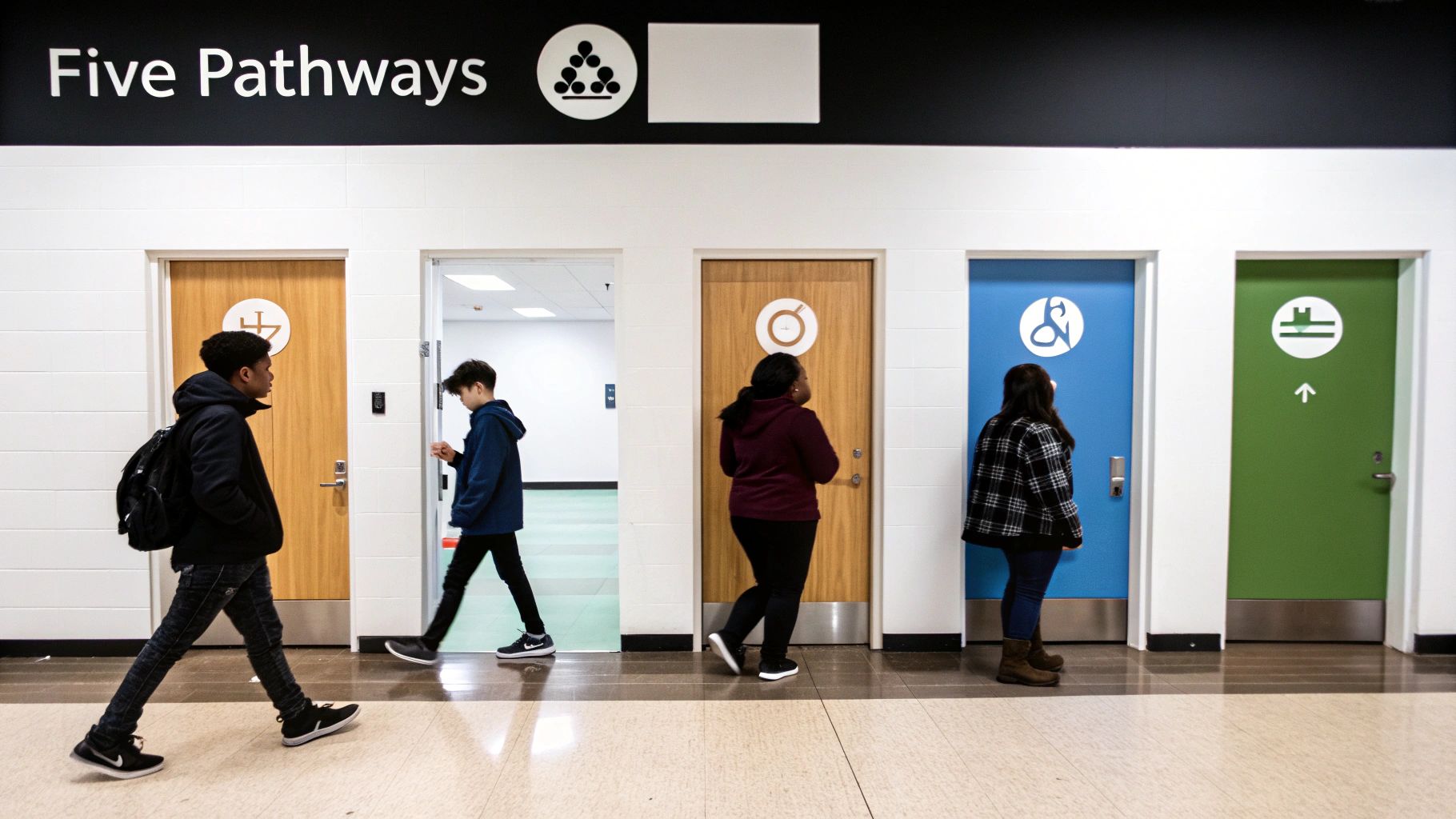
If you think of the entire Health Science Career Cluster as a bustling city, then it's helpful to know it’s made up of five distinct neighborhoods. Each one has its own unique character and specialized jobs. Getting to know these pathways is the first step in understanding how the whole healthcare system fits together—and where new skills and technologies are most needed.
So, let's take a walk through these five core pathways. We'll look at the kinds of jobs they lead to and what students actually learn. This detailed view is critical for everyone, from teachers building a curriculum to EdTech companies designing new tools, to see exactly where they can make the biggest difference.
Therapeutic and Diagnostic Services
When most of us picture a healthcare job, we’re probably thinking of Therapeutic Services. This pathway is all about hands-on work: treating, caring for, and counseling patients directly. These are the professionals who work with people face-to-face to help them get healthy and stay healthy.
A few classic examples include:
- Physical Therapists guiding patients back to mobility after an injury.
- Registered Nurses providing around-the-clock patient care.
- Dental Hygienists focused on preventive oral health.
Then you have the Diagnostic Services pathway, which I like to call the healthcare system's detective agency. These experts use sophisticated tests and equipment to figure out what's wrong. They find the clues—the data—that allow the therapeutic team to make the right treatment decisions.
Think of roles like:
- Radiologic Technologists who run the MRI and X-ray machines.
- Phlebotomists who draw blood for analysis.
- Medical Laboratory Technicians who analyze tissue and fluid samples to uncover signs of disease.
One group is focused on treatment, the other on discovery. You can't have a good patient outcome without both working in perfect sync.
Health Informatics and Support Services
Now let’s move away from the examination room and into the operational core of the healthcare city. The Health Informatics pathway is the central nervous system, managing all the data that keeps modern medicine running. It’s about organizing patient records, handling financial information, and maintaining critical IT systems.
This is where data science meets patient care. It’s less about treating a person's physical symptoms and more about managing the massive flow of information that makes their treatment possible.
People in this field, like Medical Billers and Coders or Health Information Technicians, are the guardians of data. They make sure records are accurate, secure, and available when needed, which is essential for everything from insurance claims to tracking disease outbreaks.
Just as critical is the Support Services pathway. These are the folks who create a safe and functional environment for everyone else. They are the operational backbone, managing everything from hospital maintenance and food service to sterilizing surgical equipment. A Biomedical Equipment Technician, for example, is responsible for making sure every machine works flawlessly—a job that directly impacts patient safety and a doctor's ability to make an accurate diagnosis.
Biotechnology Research and Development
Finally, we arrive at the Biotechnology Research and Development pathway. This is the innovation hub of the health science careers cluster, where the future of medicine is being built today. Professionals here are scientists and inventors working in labs to discover new treatments, develop life-saving drugs, and design groundbreaking medical devices.
Their work is all about pushing boundaries, from creating new vaccines to pioneering gene therapy. Roles like Biomedical Engineer or Toxicologist are less about today's patient and more about creating the knowledge and tools that will redefine healthcare for generations to come.
Meeting the Right Standards and Earning Real Credentials
For any health science program to be successful, it has to do more than just teach students about biology and anatomy. It needs to follow a proven educational recipe that blends the right knowledge with the right hands-on skills, all matching up with what the healthcare industry actually needs.
Think of it like building a house. You can't just start throwing up walls. You need a solid foundation and a clear blueprint. In this case, that blueprint combines three key elements:
- The "Why": Academic Knowledge. This is the core science stuff—anatomy, physiology, medical terminology. It’s the foundational knowledge that explains how the body works and why treatments are effective.
- The "How": Technical Skills. This is where students get their hands dirty. They learn the practical side of healthcare, like how to draw blood, use diagnostic tools, or properly sterilize equipment.
- The "Way": Soft Skills. You can’t be great in healthcare without knowing how to work with people. This covers everything from communicating clearly with a nervous patient to collaborating with a team and making sound ethical choices.
Aligning with National Health Science Standards
So, how do schools make sure their programs are teaching the right things? They don't have to guess. Most K-12 programs look to national standards to guide their curriculum, and a major player here is the National Consortium for Health Science Education (NCHSE). The NCHSE provides a clear framework that spells out what students need to learn and be able to do.
This alignment is a big deal. It’s a seal of approval, ensuring that a student in Florida is learning a comparable set of skills to a student in California. For any EdTech company trying to sell into this space, building products that map directly to these standards is a huge advantage. It shows you’ve done your homework and makes it way easier for a school to say "yes."
When schools stick to these shared benchmarks, they can be confident they're setting students up for success, whether they're heading to college or straight into a job. This creates a much more reliable and predictable talent pipeline for the entire healthcare industry.
The Power of Stackable Credentials
One of the smartest things about the health science career cluster is its emphasis on stackable credentials. These are real, industry-recognized certifications that students can earn while they're still in high school, giving them a direct path to a job.
These credentials work like stepping stones. A student might earn a Certified Nursing Assistant (CNA) or Phlebotomy Technician certificate, which allows them to get a job and start gaining valuable experience right after graduation. That real-world experience (and paycheck) can then help support them as they go on to earn an associate's or bachelor's degree in nursing or another field. It makes a career in healthcare feel much more attainable by offering a clear, practical ladder for advancement.
And this isn't a small-scale effort. The pipeline is massive. U.S. life sciences employment recently hit a record 2.1 million workers, and that growth is powered by colleges awarding over 174,000 degrees and certificates in biological and biomedical sciences in a single year. You can dig deeper into these life sciences talent trends to see the full picture.
Why Employer Partnerships Are Critical for Schools
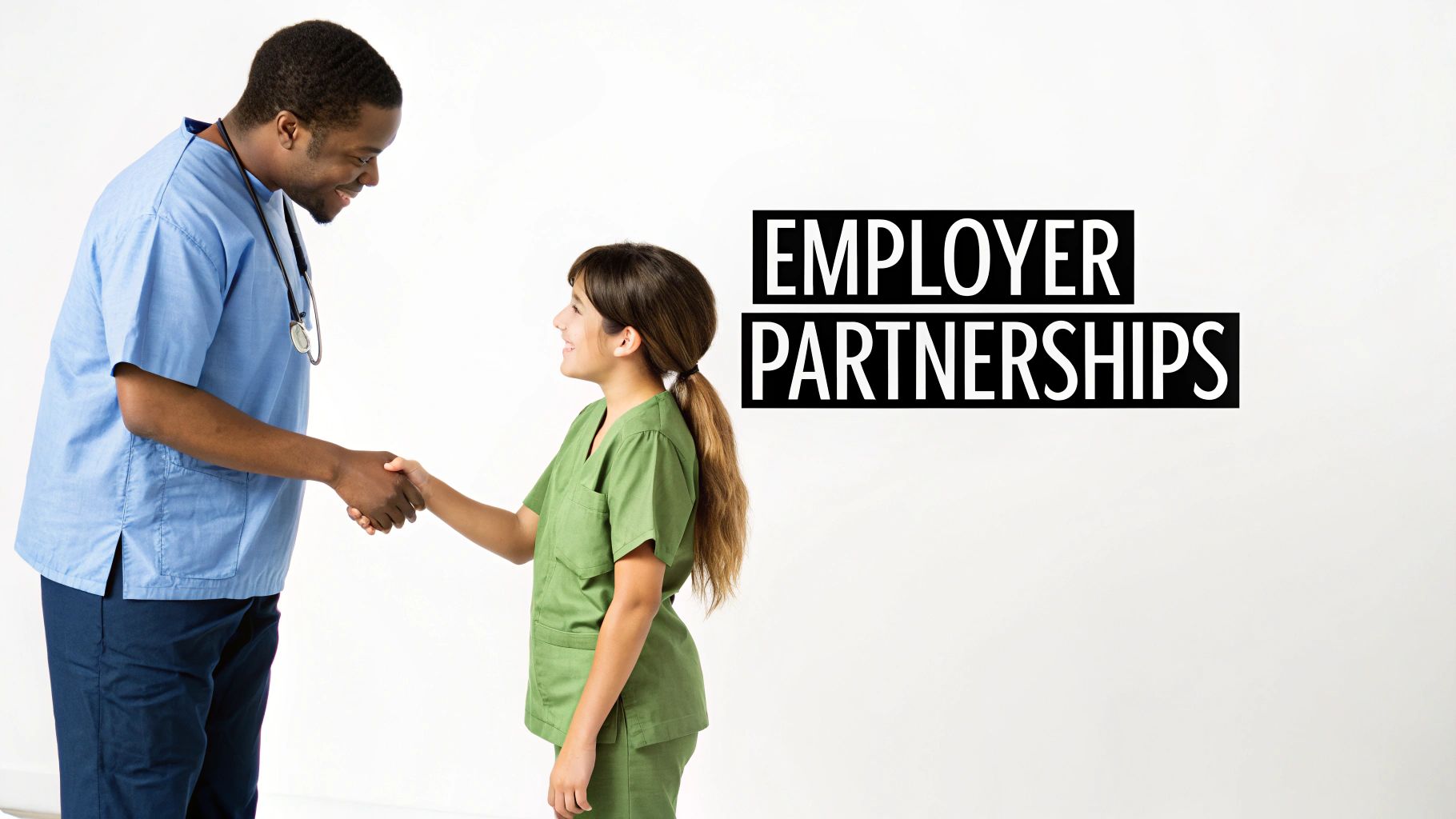
A top-tier Health Science program can't just live within the four walls of a school. To really work, it needs to build a solid bridge to the local healthcare community. These partnerships are the secret sauce, turning what students learn in class into skills they can use on the job from day one.
Think of it this way: you can't learn to swim by reading a book. You have to get in the water. For students in the health science careers cluster, partnerships with local employers are the water. They provide the real-world context that makes all the theory and textbook knowledge actually click.
These connections with hospitals, clinics, and labs aren't just a nice bonus. They’re absolutely essential for creating learning experiences that feel real and have a lasting impact.
Turning Theory into Practice
When schools and employers team up, they create powerful opportunities for work-based learning, which is the heart and soul of any good Career and Technical Education (CTE) program. These experiences are priceless for students, giving them a clear view of what their future careers will actually look like.
Some of the most valuable work-based learning experiences in health science include:
- Internships that let students work right alongside seasoned professionals on real projects and even patient care.
- Clinical Rotations which give future nurses and technicians supervised practice in different departments of a hospital.
- Job Shadowing a low-stakes way for students to simply watch, listen, and ask questions about the day-to-day realities of a job.
This isn’t just about building a resume. These experiences help a student confirm they’re on the right career path, build essential soft skills like communication and teamwork, and open up a direct hiring pipeline for local employers who need talent.
By connecting directly with the industry, schools ensure their curriculum stays fresh and teaches what the local workforce actually needs. It’s a win-win that helps close skills gaps and gets students ready for a job right after graduation.
This kind of hands-on training is more important now than ever before. The World Health Organization is already projecting a major global shortage of health workers, which means the demand for well-trained graduates with real clinical experience is skyrocketing. You can dig into the healthcare workforce projections to see just how critical this is. It all points to one thing: strong employer partnerships are the bedrock of any health science program that truly prepares students for success.
How Your EdTech Fits into Health Science Programs
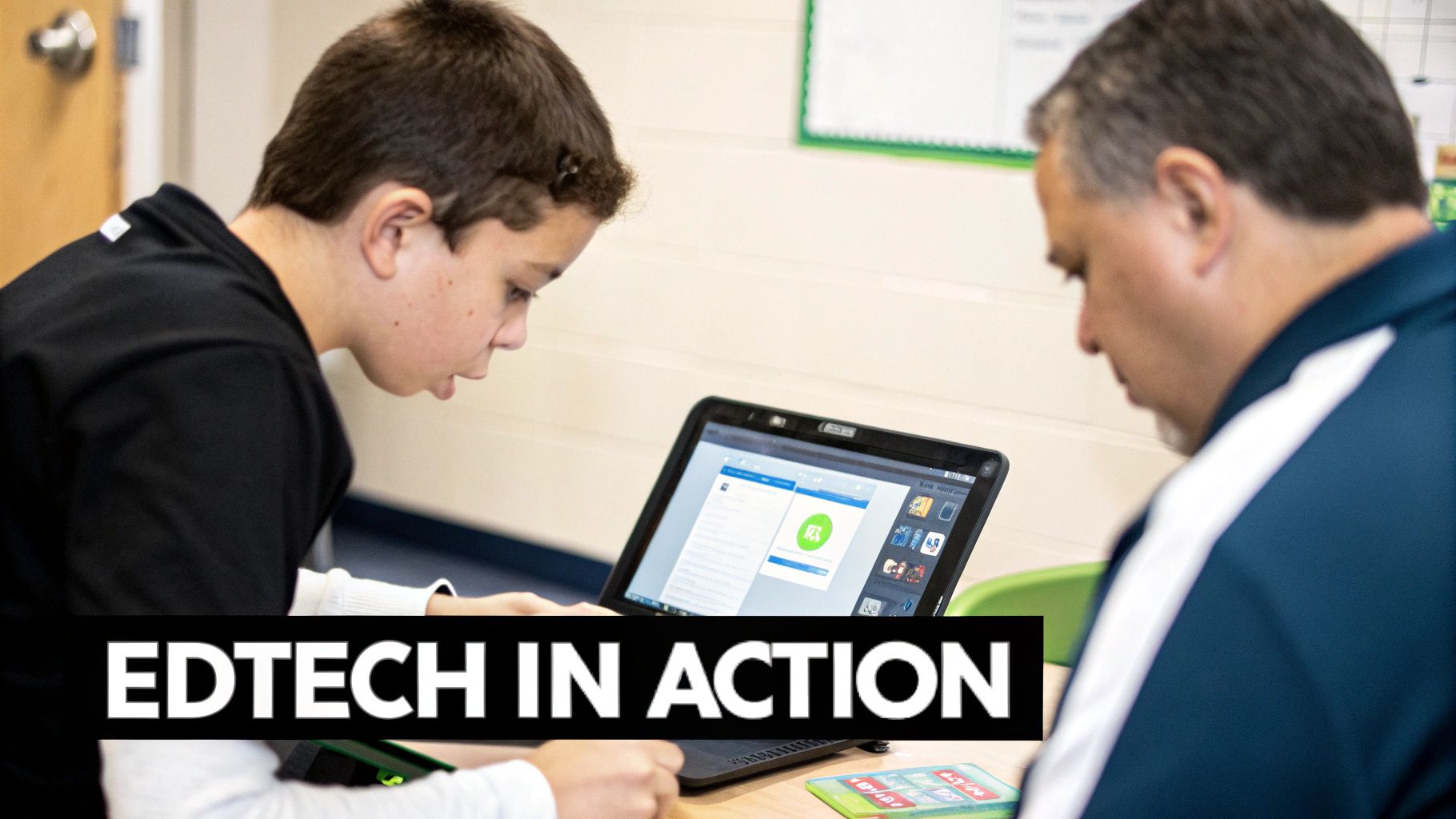
If you're an EdTech provider, knowing the structure of the Health Science career cluster is just the start. The real magic happens when you show how your product solves the day-to-day problems that teachers and students run into.
Think about it: how do you teach a student to draw blood without an actual arm to practice on? That’s where technology steps in. When you can position your tool as the answer to these kinds of real-world challenges, you’ve got a story that will resonate with CTE directors and curriculum leaders.
Bridge the Gap Between Theory and Practice
One of the biggest headaches for any Health Science program is giving students enough hands-on practice. It needs to be safe, repeatable, and available to everyone. But real-world clinical placements are limited, and expensive equipment can be a budget-breaker.
This is exactly where your technology can shine.
- Virtual Reality (VR) and Simulation Labs: Imagine students practicing surgical techniques or patient assessments in a completely risk-free setting. VR lets them try, fail, and try again, building the muscle memory they need long before they step into a real hospital room.
- Digital Anatomy and Physiology Platforms: Forget flat diagrams in a textbook. Interactive 3D models let students virtually "dissect" the human body, turning abstract concepts into something they can see and understand.
Technology that creates a safe space for trial and error doesn't just make learning more engaging—it makes it more effective. For a school district, that means better-prepared students and a safer learning environment, which is always a winning combination.
Streamline Certification and Program Management
Beyond the hands-on skills, the end goal for students is often an industry-recognized certification. This is a huge measure of success for any CTE program. At the same time, teachers and administrators are drowning in the logistics of managing it all.
A well-designed EdTech tool can be a lifesaver on both fronts.
Help Students Ace Their Exams
Tools that offer practice tests and study guides for certifications like CNA, Phlebotomy Technician, or EKG Technician are gold. When you can show a district how your product directly boosts student pass rates, you're talking their language. Highlighting these measurable outcomes should be a cornerstone of your education marketing strategy.
Simplify the Paperwork
A specialized Learning Management System (LMS) can be a game-changer. It can track a student’s clinical hours, log their demonstrated skills, and keep everything organized for compliance. This frees up teachers from administrative busywork, giving them more time to actually teach.
Showing a decision-maker how your platform saves their staff time is a powerful way to get their attention.
EdTech Product Alignment for Health Science Pathways
Different career pathways have unique learning needs, and the right technology can make all the difference. The key is to match your product's strengths to the specific skills students need to master.
Here’s a quick look at how different EdTech solutions can support the various Health Science pathways.
| Health Science Pathway | Key Student Need | Aligned EdTech Solution |
|---|---|---|
| Therapeutic Services | Mastering hands-on patient care procedures | VR/AR simulations for nursing, surgical tech, or physical therapy tasks. |
| Diagnostic Services | Learning to operate complex medical equipment | Digital simulations of EKG machines, X-ray equipment, or lab analyzers. |
| Health Informatics | Understanding data management and patient records | Electronic Health Record (EHR) practice software; data analytics platforms. |
| Support Services | Gaining knowledge of facility operations | Interactive modules on medical terminology, safety protocols, and hospital admin. |
| Biotechnology R&D | Practicing lab techniques and data analysis | Virtual lab software for pipetting, DNA sequencing, or cell culturing. |
By aligning your solution to a specific pathway, you move from being a "general" EdTech tool to an essential part of a student’s career preparation. This focused approach makes your value proposition much clearer and more compelling to educators.
Connecting With K-12 Decision-Makers
So, you understand the world of the health science career cluster. That’s a great start. But the real challenge is turning that knowledge into meaningful conversations with schools. To do that, you have to connect with the right people, and finding them can feel like searching for a needle in a haystack.
This is where a specialized K-12 contact database becomes your most valuable asset. Forget guessing who to email or getting lost in generic school inboxes. A good platform lets you bypass the gatekeepers and get your message directly in front of the people who actually make curriculum and purchasing decisions for health science programs.
Identifying the Right Contacts
Effective outreach isn't about volume; it's about precision. You need to talk to the folks who not only get the day-to-day challenges of health science education but also have the authority to do something about it.
Your best bet is to focus on these key roles:
- CTE Directors: These are the district-level leaders who oversee all Career and Technical Education programs. They manage the big-picture strategy and, crucially, the budget.
- Health Science Department Heads: At the school level, these are your champions. They make curriculum decisions and fight for the resources their teachers and students need.
- Principals and Assistant Principals: They are often the final sign-off for any new purchase made at their school.
Getting this part right is everything. For a more detailed look at who controls the budget, our guide on finding school purchase decision-makers is a great resource.
Here’s a look at how a platform like Schooleads lets you zero in on specific roles to build a hyper-targeted contact list in minutes.
By using filters for job titles and departments, you can stop wasting hours on manual research and start building relationships with the people who matter.
Crafting a Message That Resonates
Once you have your list, it's time to craft a message that actually gets opened and read. Generic sales pitches are a one-way ticket to the trash folder. You have to speak directly to the unique challenges that keep health science educators up at night.
Think of your product as the answer to a specific problem. Does it help students nail their certification exams? Can it fill the gap when clinical placements are hard to come by? Does it neatly align with NCHSE standards? Always lead with the solution, not just a list of features.
Your outreach needs to be all about them, not you. Frame your message around tangible outcomes. Talk about how your tool prepares students for in-demand local jobs, makes employer partnerships stronger, or boosts credentialing pass rates.
When your email speaks their language and addresses their goals, it stops being a sales pitch and starts being a conversation. That’s how you make a real impact.
Got Questions? We’ve Got Answers.
Trying to figure out how to get your health science tools into the right hands in K-12 schools can feel complicated. Let's clear things up with some straight answers to the most common questions we hear.
Who Actually Makes the Buying Decisions for Health Science Tech?
You’ll want to connect with two main groups: the people who hold the purse strings and the people who will actually use your product.
At the district level, the Career and Technical Education (CTE) Director is your key contact. At the school level, it’s the Principal. They’re the ones who manage budgets and give the final green light.
But don't overlook the influencers on the ground. The Health Science Department Head and the lead teachers in the classroom have a huge say. Their recommendation can make or break a deal because administrators trust their hands-on experience. If you win them over, you're halfway there.
How Can We Prove Our Product Is Worth the Investment?
School districts want to see results, plain and simple. Your best bet is to connect your product directly to tangible student success.
Forget fuzzy metrics. Your return on investment story needs to be all about employability. Can you show that students who use your tool are more likely to pass certification exams? Do they graduate better prepared for high-demand local jobs? That’s what gets a district’s attention.
Data is your best friend here. Show them the numbers that prove you’re not just another tool, but a direct pathway to a student's career.
When Is the Best Time of Year to Reach Out?
Timing really is everything. While schools are always planning, there are specific windows when they're most open to hearing about new resources. You want to reach out when they're actively thinking about budgets and new programs.
Here are the sweet spots:
- Late Winter & Early Spring: This is prime time. Districts are deep in budget planning for the upcoming school year, making decisions on major purchases.
- Fall: Once the school year settles down, this is another great window. You can start conversations for a mid-year purchase or, more likely, get on their radar for the next year's planning cycle.
Reaching out during these key periods means your message lands when decision-makers are actually ready to listen.
Ready to connect with the right people in every school district? Schooleads gives you the verified contact info you need to build your sales pipeline and get in front of K-12 decision-makers. Find out more at https://schooleads.com.