Gaming In Schools A Modern Educator's Guide To Engagement
Explore the power of gaming in schools with this definitive guide. Learn game-based learning, esports, and practical implementation for modern classrooms.
Once upon a time, the idea of video games in a classroom would have been dismissed as a distraction. Not anymore. Today, gaming in schools is a reality, and it's proving to be a remarkably effective teaching tool. It’s all about harnessing the mechanics that make games so captivating and using them to get students excited about learning, build crucial skills, and connect with them in a digital world they already know inside and out.
From Distraction To Digital Learning Tool
Remember when computers first started showing up in schools? A lot of teachers were skeptical, seeing them as little more than expensive toys. Fast forward to today, and it's hard to imagine a classroom without them. We're seeing that same exact shift happen with gaming. It's moving beyond just "playtime" as we recognize the real, tangible educational power packed into games.
Digital games are quickly becoming a staple in modern lesson plans for a simple reason: they click with how students think. They offer instant feedback, let kids experiment and take risks without fear of failure, and demand active involvement—a world away from just passively listening to a lecture. This isn't just a minor tweak; it's a fundamental change in how we approach teaching, meeting students right where they are.
The Momentum Is Undeniable
And this isn't just a niche trend. The numbers tell a powerful story. The game-based learning market was already valued at a staggering $16.16 billion in 2023 and is on a steep upward climb. A lot of this growth got a major push during the pandemic, when schools scrambled for remote learning options and discovered that digital games delivered real results, converting even the biggest skeptics. You can dig deeper into the explosive growth of the game-based learning market and see where it's headed.
Platforms like Minecraft Education are perfect examples, taking a game kids already love and transforming it into a space for learning everything from coding and STEM to history and art. It makes complex topics feel natural and fun.
When we reframe gaming as an educational strategy, we're essentially tapping into a language our students are already fluent in. This isn’t about throwing out traditional teaching methods. It's about adding an incredibly powerful and dynamic new tool to the educator’s toolkit.
The evidence is mounting: bringing games into the classroom makes learning an active, immersive experience that genuinely boosts engagement. As we get into the nuts and bolts of how this works, you'll see just how effective this approach can be in equipping students with the creative, collaborative, and strategic thinking skills they'll need for the future.
Understanding The Three Models Of Educational Gaming
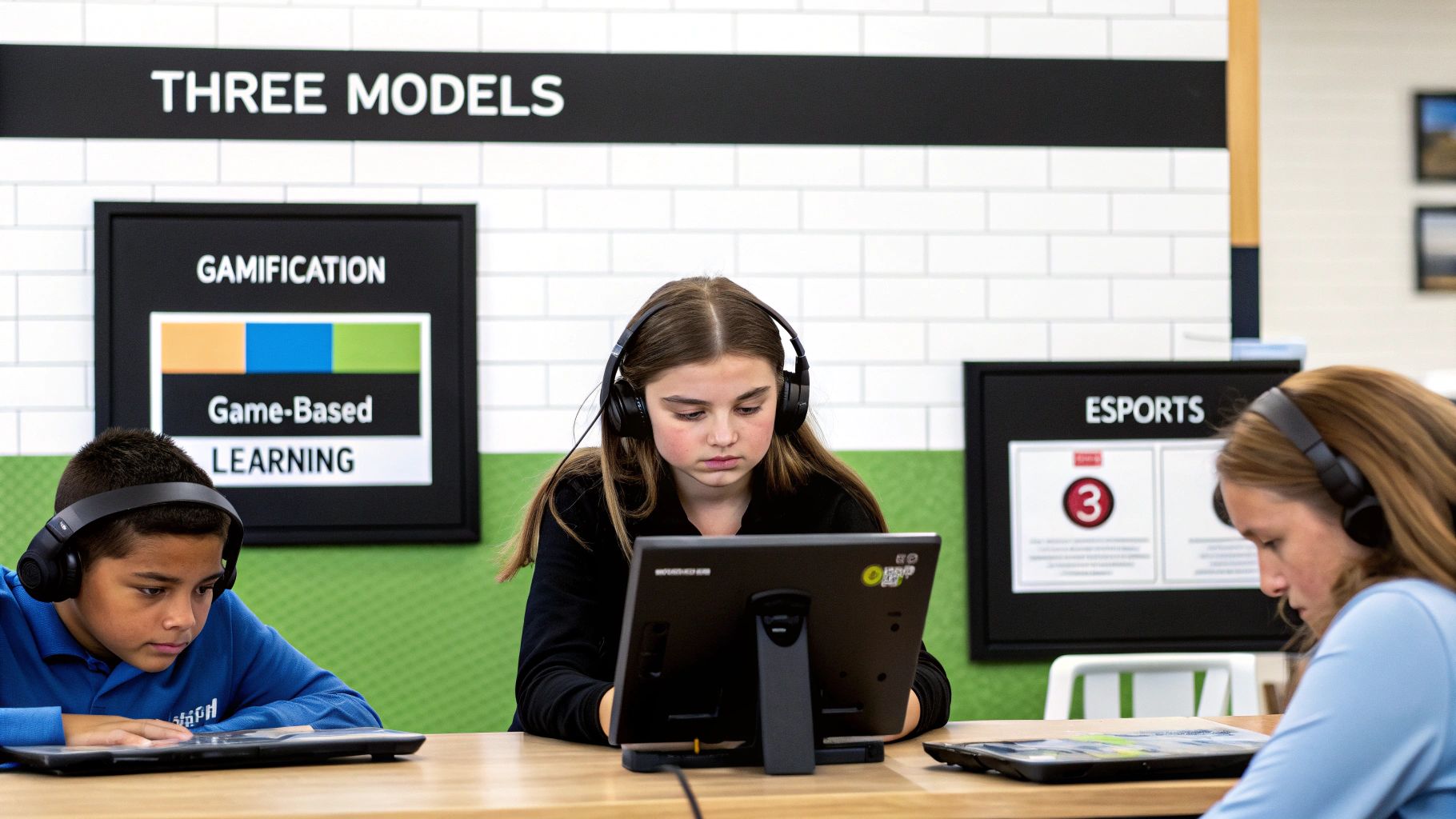
So, you're thinking about bringing gaming into your school. That’s great! But it's not as simple as just rolling out a few tablets. To get it right, you first need to know the landscape. There are really three distinct paths you can take: Gamification, Game-Based Learning (GBL), and Esports.
They all involve games, sure, but they’re fundamentally different in their purpose and how they work in a classroom. Think of it like a builder’s toolkit. You wouldn't use a sledgehammer for a delicate job, right? Choosing the right model is the first and most important step. Let’s break them down.
H3: Gamification: Adding Game Mechanics To Everyday Learning
This is the one most people think of, but it's also the most misunderstood. Gamification isn't about playing video games in class. Not at all. It's about borrowing the elements that make games so addictive—points, badges, leaderboards—and applying them to regular classroom tasks.
Imagine a standard math worksheet. Instead of just a grade at the end, a gamified version might award points for each correct answer. Get a perfect score? You unlock a "Math Master" badge. The whole class can see their progress on a leaderboard, sparking a little friendly competition. The worksheet is the same, but the motivation to complete it is completely different.
Gamification is a motivational tool, plain and simple. Its goal isn't to teach through gameplay. It’s about making the process of learning more engaging and rewarding, ultimately changing student behavior and building a more positive attitude toward schoolwork.
It works because it taps into basic human psychology—our love for achievement, progress, and a bit of recognition. It’s the same reason frequent flyer miles work. You're still just flying, but the points system encourages you to stick with one airline.
H3: Game-Based Learning: Where The Game Is The Lesson
With Game-Based Learning (GBL), we flip the script entirely. Here, the game isn't just a layer on top of the lesson; the game is the lesson. Students learn content by playing, exploring, and solving problems inside a purpose-built game world.
A history teacher could use a game like Civilization to let students experience firsthand the challenges of managing resources, engaging in diplomacy, and advancing a society. The learning happens organically as they make strategic choices and see the immediate consequences.
Or think about a science class using Kerbal Space Program to teach physics. Students design, build, and launch their own rockets. The hands-on trial-and-error of trying to get a spacecraft into orbit makes abstract concepts like thrust and gravity feel real and understandable in a way a textbook never could.
H3: Esports: The Competitive Sport Of Gaming
Finally, there’s Esports (electronic sports). This model treats competitive gaming exactly like a traditional school sport. Think of it as the digital equivalent of the basketball team or the debate club, complete with coaches, practices, and official tournaments against other schools.
Students might be playing popular titles like League of Legends or Rocket League, but the learning goes far beyond the game itself. The real focus here is on developing critical life skills: teamwork, clear communication, strategic thinking, and grace under pressure.
An esports program creates a structured, inclusive space for students who might not be drawn to traditional athletics. It gives them a team and a sense of belonging. Research even shows that students involved in esports often have better attendance, higher GPAs, and stronger social-emotional skills. It's a powerful way to reach and teach an often-underserved group of students through something they are genuinely passionate about.
To help you see the differences side-by-side, here’s a quick breakdown of how these three models compare in a school setting.
Comparing Educational Gaming Models
| Model | Primary Goal | Classroom Example | Key Student Skills |
|---|---|---|---|
| Gamification | Increase motivation & engagement | Earning points and badges for completing math homework on a platform like Classcraft. | Persistence, task completion, positive behavior |
| Game-Based Learning | Teach specific academic content | Using Minecraft Education to build historical structures or model ecosystems. | Critical thinking, problem-solving, subject mastery |
| Esports | Develop soft skills & community | Forming a school team to compete in a regional Rocket League tournament. | Teamwork, communication, strategic planning, resilience |
Ultimately, understanding the strengths of each model allows you to make a smart, informed decision about which approach will best serve your students, your teachers, and your school's unique goals.
How Gaming Develops Critical Skills
When students play games, they're doing far more than just passing the time. They're sharpening the very skills they’ll need to thrive in the real world. In a school setting, gaming becomes a powerful engine for cognitive development—think of it as a mental gym where every challenge builds intellectual muscle.
Imagine a student immersed in a complex strategy game. They aren't just clicking buttons. They're managing resources, planning several moves ahead, and reacting to unexpected obstacles. This is a direct parallel to long-term planning and strategic resource allocation, crucial skills for everything from a big school project to a future career.
Or take puzzle-based games. They demand logical deduction and hypothesis testing, one step at a time. This cycle of trial and error naturally builds resilience and a methodical approach to problem-solving. Every failed attempt is just feedback, teaching students that mistakes are simply learning opportunities, not dead ends.
Building The Brains Of Tomorrow
The benefits of gaming in schools aren't just wishful thinking; a growing body of evidence backs them up. Games are uniquely good at nurturing skills that traditional teaching methods sometimes struggle to hit head-on. They create a dynamic learning space where students are intrinsically motivated to push their own cognitive limits.
For example, many fast-paced games force players to process a ton of information quickly and make split-second decisions. This sharpens spatial reasoning, improves reaction time, and enhances their ability to spot patterns under pressure. These aren't just niche gaming skills—they're foundational for success in STEM fields and many other areas.
The true power of educational gaming lies in its ability to make rigorous thinking feel like play. When students are deeply engaged, they are more open to tackling complex problems and persisting through challenges, which is the very essence of meaningful learning.
This engagement leads to real academic gains. When students are motivated and actively involved, their comprehension and retention shoot up. A student who might seem disengaged in a traditional lesson can quickly transform into a confident, analytical thinker when given a challenge they're genuinely excited to solve.
Evidence Of Real World Impact
The link between gaming and skill development is getting noticed on a global scale. A landmark Oxford University study of over 80,000 players found that half of them felt video games had a positive impact on their education or career. Here in the United States, 79% of adults believe games enhance cognitive abilities, showing just how mainstream this idea has become. Another detailed review confirms that gamers consistently outperform non-gamers in tasks related to perception, attention, and decision-making. You can dig into more of this research in the Global Power of Play Report.
This data simply confirms what many educators are already seeing in their own classrooms. Well-designed gaming programs help grow a whole range of skills critical for 21st-century success.
- Critical Thinking and Problem-Solving: Students learn to break down complex situations, come up with strategies, and pivot when things don’t go as planned.
- Collaboration and Communication: Multiplayer games and esports aren't solo activities. They demand constant teamwork, clear communication, and working together toward a common goal.
- Creativity and Innovation: Sandbox games like Minecraft give students a blank canvas to experiment, design, and build, unlocking their creative and innovative potential.
- Resilience and Adaptability: Overcoming a tough in-game boss or a tricky puzzle teaches persistence. Students learn to bounce back from failure, adjust their approach, and try again.
By bringing thoughtful gaming programs into schools, we can give students a powerful, engaging, and effective way to prepare for the future. The skills they build while playing aren't just for the game—they're skills for life.
Your Step-By-Step Implementation Plan
So, you have this great idea to bring gaming into your school. How do you get from a spark of an idea to a full-blown, successful program? It can feel like a massive jump, but the trick is to break the journey down into smaller, more manageable steps.
This roadmap is designed to help you do just that. Think of it like building a house—you have to pour a solid foundation before you start putting up the walls. Each step ensures your program is stable, well-supported, and actually helps your school achieve its goals. A little groundwork now prevents the whole thing from collapsing later.
H3: Assemble Your Core Team
Let's be real: no big change in a school happens because of just one person. Your first move is to find a small crew of passionate people who get what you’re trying to do with gaming in schools. This is your championship team, your core support system.
You're looking for a good mix of allies who bring different strengths to the table. An ideal team would include:
- An Enthusiastic Teacher: You need someone who is already excited about trying new things in the classroom. This is your first pilot candidate.
- An IT Department Member: A tech-savvy friend who understands the school's network and security is absolutely essential. They'll know what’s possible and what’s not.
- A Curriculum Leader or Administrator: Getting a decision-maker on board early on gives you instant credibility and helps you navigate all the approvals you’ll need down the line.
Your group doesn’t have to be huge. A solid team of three to five people is often the perfect size to get the ball rolling without getting bogged down.
H3: Define Your "Why" and "What"
Okay, you've got your team. Now it’s time to get crystal clear on your vision. Before you can convince anyone else, you have to know exactly what you’re aiming for. It all boils down to two simple questions: "Why are we doing this?" and "What will it actually look like?"
Your "why" is your mission. Is the goal to get students fired up about STEM? Maybe it’s about developing teamwork and emotional skills through an esports club. Or perhaps you want to teach complex history lessons using a game. Whatever it is, your goal has to connect directly to your school or district's existing improvement plan. This alignment is the secret to getting buy-in.
For example, if your district’s big push is for better collaborative problem-solving, an esports club is a natural fit. If the main focus is boosting math scores, a game-based learning platform for algebra makes a lot more sense.
Once the "why" is solid, define your "what." This is where you choose one of the three models: gamification, game-based learning, or esports. It’s so much more effective to start with a single, focused approach instead of trying to do everything at once. This keeps your pilot program easy to manage, measure, and explain to others.
H3: Launch a Pilot Program
The absolute best way to show that gaming works is to… well, show that it works. A small, controlled pilot program is your chance to iron out the wrinkles, collect some real data, and create a success story you can share with the people who hold the purse strings.
Don't even think about launching district-wide from the get-go. Pick one or two of your most passionate teachers and have them run the pilot in their own classrooms. This keeps the risk low and lets you learn and adapt in a friendly environment.
Here’s a simple template to structure your pilot:
- Objective: State one clear, measurable goal. (e.g., "Increase student engagement in 8th-grade history by 15% over one semester.")
- Participants: Name the teacher(s) and the specific students involved. (e.g., "Mr. Smith's two 8th-grade history classes, totaling 55 students.")
- Tools: List the exact game or platform you'll be using. (e.g., "Civilization VI for the historical simulation unit.")
- Timeline: Set a firm start and end date. (e.g., "From September 15th to December 15th.")
- Metrics: Decide how you'll measure success. This could be anything from pre- and post-surveys on engagement to attendance records or assignment completion rates.
H3: Craft Your Proposal and Identify Decision-Makers
Once your pilot is done and you have some positive data, you’re ready to make your case for a bigger rollout. Your proposal should be a short, compelling document that tells a story. Start with the problem you wanted to solve, explain how your pilot program tackled it, and then show off your results.
This is where a little marketing savvy comes in handy. You’re not just presenting an idea; you're selling a solution to a problem your school leaders already care about. To frame your pitch in the most effective way, it's worth learning about the principles of agile education marketing.
Finally, know who you're talking to. The key decision-makers you need to win over usually include:
- Principals and Assistant Principals: They control school-level budgets and schedules.
- Curriculum Directors: They need to see how this fits with educational standards.
- IT Directors: They have to sign off on any new software or hardware.
- Superintendents and School Boards: For any big, district-wide programs, their approval is a must.
Tweak your presentation for each person. For the IT director, focus on security and network impact. For the curriculum director, highlight the academic outcomes and learning standards. This targeted approach makes it much harder for them to say no.
Securing Your Budget And Finding The Right Tools
An incredible idea for a gaming program is just that—an idea. To bring it to life, you need funding. While your passion can spark the initial interest, a solid budget and the right tools are what will keep it going long-term. Let's be honest, talking about money can feel daunting, but it's really just a matter of breaking down the costs and knowing who to ask.
Think of it like building a new gaming rig. You have your essential components (the hardware), the software you need to run, and maybe some optional accessories to make the whole experience better. Each part has a price tag, and planning for them upfront saves you from nasty surprises down the road.
Building Your Program Budget
First things first: you need a detailed shopping list. The costs can swing wildly depending on your vision. Are you planning a small classroom pilot using a game you already own, or are you building a full-blown, competitive esports program from the ground up?
No matter the scale, your budget will likely need to cover these key areas:
- Hardware: This is usually the biggest expense. Think gaming PCs, consoles like the Nintendo Switch or PlayStation, high-refresh-rate monitors, and all the peripherals—keyboards, mice, and headsets.
- Software and Licensing: Many educational titles, like Minecraft Education, run on an annual subscription model. If you're fielding an esports team, you'll also need to buy copies of the games you'll be competing in.
- Furniture and Infrastructure: A dedicated gaming space might need ergonomic chairs and desks. You may also need to account for network upgrades to make sure your school's internet can handle the extra demand without lagging.
- Stipends and Fees: For an esports program, don't forget to budget for coaching stipends, tournament entry fees, and travel expenses.
A well-structured budget proposal does more than just ask for money; it tells a story of responsible planning. By clearly outlining every potential cost, you demonstrate foresight and build trust with the people who approve the spending.
Navigating The Procurement Maze
Okay, you have your budget. Now comes the real challenge: getting it approved. School and district procurement can feel like a labyrinth, with multiple sign-offs needed from different departments. Understanding this workflow is the key to getting your project off the ground.
Typically, a purchase request has to climb a ladder. It might start with a department head, then go to the principal, and finally land with the district's business or IT office for the final green light. Each person in that chain is looking at your request through a different lens. The principal wants to know how it helps students, while the IT director is thinking about network security and device management.
Knowing who to talk to is half the battle. To get a better feel for the landscape, it helps to understand the key K-12 purchase decision-makers and what they care about most. This insight lets you frame your proposal in a way that directly addresses their biggest concerns.
Finding Creative Funding Sources
Don't make the mistake of thinking the school's general fund is your only option. Many of the most successful gaming programs are funded through a creative mix of sources that don't put a strain on existing budgets.
Here are a few places to start looking:
- Technology and STEM Grants: Plenty of federal, state, and private grants are out there specifically to support new uses of technology in the classroom. If you frame your proposal around building valuable STEM skills, you'll be speaking their language.
- Career and Technical Education (CTE) Funding: Does your program have a career-focused angle, like game design, streaming, or digital media? It might just qualify for CTE funds.
- Parent-Teacher Organizations (PTO/PTA): Never underestimate the power of your local PTO. They can be a fantastic source for smaller-scale funding, especially for getting a pilot program off the ground with its first set of hardware.
- Corporate Sponsorships: Local businesses are often looking for ways to support schools in their community. A company might sponsor an esports team's jerseys or donate hardware in exchange for a little recognition.
When you combine a detailed budget with a smart plan for getting approvals and finding money, you can turn your vision for gaming in schools from a great idea into a fully-funded reality.
5. Building A Safe and Equitable Gaming Program
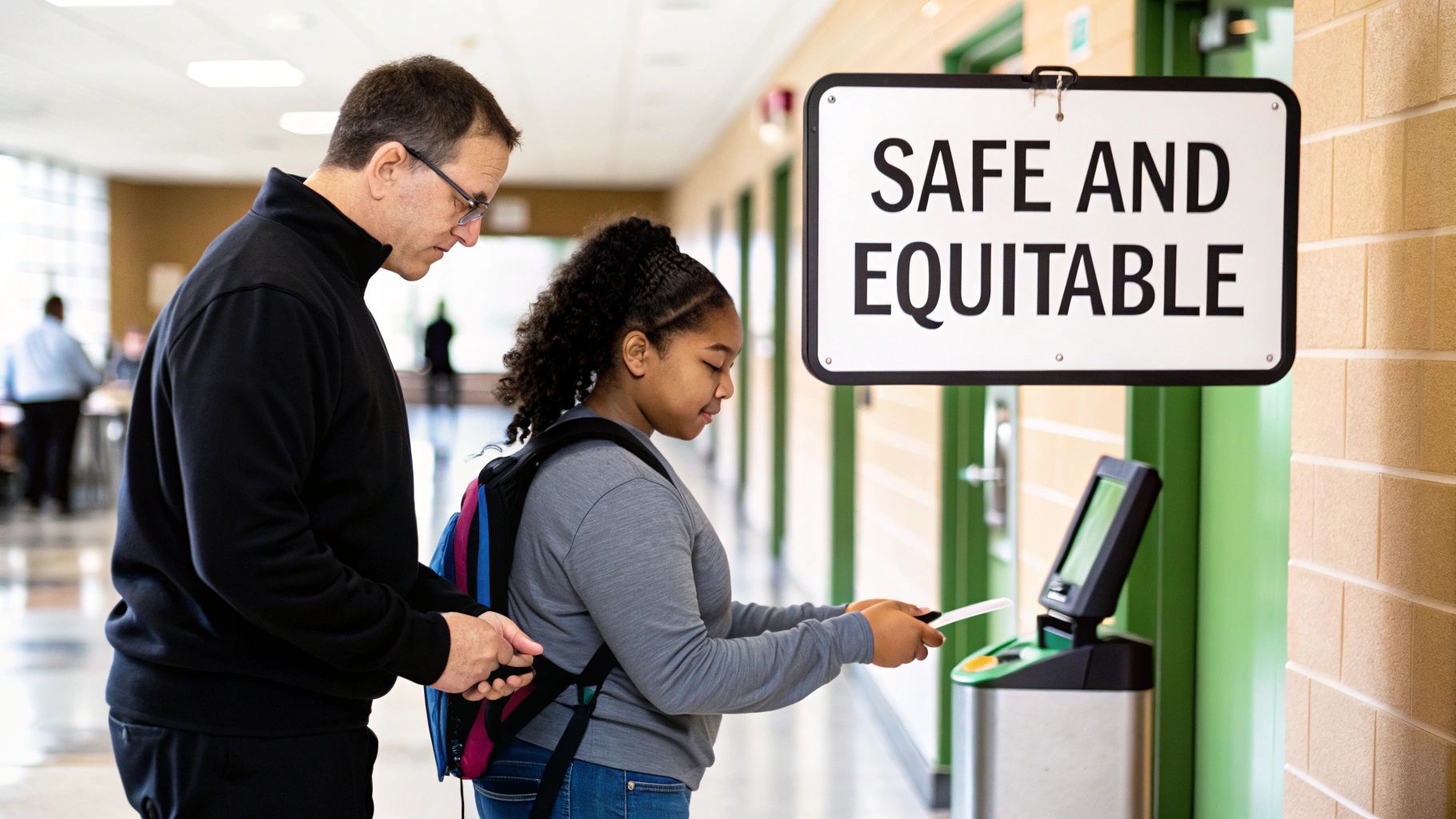
A great gaming program isn't just about high scores and fancy graphics. For it to truly succeed, it has to be inclusive, secure, and built to last for every student who wants to join.
This means thinking carefully about equity, student privacy, and how you'll manage all the new tech. If you skip these steps, a promising initiative can quickly create unfair advantages or expose the district to real risks. Getting these fundamentals right from the start is what separates a short-lived fad from a lasting, valuable program.
Ensuring Equitable Access For All Students
Let's be honest: the digital divide is still a major hurdle. If a gaming program requires students to have their own high-powered PCs or the latest consoles at home, you’re unintentionally leaving a lot of kids behind.
Real equity means that every student gets a chance to play, learn, and compete, no matter their family's financial situation.
Here are a few proven ways to make that happen:
- Create Dedicated Gaming Labs: Set up a space on campus with all the equipment ready to go. This guarantees every student gets the same high-quality experience.
- Start a Device-Lending Program: Think of it like a library for tech. Let students check out gaming laptops or consoles to practice at home or for club events.
- Offer After-School Access: Keep the lab doors open after the final bell. This gives students who rely on the school bus or have other commitments a fair shot at participating.
By designing your program for access from day one, you’re not just buying equipment—you’re building a community hub. It sends a powerful message that every student belongs.
Protecting Student Privacy and Data
Bringing any new technology into your schools means you have a duty to protect student data. It’s that simple. Gaming platforms are no different, and many collect user information that falls under strict privacy laws.
You absolutely have to be compliant with federal regulations like the Children's Online Privacy Protection Act (COPPA) and the Family Educational Rights and Privacy Act (FERPA). Before a single student logs on, your IT department needs to put every potential platform through its paces.
This means digging into the vendor’s data policies, finding out where student information is stored, and confirming that you have the ability to delete it. Skipping this step isn't just careless; it can open the district up to serious legal and ethical trouble.
Managing Devices and Content
Finally, you need a solid plan for the hardware itself. Your IT team is going to be responsible for installing games, rolling out patches and updates, and, crucially, setting up content filters to keep the environment safe.
Without a clear device management strategy, you’ll be stuck dealing with constant technical glitches and security holes. A well-managed system keeps the tech running smoothly and ensures the gaming space remains a positive one for everyone involved.
Got Questions About Gaming in Schools? Let's Talk.
Bringing video games into the classroom is a big step, and it’s only natural for parents, administrators, and even other teachers to have questions. Getting everyone on board means tackling those concerns head-on with clear, honest answers.
Let's start with the big one: screen time. It’s a completely fair question. But it's important to remember that educational gaming isn’t just mindless clicking. We’re talking about structured, purposeful, curriculum-driven activities.
Think of it this way: you wouldn't worry about screen time in a high-tech science lab or a digital arts class. This is the same idea. It’s a powerful tool used for a specific learning goal during a designated class period.
How Do We Make Sure the Games Are Actually Educational?
This is where the magic really happens, and it all comes down to intentional design. The first step is knowing the difference between a game built for pure entertainment and one designed for the classroom.
Platforms like Minecraft Education were created specifically with learning goals in mind. But even a commercial game can be an incredible teaching tool if you wrap it in a strong lesson plan.
The real educational value isn't just in the game itself. It's in the entire experience—the lesson you teach beforehand, the specific challenges you set within the game, and the group discussions you lead afterward. That structure is what connects the fun of gameplay to real academic standards.
People often assume that "gaming in school" is just a trick to let kids play. The reality is, we're meeting students in a world they already love. We're using that incredible engagement as a launchpad for deeper learning and critical thinking.
Is This Just for a Small Group of "Gamer" Kids?
You might think gaming only appeals to a certain crowd, but the numbers tell a very different story. A staggering 85% of teens in the US (ages 13-17) play video games, and 41% play every single day. This isn't some niche hobby anymore; it's a massive part of youth culture.
Globally, we're looking at a community of 3.32 billion active gamers. You can dig deeper into how widespread teen gaming really is and see the social benefits for yourself.
This is exactly why gaming works so well in the classroom. It’s an instant common ground. It brings students from all different backgrounds together to solve problems, collaborate, and build confidence, creating a more level and inclusive playing field for everyone.
Ready to connect with the forward-thinking school leaders who are championing programs like these? Schooleads provides the verified contact data you need to reach principals, curriculum directors, and IT administrators across the country. Start building your pipeline with the decision-makers who are shaping the future of education. Find your next school partner at https://schooleads.com.