A Practical Guide to Equity in Education for All Students
Discover what equity in education truly means, why it matters more than equality, and how schools and EdTech can build inclusive learning environments.
At its most fundamental level, equity in education is about giving every single student the specific resources and support they need to be successful. This isn't about giving everyone the exact same thing; it's about making sure everyone has a fair shot at reaching their full potential. This approach acknowledges a simple truth: students don't all start from the same place, so they won't all need the same tools to get ahead.
Unlocking Potential Through Educational Equity
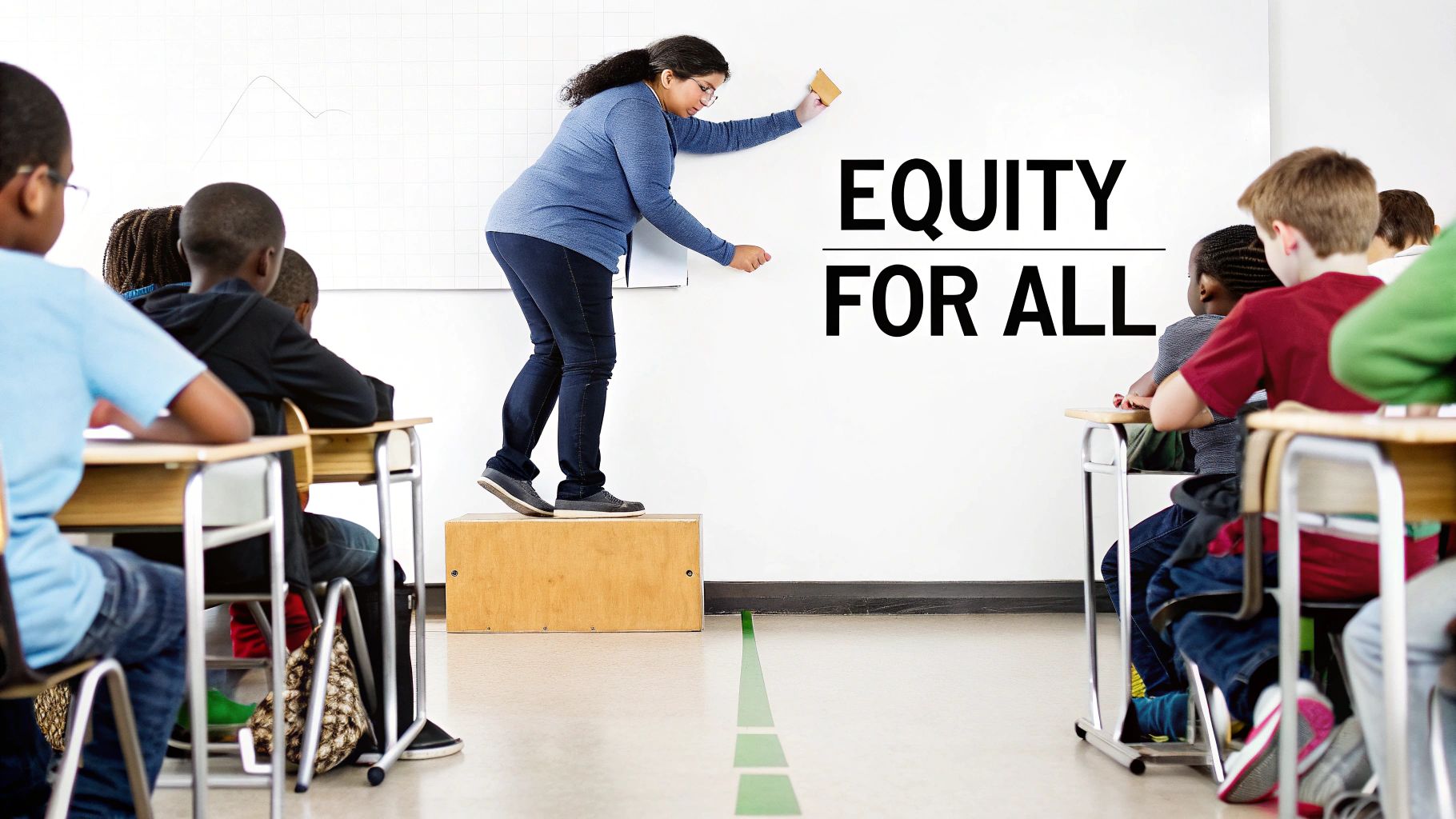
Here’s a simple way to think about it: imagine a race. Some runners have hurdles scattered across their lane, while others have a completely clear path. Just handing every runner the same sneakers doesn't suddenly make the race fair. Real equity in education is about removing those hurdles for the runners who have them, making sure the track itself is fair for everyone.
This difference is more than just a thought exercise; it has massive real-world implications. When schools put equity at the forefront, they move away from a one-size-fits-all approach and toward a system that is far more personal and responsive. It means understanding that students from different socioeconomic backgrounds, cultures, and with different learning abilities require support that's built for them.
Why Equity Matters for Everyone
Chasing equity in education isn't just the right thing to do—it's a practical necessity for building a stronger society and a more competent workforce. When systemic barriers hold talented students back, we all lose. The innovations they could have created, the leadership they could have provided, and the contributions they could have made are lost forever. That creates a deficit that hurts our collective economic and social health.
A commitment to educational equity is an investment in our shared future. It’s the understanding that a society's success is directly tied to its ability to cultivate the talent of all its members, not just a select few.
Getting this right means we have to take a hard look at many long-held practices in our school systems. It forces us to ask tough questions about how resources are divided, how curriculums are designed, and how we deliver support services to students. The ultimate goal is to build an environment where every child’s background is seen as a strength, not a weakness.
The Core Components of an Equitable System
Building a genuinely equitable educational system means working on several key areas at once. It’s a complex effort that extends far beyond the classroom walls and demands a real commitment from everyone involved.
Key areas of focus include:
- Fair Funding Distribution: This means sending money where it's needed most. Schools in lower-income areas should have the funding required for great teachers, up-to-date materials, and modern facilities.
- Inclusive Curriculum Design: The curriculum should reflect the diverse backgrounds and histories of all students. When kids see themselves in what they're learning, it becomes far more engaging and relevant.
- Targeted Student Support: Providing one-on-one academic, social, and emotional help to students who need it, whether that’s through tutoring, counseling, or access to special education programs.
- High-Quality Instruction: Making sure that every student—no matter their zip code—has access to skilled, effective, and well-supported teachers.
This basic understanding of what equity in education is, and why it's so incredibly important, is the first step. With this mindset, we can start to build an education system that truly works for every student, unlocking their potential and paving the way for a more just and prosperous future for all of us.
Equity vs Equality in Schools: A Critical Distinction
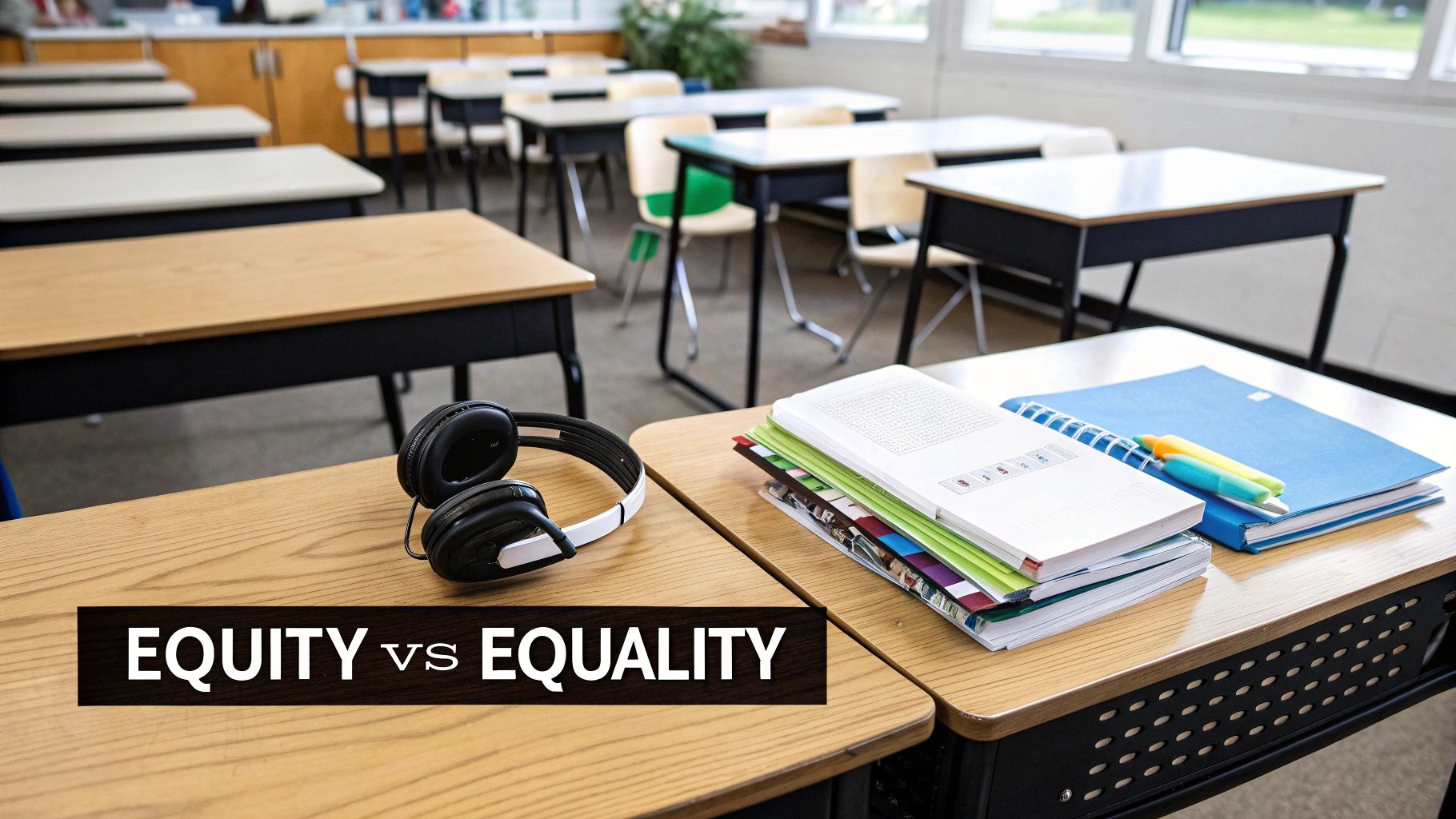
To make any real progress in education, we have to start with a fundamental distinction: the one between equity and equality. It’s easy to use these words interchangeably, but they represent two vastly different ways of supporting students. Confusing them can lead to well-intentioned policies that completely miss the mark, failing to address the real reasons for achievement gaps.
Equality is all about sameness. It means giving every single student the exact same resources and opportunities. On the surface, that sounds perfectly fair. But it’s based on a flawed assumption—that every student is starting from the same place and has the same needs.
Equity, on the other hand, is about fairness. It starts by acknowledging that students have different starting points, different backgrounds, and different challenges. The goal of equity isn't to give everyone the same thing, but to ensure everyone has a fair shot at reaching the same positive outcome. Their paths to get there might just look a little different.
Seeing the Difference in Action
Let’s bring this down to a simple classroom example.
Imagine a history class. An equal approach would be to give every student the same standard textbook. Simple, right? Everyone gets one copy.
But an equitable approach looks at the situation differently. It recognizes that a single textbook isn't the best tool for every learner and asks a better question: what does each student actually need to master this material?
- For a student with a visual impairment, equity means providing a large-print version of the book or an audiobook.
- For an English language learner, it might mean offering a bilingual edition or extra materials in their native language.
- For a student who struggles with reading comprehension, it could mean providing a graphic novel version that breaks down complex events visually.
The resources are different, but the goal is the same: to give every student a genuine opportunity to learn history. Equity is about providing the right tools to overcome individual barriers, a concept that a one-size-fits-all equality approach misses entirely.
Equity vs Equality: A Practical Comparison
To truly grasp why this distinction matters so much, let's look at how these two approaches play out in different school scenarios. The table below illustrates how equity customizes support to meet individual needs, while equality provides a uniform—but not always effective—solution.
| Scenario | An Equal Approach (Sameness) | An Equitable Approach (Fairness) |
|---|---|---|
| School Funding | Each school in a district receives the exact same per-pupil funding amount. | Schools with higher concentrations of students from low-income families or with special needs receive additional funding for extra support services. |
| Technology Access | Every classroom is equipped with 30 identical laptops for student use. | The district provides take-home devices and mobile hotspots to students who lack reliable internet access at home. |
| Teacher Attention | A teacher tries to divide their time equally among all 25 students in the class. | A teacher dedicates extra one-on-one time to a small group of students who are falling behind on a key concept. |
| Discipline | A zero-tolerance policy is applied uniformly, with the same consequence for every student who commits a specific infraction. | Restorative justice practices are used to understand the root cause of a student's behavior and address the harm caused, tailoring the response to the situation. |
As these examples show, equality focuses on the inputs, while equity is all about the outcomes. It’s a crucial shift from treating everyone the same to treating everyone fairly based on their unique circumstances.
This isn't just a local issue; it has global implications.
While global completion rates for primary, lower secondary, and upper secondary education have reached 88%, 78%, and 60% respectively, severe inequities persist. Disparities are most pronounced in low-income countries, where 36% of school-aged children are out of school, compared to only 3% in high-income nations. You can dig deeper into these global education trends and disparities on the UN's sustainable development goals report.
By adopting an equity lens, we can start asking the right questions and critically evaluate whether a policy is truly creating fairness or just enforcing a superficial sameness that ignores the diverse realities of our students.
Identifying the Key Barriers to Educational Equity
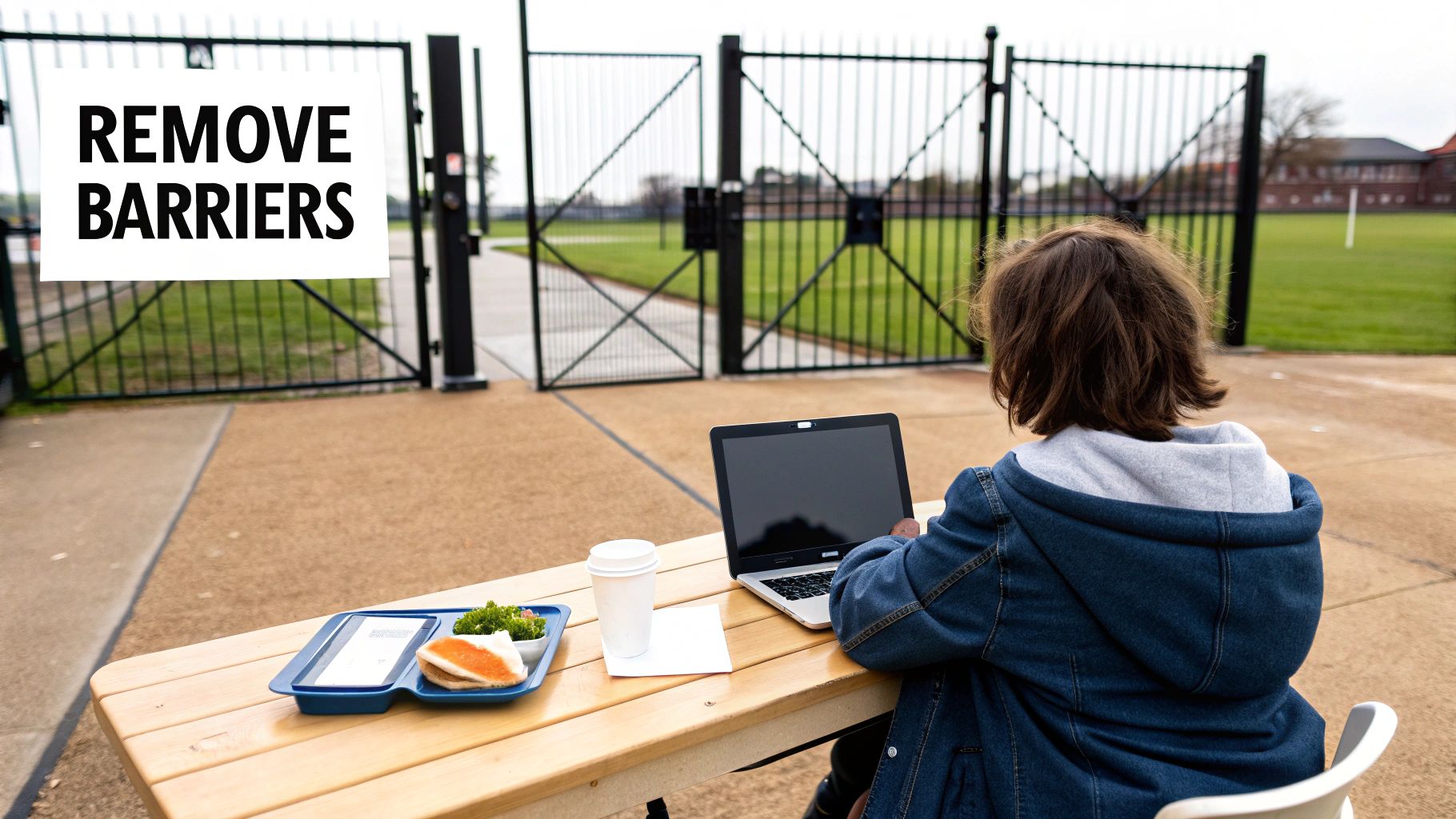
If we're serious about creating equity in education, we first have to get honest about what’s standing in the way. The roadblocks aren't just minor speed bumps; they're deep-rooted, systemic problems that rig the game from the start for far too many students.
These challenges are tangled up in the very structure of our schools, influencing everything from the condition of the buildings to the lessons taught in class. By looking past the surface, we can start to see how factors like a student’s family income, race, or disability don't just add up—they multiply, creating huge disadvantages.
Once we name these hurdles, we can stop putting bandages on symptoms and start tackling the root causes. That's how we clear the path to an education system where every single student truly has a fair shot.
Systemic Funding Gaps
Let's start with the most obvious barrier: money. Huge gaps in school funding create a chasm of opportunity. In the U.S., schools get a lot of their funding from local property taxes, which sounds fair on the surface but isn't. Wealthy neighborhoods can easily raise more money, while lower-income communities simply can't.
This isn't about luxury. It's about essentials. A student in a well-funded district gets experienced teachers, modern technology, and a rich curriculum. Just a few miles away, another student is stuck with crumbling buildings, outdated textbooks, and overcrowded classrooms.
When a student's zip code is a better predictor of their success than their own potential, we have a problem. This funding model locks in a cycle of inequality. The only way out is to completely rethink how we fund our schools, making sure resources get to the kids who need them the most.
The Impact of Implicit Bias
Money isn't the whole story. Sometimes, the biggest barriers are inside the classroom, created by biases we don't even know we have. Implicit bias is the collection of unconscious stereotypes and attitudes that shape how we see and treat others. In a school setting, it can be devastating.
These hidden biases can quietly influence a teacher's expectations, how they hand out discipline, and even what they choose to teach. A teacher might, without realizing it, expect less from students of color or discipline them more harshly than their white peers for the exact same behavior. This slowly erodes a student’s confidence and can derail their academic path.
Here are a few ways implicit bias shows up:
- One-Sided Stories: When textbooks and lessons only reflect one culture, students from other backgrounds can feel invisible and unimportant in their own education.
- Unfair Discipline: Data shows time and again that Black and Latino students are suspended and expelled at much higher rates than their white classmates, often for minor, subjective reasons.
- Lowered Expectations: An educator might unintentionally guide students from marginalized groups away from advanced classes, closing doors to future opportunities before they even know they exist.
Socioeconomic and Environmental Hurdles
A student’s life doesn't stop at the schoolhouse door. What happens at home has a massive impact on their ability to learn. Students from low-income families often face a daily battle with food insecurity, unstable housing, and poor access to healthcare. It’s hard to focus on algebra when you’re hungry or worried about where you’ll sleep.
The digital divide is another major hurdle. Lacking reliable internet or a computer at home puts a student at an immediate disadvantage, making it tough to do homework or research. We saw this clearly during the pandemic, but for millions of kids, it’s a constant reality.
These challenges are pushed to the extreme in crisis zones. Around the world, nearly a quarter of a billion school-aged children—234 million in total—have had their education disrupted by humanitarian crises. To see more on how these events create massive inequities, check out the global estimates report from Education Cannot Wait.
Understanding these barriers is the first, non-negotiable step. Only then can we start building a more just and effective system for everyone.
Practical Strategies for Championing Equity in Schools
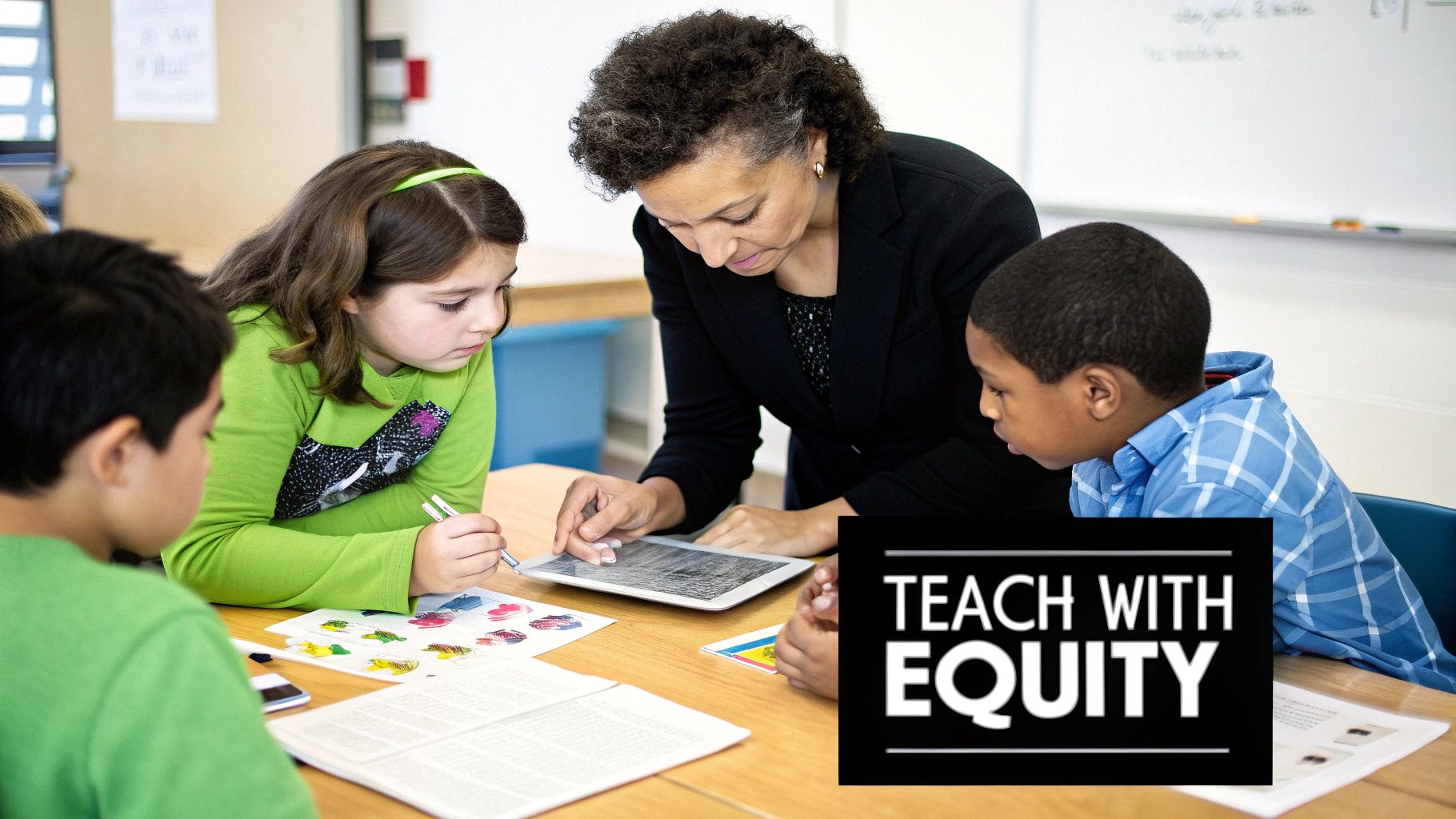
Knowing the barriers to equity in education is one thing, but the real work starts when we move from talking about it to actually doing something. Championing equity takes more than good intentions. It demands real-world, proven strategies that can reshape a school’s culture from the ground up.
The good news? Educators and administrators aren't starting from scratch. There’s a growing playbook of effective approaches that create learning environments where every single student feels seen, valued, and set up to succeed. Let’s dive into a few of the most impactful ways schools are making equity a daily reality.
Embrace Culturally Responsive Teaching
At its heart, culturally responsive teaching is about connecting learning to a student's own life. It means using their backgrounds, experiences, and cultural perspectives to make lessons stick. This isn’t just about celebrating holidays; it’s a deep shift in how we teach.
Instead of seeing diversity as a hurdle, this approach treats it as a classroom superpower. A literature teacher might bring in books by authors from different backgrounds so every student can see a piece of their own story in the curriculum. That small change validates who they are and helps them connect with the material on a much deeper level.
When a teacher can build that bridge between what a student already knows and what they need to learn, engagement goes through the roof. The learning becomes more personal, meaningful, and it lasts.
Implement Restorative Justice Practices
Traditional discipline often focuses on punishment, which can easily isolate struggling students and push them further away. Restorative justice flips the script. It’s about repairing harm and rebuilding relationships. The core question changes from, "What rule was broken?" to, "Who was hurt, and how can we make it right?"
This is a huge departure from the zero-tolerance policies that disproportionately impact students of color and those with disabilities. It’s a method that teaches empathy, accountability, and real-world conflict resolution.
By focusing on community and understanding rather than just punishment, restorative practices help keep students in school and engaged in their education. It’s a fundamental change that addresses the root causes of behavior, building a safer and more supportive environment for everyone.
Think of it this way: instead of an automatic suspension after a fight, a restorative approach might bring everyone involved into a "circle" to talk it out. This process gives students a chance to understand the real impact of their actions and work together to find a better way forward.
Adopt Universal Design for Learning
Universal Design for Learning (UDL) is a framework that’s all about building flexibility into a lesson from the very beginning. Instead of creating one lesson and then scrambling to adapt it for different students, UDL bakes in options for everyone right from the start.
The idea is to provide multiple ways for students to engage with a topic. It focuses on offering multiple means of:
- Engagement: Giving students choices in their assignments to spark their interest.
- Representation: Presenting information in different ways, like text, audio, and hands-on activities.
- Action & Expression: Letting students show what they know in a way that works for them, whether it’s an essay, a video, or a presentation.
It's a proactive way to make sure every lesson is accessible to students with different learning styles, physical abilities, and language backgrounds. The result is a more inclusive and equitable classroom for all.
Use Data to Drive Equitable Outcomes
Data is one of the most powerful tools we have for finding and fixing equity gaps. When used correctly, it lets school leaders stop guessing and start seeing exactly where the disparities are. This means breaking down data by race, income level, language, and disability to see which groups are thriving and which need more support.
Strong, equitable leadership is also key here. A recent UNESCO report found that female principals can boost outcomes for marginalized girls by 10-20% through targeted support. You can read more about the impact of equitable leadership on the UNESCO Gender Report.
By analyzing this kind of information, districts can make smarter decisions about where to put resources and what teaching strategies to use. It creates a vital feedback loop that ensures their efforts are actually moving the needle. It’s also important to know who to talk to; our guide on identifying purchase decision-makers in education can help you find the people who drive these data-backed initiatives.
How EdTech Can Advance Educational Equity
Technology has incredible potential to move the needle on equity in education, but it’s no silver bullet. Without a thoughtful approach, the very same tools meant to help can end up widening the gaps we're trying to close. EdTech really plays a dual role here: it can be a powerful bridge to opportunity, or it can become just another barrier for the students who need that bridge the most.
When it's done right, EdTech can be a great equalizer. Think about personalized learning platforms that meet students exactly where they are, offering just the right support to help them catch up or leap ahead. Digital tools can also bring top-tier resources, expert-led lessons, and specialized courses to kids in underserved communities who would otherwise never get that chance. The key is making sure these tools are built for everyone from the start.
But we have to be honest about the risks. The digital divide—that gap between students with reliable internet and devices and those without—is still a huge problem. On top of that, bias baked into software algorithms can reinforce harmful stereotypes, and poorly designed interfaces can completely shut out students with disabilities.
Designing EdTech with an Equity Lens
If we want technology to genuinely support educational equity, we have to design it with the needs of our most marginalized students front and center. This means getting proactive and intentional, moving beyond just the basic features. EdTech companies and school districts need to partner up to ensure the tools they build and buy are truly accessible, fair, and effective for every single learner.
Technology is a tool, not a solution in itself. True equity in education is achieved when EdTech is designed to dismantle barriers, not just digitize existing practices. This means prioritizing accessibility, cultural relevance, and the unique needs of every student from the very first line of code.
To get from good intentions to real impact, companies have to build their products on a foundation of inclusivity. This touches everything, from the user interface design all the way down to the data used to train the AI models.
A Practical Checklist for Evaluating EdTech Tools
So, how can school leaders and EdTech creators make sure their technology choices actually promote fairness? It all starts with asking the right questions. Looking at tools through an equity lens helps you spot the truly inclusive products and see past the ones that just have a shiny, innovative veneer.
Here’s a practical checklist to guide your evaluation:
- Accessibility Compliance: Does the tool meet Web Content Accessibility Guidelines (WCAG)? This is a baseline requirement to ensure students with disabilities aren't left out.
- Low-Bandwidth Functionality: Does it work smoothly on a slow internet connection? Many students in rural and low-income urban areas don't have high-speed broadband, so a tool that needs it is a non-starter.
- Device Agnosticism: Does the software run just as well on an old laptop or a smartphone as it does on a brand-new device? Assuming every student has the latest gear is a classic equity pitfall.
- Cultural Responsiveness: Does the content reflect the diverse students using it? The images, stories, and examples should represent a wide range of cultures and backgrounds so all students feel seen and valued.
- Data Privacy and Security: How is student data being collected, stored, and used? You need clear, transparent policies that protect student information—especially for vulnerable populations—from being misused.
- Bias Mitigation: What steps has the company taken to find and fix algorithmic bias? Any platform using AI for recommendations or grading needs to be checked to ensure it isn’t putting certain groups of students at a disadvantage.
By carefully working through these points, districts can make choices that empower every learner. This deliberate process helps ensure technology lives up to its promise as a powerful force for advancing equity in education, creating a more just learning environment for all.
Building an Equity-Focused Outreach Strategy
If you're an EdTech company, folding equity in education into your outreach isn't just a nice-to-have—it's essential. School and district leaders are looking for partners who get their real-world challenges and offer solutions that actually work, not just another piece of software. A genuine, equity-focused strategy proves you're serious about helping all students succeed.
It all starts with your marketing materials. Do they show a diverse mix of students and teachers, the kind you'd see in a real classroom? Go deeper than just a few stock photos and spotlight the features that tackle specific equity gaps. Show, don't just tell, how your tool supports English learners, includes accessibility options for students with disabilities, or works offline for kids with spotty internet at home.
Crafting a Narrative of Impact
Move away from talking about what your product does and start telling stories about the impact it creates. A powerful way to do this is through case studies. Zero in on how your tool helped an under-resourced school narrow achievement gaps or boosted outcomes for students from marginalized groups. This isn't just marketing; it's social proof that you’re a real partner in the work of equity.
Swap out vague promises for hard numbers and specific examples:
- Showcasing a 15% reduction in chronic absenteeism in a partner district.
- Highlighting how your tool helped increase reading proficiency among low-income students.
- Detailing support for special education populations with concrete examples.
An equity-focused outreach strategy builds trust by prioritizing problem-solving over sales. It demonstrates that you see districts not just as customers, but as partners in the shared mission of creating opportunity for every child.
This kind of approach demands a smart and ethical targeting strategy. Instead of only chasing well-funded districts, make a point to identify schools grappling with significant equity challenges. Then, tailor your message to speak directly to their needs. To sharpen your plan, check out our guide on developing a successful education marketing strategy for more insights on reaching the right people.
Answering Common Questions About Equity in Education
Even as more people talk about equity in education, a few common questions and myths tend to pop up again and again. Let's clear the air and tackle some of the biggest ones head-on. This helps everyone get on the same page for more productive conversations about how to build genuinely fair learning environments.
Does Equity Mean Lowering Standards for Some Students?
Not at all. This is probably the most persistent myth out there. The goal of equity isn’t to lower the bar, but to give every single student the support they need to reach it.
Think of it this way: imagine a marathon. Equity isn't about making the race shorter for some runners. It's about making sure every runner has the right shoes, coaching, and nutrition to have a fair shot at crossing the finish line. The standard—the 26.2 miles—doesn't change.
Is Equity Just About Race?
While racial injustice is a huge and critical part of the equity conversation, the concept is much broader. Equity in education is about dismantling all systemic barriers that hold students back, whatever their background.
This includes disadvantages tied to:
- Socioeconomic status: A student from a low-income family simply doesn't have the same starting line as their wealthier peers.
- Disability: Students with physical, learning, or developmental disabilities need specific tools and support to thrive.
- Language: Newcomers learning English need specialized instruction to keep up with coursework while also mastering a new language.
- Geography: A student in a small rural district might not have access to the same AP courses or experienced teachers as someone in a well-funded suburban one.
Ultimately, equity is about creating fairness for every student facing a systemic disadvantage, no matter where it comes from.
Why Can’t We Just Treat Every Student the Same?
This is the classic equality vs. equity question. Treating every student identically sounds fair on the surface, but it ignores the simple fact that students don't all start from the same place. Giving the exact same laptop to a student who has high-speed internet and a quiet study space at home and to one who has neither doesn't produce a fair result.
An equitable approach sees those differences and provides targeted support to actually level the playing field. It’s not about giving everyone the same thing; it's about giving everyone the same chance to succeed.
True fairness demands that we recognize and respond to the unique realities each student brings with them to school. That’s the heart of equity in education.
Finding the right people to champion these equity initiatives is crucial. Schooleads provides a verified K-12 contact database, helping you connect with district leaders and administrators who are driving change. Discover how to reach the right decision-makers at https://schooleads.com.