A Guide to Using Email Lists for Schools to Grow Your Reach
Discover how to find, evaluate, and use quality email lists for schools. This guide covers everything from segmentation to campaign optimization for EdTech.
If you're a vendor trying to break into the K-12 market, you know how hard it can be to reach the right people. An email list for schools is your secret weapon—a curated database packed with the contact info of key education professionals like principals, teachers, superintendents, and IT directors. For companies selling software, curriculum, or services, these lists are the most direct way to connect with decision-makers.
What Are Email Lists for Schools
Think of a good school email list as less of a spreadsheet and more of a specialized key. It doesn't just open a random door; it opens the right door, putting you in touch with the exact person who can champion your solution. It’s the difference between shouting into the void and starting a meaningful conversation with the people shaping modern education.
At its core, a school email list is a powerful tool for generating leads. Instead of spending months digging for contacts one by one, you get instant access to a verified and neatly segmented audience. This direct line into the education system is absolutely essential for EdTech companies, publishers, and service providers who want to make a real impact.
More Than Just a List of Contacts
A high-quality list is so much more than just a collection of names and email addresses. It’s a goldmine of structured data that lets you be strategic with your outreach. Every contact is an opportunity to solve a real problem for a teacher or administrator, but the true value is in the details.
These lists are carefully put together and often include crucial information, such as:
- Job Titles: So you can tell the difference between a District Superintendent and a 3rd Grade Science Teacher.
- School Type: Letting you segment contacts by public, private, or charter schools.
- Location: Helping you target specific states, counties, or even individual school districts.
- School Data: Including details like student enrollment numbers and budget information.
This is where the magic happens. A company selling advanced STEM software can filter its list to find only high school science department heads in districts with a specific technology budget. That kind of precision makes sure your message is relevant, respected, and way more likely to get a response.
A well-maintained list is the foundation for personalized outreach. It lets you speak to an educator's specific challenges rather than just sending another generic email, turning a cold lead into a warm introduction.
The Strategic Advantage for K-12 Vendors
If you're in the education business, you know that time and money are always tight. Trying to build a comprehensive contact list from scratch is a slow, painful process that can take years to pay off. Buying email lists for schools from a reputable source gives you a massive head start.
It allows your sales and marketing teams to skip the grunt work of data collection and jump straight to what they do best: building relationships and showing value. When you start with a verified, accurate list, you can launch campaigns faster, test your messaging, and start generating qualified leads from day one. In the competitive K-12 market, this shortcut is often what separates the winners from the rest.
How to Segment School Email Lists for Better Results
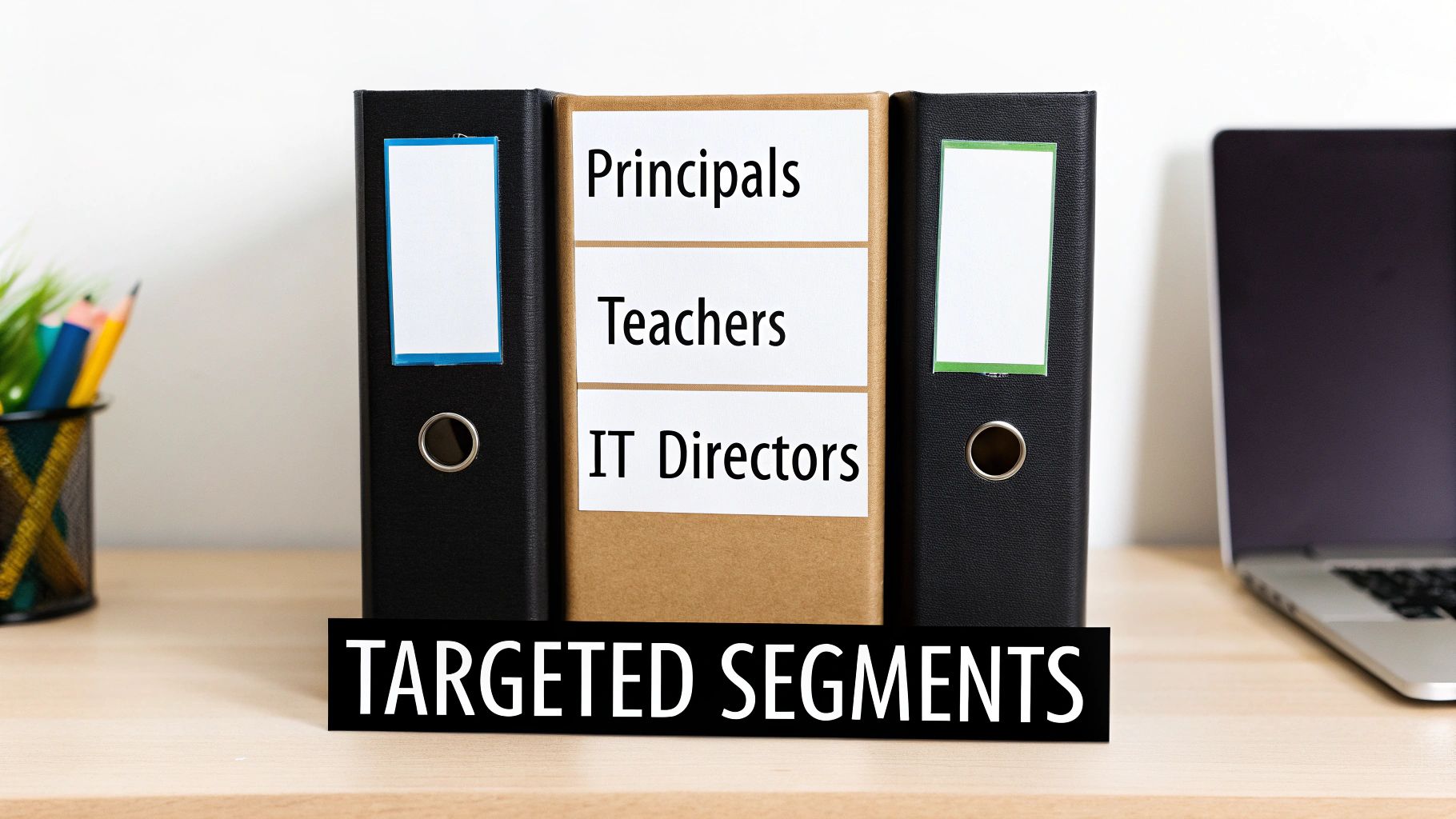
Imagine trying to fix everything with a single hammer. It might work for a nail, but it's the wrong tool for a screw or a bolt. Treating your entire school email list the same way is just as ineffective. Not every educator has the same problems or priorities, so a generic, one-size-fits-all message rarely works.
This is where segmentation comes in. It’s simply the process of breaking down your master list into smaller, more focused groups based on what they have in common. This lets you send messages that speak directly to a person's specific situation, which is the key to getting them to actually open, read, and respond to your email.
After all, sending a pitch for a high school physics platform to an elementary school art teacher is a waste of everyone's time. By segmenting your email lists for schools, you make sure your message always lands with someone who might actually care.
Start with Role-Based Segmentation
The easiest and most powerful place to begin is with a person’s job title. The day-to-day world of a District Superintendent couldn't be more different from that of a middle school science teacher. Grouping them separately allows you to craft emails that address their unique responsibilities and pain points.
Think about the different perspectives of these common roles:
- District Administrators: They’re thinking big picture—budgets, scalability, district-wide compliance, and measurable student outcomes.
- Principals: Their focus is on the school building itself. They worry about teacher support, school operations, parent communication, and how new programs will be implemented.
- Department Heads: These folks are in the weeds of their specific subject, focused on curriculum standards, finding great resources, and getting the right tools for their teams.
- Teachers: They live in the classroom. Their top priorities are student engagement, practical instructional tools, and anything that makes learning more effective and their job easier.
When your email’s value proposition is tailored to the recipient's role, it shows you've done your homework and understand their world. This simple adjustment is a cornerstone of any good education marketing strategy.
Go Deeper with Institutional and Geographic Filters
Once you have your roles sorted, you can add more layers of precision by filtering based on the school itself and where it's located. This helps you craft even more relevant messages that acknowledge the specific environment influencing their decisions.
For instance, a major list provider might offer access to over 3.9 million K-12 contacts that can be filtered by school type, student enrollment, budget size, and even the technology they currently use. These deep segmentation options open the door for incredibly precise outreach.
Segmentation isn't just about sending different emails; it's about starting different conversations. A personalized message that acknowledges a recipient's specific context is far more likely to be opened, read, and acted upon.
To help you get started, here is a breakdown of the most common and effective ways to segment a school email list.
Key Segmentation Criteria for School Email Lists
| Segmentation Criterion | Description | Best Use Case Example |
|---|---|---|
| Institution Type | Differentiating between public, private, charter, and parochial schools. | A company selling premium curriculum might target private schools, which often have more flexible budgets and different procurement cycles than public schools. |
| Grade Levels | Grouping contacts by the grades they serve, such as elementary (K-5), middle (6-8), or high school (9-12). | A vendor with a reading intervention tool for young learners would focus exclusively on elementary school teachers and literacy specialists. |
| Geographic Location | Filtering by state, region, or school district. | A textbook provider could run a campaign targeting Texas schools, referencing alignment with the state's specific TEKS curriculum standards. |
| School Size | Segmenting based on student enrollment numbers. | A SaaS company offering a district-wide communication platform would target large districts (20,000+ students) where scalability is a key selling point. |
| School Budget | Targeting schools based on their per-pupil spending or Title I funding status. | A grant-writing consultancy or a vendor with products eligible for federal funding could create a targeted campaign for Title I schools. |
By combining these criteria, you can create powerful, hyper-targeted audiences.
Imagine launching a campaign specifically for "Science Department Heads in California Public High Schools with over 1,500 students." That level of detail ensures every single email you send is as relevant as possible. This approach doesn't just improve your metrics; it helps you build real, meaningful connections with the right people in education.
Finding a Quality Email List Provider You Can Trust
Buying an email list isn't so different from buying a car. You can be wowed by a shiny paint job, but it's what's under the hood that really matters. A cheap list might look good on paper, but it often leads to a sputtering engine of high bounce rates, a damaged sender reputation, and a whole lot of wasted effort.
Picking the right provider is one of the most critical moves you'll make. The goal is to find a partner who delivers accurate, compliant, and current email lists for schools, giving you a rock-solid foundation for your outreach. This means looking past flashy promises of massive contact numbers and digging into the real quality of the data.
Look for Proof of Data Accuracy
Data accuracy is everything. It’s the single most important factor. If the data is wrong, your perfectly written emails will never land in the right inbox, dooming your campaigns from the start. People move around a lot in the education sector, so a list can get stale surprisingly fast.
A provider you can trust will be open about how they keep their data clean. Don't be shy—ask them some direct questions about their process:
- Verification Methods: How do they actually check that contacts are still active and at the right school? Do they use automated tools, have real people checking things, or a mix of both?
- Accuracy Guarantee: Top-tier providers, like our team here at Schooleads, stand by their data with a high accuracy rate (we guarantee 98%) and will offer credits for any contacts that bounce.
- Data Sources: Where is the information coming from? Reputable vendors use public records and official school directories, not shady scraping methods.
If a vendor gets cagey when you ask these questions, consider it a major red flag. They should be proud of the work they do to maintain quality data.
Confirm the Data Refresh Cadence
The K-12 world is always in motion. Teachers take jobs at new schools, principals retire, and districts create new positions every single year. An email list that was on the money six months ago could be full of dead ends today. That's why the provider's refresh cadence—how often they update their database—is so crucial.
A static list loses value every single day. Look for providers who perform regular, frequent updates, like weekly or monthly sweeps, to weed out old contacts and add new ones. This ensures you're always working with the freshest data possible.
This commitment to maintenance shows a deep understanding of the education market's fluid nature. It also protects you from pouring time and money into emails that are guaranteed to bounce. A provider who only bothers to update their list once or twice a year simply isn’t keeping up.
Prioritize Compliance and Ethical Sourcing
In email marketing, compliance isn't a "nice-to-have"—it's a must. Sending emails without the right permissions or to people covered by specific regulations can land you in serious legal hot water and tarnish your brand's reputation for good.
Make sure your provider is fully compliant with key regulations, including:
- The CAN-SPAM Act: This is the foundational US law for commercial email. It sets the rules of the road, gives recipients the right to opt out, and outlines stiff penalties for breaking the rules.
- GDPR/CCPA: If you plan to reach out to educators in Europe or California, your data must adhere to these strict privacy laws.
Ask any potential vendor to walk you through how they stay compliant. They should be able to clearly explain their data collection and management practices. A reliable partner lets you conduct outreach with confidence, knowing you're building relationships the right way—ethically and legally. Don’t gamble with your company's future by cutting corners here.
Putting Your School Email List into Action
Getting your hands on a high-quality, verified list is a huge first step, but it’s really only half the battle. Think of it like a finely tuned engine—it has all the potential in the world, but it won’t take you anywhere until you turn the key. Putting your list into action is all about moving from data collection to smart, strategic outreach that builds real relationships.
This is where your email lists for schools become part of your bigger marketing and sales strategy. The mission is to turn that spreadsheet of contacts into a powerful engine for growth. Whether you're launching a new product or trying to fill a webinar, the right game plan makes all the difference.
Define Your Campaign Objective
Before a single email goes out the door, you need to know exactly what you're trying to accomplish. What's the goal? A vague objective like "increase sales" just won't cut it. You need a focused, measurable target to guide every decision you make.
That one objective will shape everything—the audience you pick, the message you write, and the call-to-action you use.
Here are a few common goals for K-12 vendors:
- Generate qualified leads for your sales team by getting people to request a demo.
- Drive registrations for an upcoming professional development webinar aimed at high school science teachers.
- Announce a new product feature to your existing customers to get them using it.
- Promote a free trial of your software, maybe targeting IT directors in a specific state.
Each of these goals requires a completely different approach. Knowing precisely what you want to achieve is the first step toward actually making it happen.
Segment Your Audience for a Specific Goal
Okay, you’ve got your objective. Now you can dive back into your list and slice it up for maximum impact. Instead of blasting a generic message to everyone, you’re going to hand-pick a super-relevant group. This is where all that rich data in a quality list really shines.
Let’s walk through a quick example. Imagine you’re launching a new literacy assessment tool for early elementary grades.
- Identify the Core Audience: The people who care most are elementary school principals, curriculum coordinators, and literacy specialists.
- Apply Grade-Level Filters: Next, you’ll narrow the list down to contacts who work specifically with Pre-K through 3rd-grade students.
- Add Geographic or Budgetary Layers: Maybe you want to target districts in states with new literacy mandates or focus on schools with a reputation for having a healthy technology budget.
A highly targeted segment like this is way more likely to engage with your message because it speaks directly to their world and their problems.
The most successful campaigns don't just send emails; they start conversations with the right people at the right time. Hyper-segmentation ensures your outreach feels like a helpful suggestion, not unsolicited spam.
Craft Messaging That Connects with Educator Pain Points
Now that you know who you're talking to and what you want them to do, it's time to write the actual email. The secret is to make it about them, not you. Educators are incredibly busy and their inboxes are a war zone. Your message has to immediately answer their silent question: "What's in this for me and my students?"
To pull this off, lead with value and speak directly to their challenges.
- For Principals: You might frame your tool in terms of school-wide data tracking, teacher support, and how it aligns with district goals.
- For Literacy Specialists: It would be better to highlight features that simplify diagnostic assessments, save time on reporting, and give them clear insights for intervention groups.
Your call-to-action (CTA) needs to be just as clear and compelling. Ditch the generic "Click Here." Instead, use action-oriented language that promises a clear benefit, like "See How It Works in 60 Seconds" or "Download a Sample Report."
The good news is that educators are often receptive to relevant, valuable information. Industry data shows that education-related emails can hit an average open rate of around 21.92%, which is actually higher than many other sectors. This suggests a well-targeted message has a great shot at getting read. You can find more details about education email engagement rates. By connecting with their pain points and offering a genuine solution, you can turn a name on a list into a real conversation.
Crafting Emails That Educators Actually Open and Read
Let's be honest: an educator's inbox is a battlefield. It’s flooded with messages from parents, administrators, and countless vendors just like you. To have any chance of standing out, your email can't just be another sales pitch. It has to feel like a helping hand, not a hard sell.
The secret is to stop selling and start helping. Success comes when you craft messages that respect an educator’s incredibly limited time and offer something genuinely useful right away. Think compelling subject lines, content that's easy to scan, and a single, obvious next step.
When you approach it this way, you're not just blasting out marketing emails. You're starting a conversation. Using your email lists for schools to provide real help is how you begin to build partnerships that actually last.
Personalize Beyond the First Name
Anyone can use a [First_Name] mail merge. Real personalization goes deeper. It’s about showing you’ve done a bit of homework and understand the world of the person you’re emailing. This little bit of effort signals that your message isn't just spam.
Instead of a generic "Hope you're having a great week," try referencing something specific you noticed. It makes a world of difference.
For example:
- Acknowledge a recent achievement: "I saw Northwood High just earned a Blue Ribbon award—congratulations! Your focus on STEM is really impressive."
- Connect to a district goal: "I noticed your district is launching a new 1:1 device program. I thought this resource on teacher onboarding might be helpful."
- Speak to their specific role: "As the head of a high school science department, I can only imagine how tough it is to find engaging lab simulations for remote learners."
See the difference? That level of detail proves you see them as an individual, not just another contact on a list.
Write Subject Lines That Spark Curiosity
Your subject line is the gatekeeper. If it’s boring or spammy, the rest of your carefully crafted email is history. Educators are masters of the quick scan, so you have maybe three seconds to give them a reason to click.
The best subject lines are clear, short, and focused on a benefit. They skip the hype ("Amazing New Product!") and hint at a solution to a problem they actually have.
A great subject line makes a promise that the email body keeps. It should be specific enough to be interesting but brief enough to be read on a phone, where most people check their email first.
Here are a few formulas that work well:
- Question-Based: "A better way to track student reading progress?"
- Resource-Focused: "Free Guide: Engaging students in hybrid classrooms"
- Benefit-Driven: "Save 5+ hours/week on lesson planning"
Structure Your Email for Scannability
Let's get one thing straight: educators do not read emails. They scan them. A giant wall of text is an instant-delete. You have to use formatting to your advantage so your key points pop.
Break up your content and make it easy on the eyes.
- Keep paragraphs short—just one or two sentences.
- Use bulleted or numbered lists for benefits, features, or steps.
- Make key phrases bold to draw their attention.
Your goal is to let a busy principal or teacher grasp your main point in under 15 seconds. Design your email with a clear path that leads their eyes right to your call-to-action (CTA). A simple, low-commitment CTA like "Book a 15-Minute Demo" or "Download the Case Study" respects their time and tells them exactly what to do next.
To make this even clearer, here’s a quick rundown of what works and what doesn't when you're reaching out.
Do's and Don'ts of Emailing School Professionals
| Do | Don't |
|---|---|
| Personalize with specific school or district details. | Use generic [First_Name] and [School_Name] tags only. |
| Keep the entire email focused on a single idea. | Try to sell multiple products or ideas in one email. |
| Write a clear, benefit-driven subject line. | Use clickbait or overly salesy subject lines. |
| Use bullets, bolding, and short paragraphs. | Write long, dense paragraphs of text. |
| Offer a single, clear call-to-action (CTA). | Include multiple links and confusing next steps. |
| Provide immediate value, like a free resource. | Talk only about yourself and your company. |
Sticking to these simple rules will dramatically improve your chances of not only getting your emails opened but also getting a positive response.
How to Measure and Improve Your Campaign Success
Launching an email campaign without tracking its performance is like trying to navigate a new school district without a map. You might be moving, but you have no idea if you're actually getting anywhere. Measuring your results is the only way to turn your email lists for schools into a reliable growth engine.
By digging into a few key numbers, you can see what’s working, fix what isn’t, and make smarter decisions down the road. This isn’t about becoming a data scientist; it’s about paying attention to what your audience is telling you with their clicks.
Understanding Your Core Campaign Metrics
Before you can get better, you have to know where you stand. A handful of key performance indicators (KPIs) can give you a crystal-clear picture of how educators are reacting to your messages. Think of them as your campaign’s vital signs.
- Open Rate: The percentage of people who actually opened your email. This tells you flat-out if your subject line and sender name were strong enough to cut through the noise of a busy inbox.
- Click-Through Rate (CTR): This is the percentage of recipients who clicked on a link inside your email. Your CTR reveals whether your message and call-to-action were compelling enough to make someone act.
- Bounce Rate: The percentage of emails that failed to deliver. A high bounce rate is a red flag. It usually points to an old, low-quality list and can seriously hurt your sender reputation over time.
The real magic happens when you look at these numbers together. A high open rate but a low CTR, for example, is a classic sign of a great subject line that led to a disappointing email. You got their attention, but the content inside didn't deliver on the promise.
Your email data tells a story. A high unsubscribe rate might mean your content isn't relevant, while a low open rate could simply mean you're sending emails when teachers are busiest in the classroom. Listen to the data to refine your approach.
Turning Data into Actionable Improvements
Once you’ve got a handle on the numbers, you can start making targeted changes. The best way to do this is with A/B testing—a straightforward method where you compare two versions of an email to see which one performs better.
This cycle of testing and learning is at the heart of what's known as agile education marketing. It allows you to make small, data-backed tweaks that lead to big wins over time.
For instance, you could test:
- Subject Lines: Send one version with a question ("A new tool for your science class?") and another with a direct benefit ("Save 5 hours on lesson planning").
- Calls-to-Action (CTAs): Compare a button that says "Request a Demo" against one that says "See a 2-Minute Video."
- Email Content: Pit a short, text-based email against a more visual version with a different layout.
The email world is massive. By 2025, there will be an estimated 4.83 billion global email users, with daily traffic hitting around 392 billion messages. To stand out, constant improvement isn’t just a good idea—it’s essential. You can dig into more global email usage statistics on cloudhq.net.
By consistently measuring your results and testing new ideas, you can fine-tune your campaigns to connect more effectively with educators and hit your goals.
Frequently Asked Questions About School Email Lists
When you're trying to break into the K-12 market, a lot of questions pop up about school email lists. Should you build your own? How much should you pay? And how do you make sure your emails actually get read? Let's clear up some of the most common questions.
Is It Better to Build or Buy an Email List for Schools?
Building a list from scratch is the slow-and-steady route. The contacts you gather will be highly engaged because they opted in, but it can take months—or even years—to build a list that’s large enough to make an impact.
Buying a list, on the other hand, gives you an immediate launchpad. You can start connecting with a broad, segmented audience from day one. For most vendors trying to grow quickly, purchasing a high-quality list is the smartest way to start. You can always add to it with your own organic efforts, giving you the best of both worlds.
What Is a Realistic Price for a School Email List?
There’s no single answer here. The cost really depends on the size of the list, the quality of the data, and how granular you can get with your targeting. You might spend a few hundred dollars for a small list of local schools or thousands for a nationwide database packed with detailed info.
Think of a good list as an investment in your sales pipeline, not just another line item on an expense report. The real value isn't in the upfront cost but in the accuracy and potential return it brings.
Remember, a cheap list full of bad data will cost you far more in the long run. You'll waste time, hurt your sender reputation, and miss out on real opportunities.
How Can I Keep My Emails Out of Spam Folders?
Staying out of the spam folder isn't about one magic trick; it's about a series of smart moves that start with your contact data.
- Start with clean data: A verified list from a trusted provider is your first line of defense against high bounce rates.
- Authenticate your domain: Set up your SPF and DKIM records. This is like showing your ID to email services, proving you are who you say you are.
- Write smart subject lines: Avoid "spammy" words like "free" or "guarantee" and don't go overboard with exclamation points.
- Make unsubscribing easy: A clear unsubscribe link is required by law (think the CAN-SPAM Act), and it shows you respect your audience.
Ultimately, the best way to land in the inbox is to send content that people actually want to read. When educators open and engage with your emails, your sender reputation gets a natural boost, making you a trusted source in their eyes.
Ready to connect with the right decision-makers in K-12 education? Schooleads provides a 98% accurate, verified database of school and district contacts to build your pipeline faster. Find your ideal prospects today at https://schooleads.com.