A Guide to Ed Data Services for K-12 Vendors
Discover how ed data services can transform your K-12 sales strategy. Learn to choose the right partner, ensure data quality, and drive real growth.
Think of ed data services as a specialized GPS for navigating the complex K-12 market. These services take raw, often messy, school and district information and turn it into a clear, actionable roadmap for education companies. They give you the map, the real-time traffic updates, and the best routes to reach your destination.
What Are Ed Data Services and Why They Matter
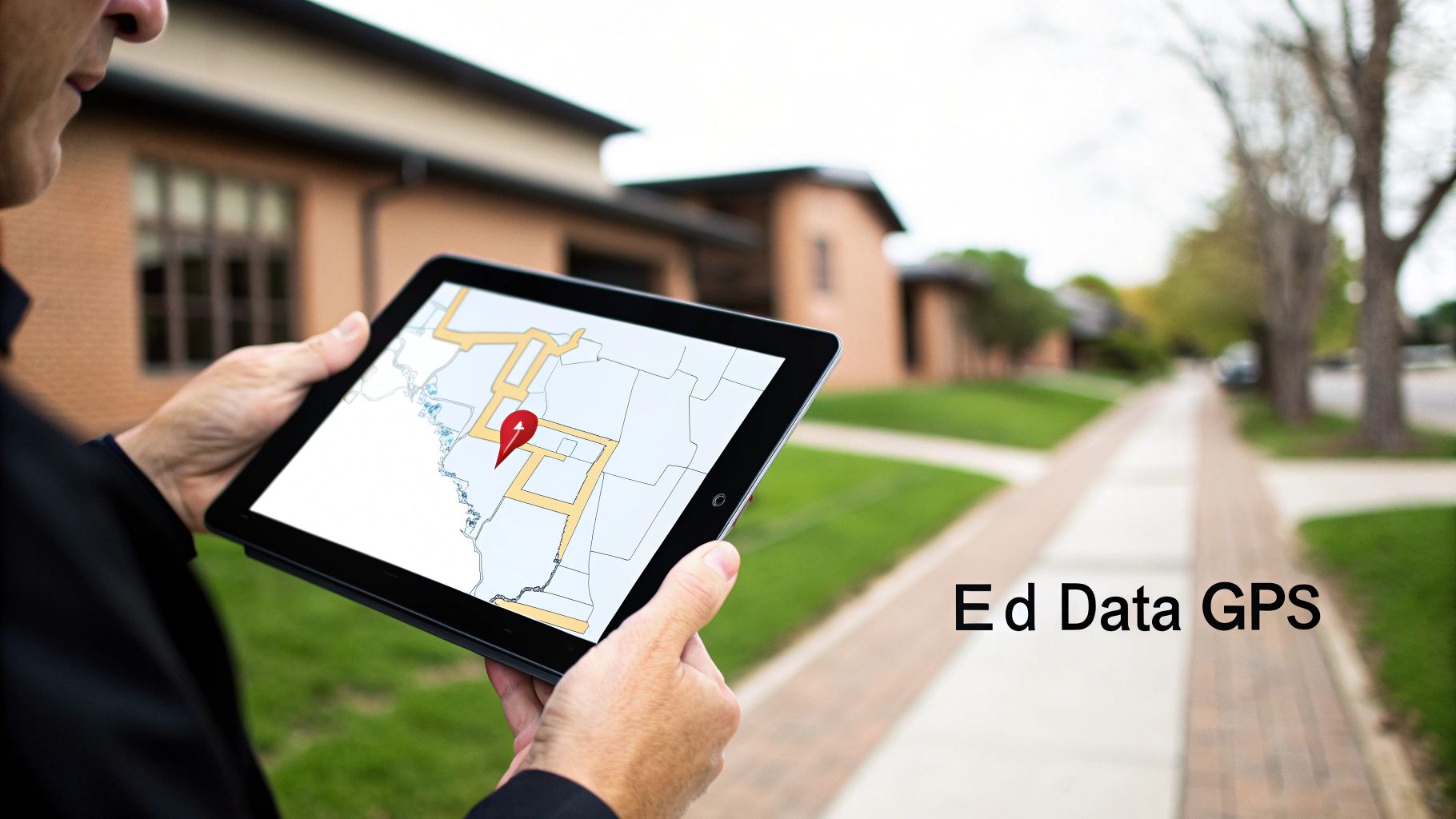
Imagine trying to drive across the country with nothing but an old paper map. You wouldn't know about road closures, new highways, or even which towns have gas stations. For K-12 vendors, working without ed data services feels a lot like that—a frustrating journey filled with guesswork and dead ends.
The K-12 education market is huge and in constant motion. Principals retire, curriculum directors move, and new schools pop up all the time. This churn creates some serious headaches for companies trying to connect with educators:
- Outdated Contacts: How much time is wasted sending emails that bounce or calling people who left the job months ago?
- Finding the Right Person: It's a real challenge to pinpoint the exact person—whether it's the district tech director or the high school science department head—who actually makes the purchasing decisions.
- Mapping the Territory: It’s tough to get a clear picture of how schools are structured within a district or which ones even fit your ideal customer profile.
Turning Chaos into Clarity
This is exactly where ed data services step in. They don't just hand you a list of names; they provide structured, verified, and constantly updated intelligence. It's like having a live navigation system that’s always giving you the most current information.
These services are the bridge between raw information and a winning strategy. They turn overwhelming streams of school data into a clear path that guides your sales and marketing teams straight to the right people at the right time.
For instance, instead of spending hours digging through clunky district websites, an ed data service gives you a clean, searchable database. You can instantly pull a list of every middle school principal in Texas or find all the curriculum coordinators in districts with over 10,000 students.
To make this even clearer, here’s a quick breakdown of what these services do and the impact they have.
Ed Data Services At a Glance
| Service Function | What It Provides | Business Impact |
|---|---|---|
| Contact Aggregation | Verified names, titles, emails, and phone numbers for K-12 staff. | Drastically reduces bounce rates and wasted outreach efforts. |
| Data Verification | Continuous updates to reflect job changes, new hires, and retirements. | Ensures sales and marketing teams are always working with accurate info. |
| Market Segmentation | Tools to filter schools by size, demographics, funding, and location. | Enables highly targeted campaigns that resonate with specific audiences. |
| Organizational Mapping | Clear hierarchies showing how schools connect to districts and who reports to whom. | Helps identify key decision-makers and influencers within an organization. |
Ultimately, this all translates into smarter, more efficient business operations.
Fueling a Growing Market
The demand for these precise tools is only getting bigger as the education market expands. The global educational services sector is projected to grow from $3.49 trillion in 2024 to $4.92 trillion by 2029. You can find more details about this market growth on ResearchAndMarkets.com, but the takeaway is clear: opportunity and competition are both on the rise.
In the end, ed data services solve the fundamental problem of connection. They help vendors cut through the noise, skip the manual grunt work, and build a reliable sales pipeline. By providing a clear map of the K-12 world, these services let you focus on what you do best: building relationships and supporting educators.
What Kinds of Ed Data Services Are Out There?
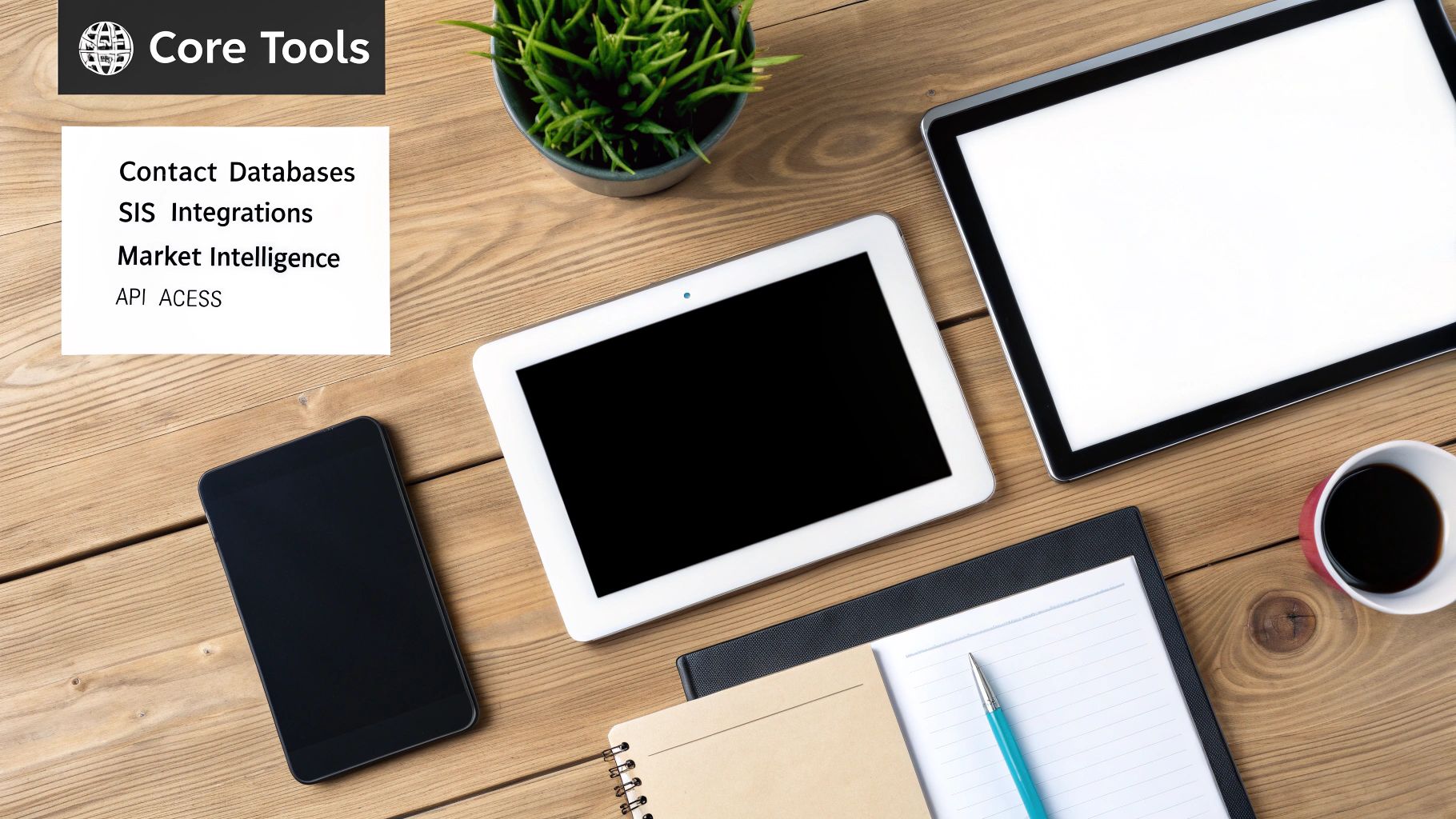
Not all education data services are the same. It helps to think of them like tools in a toolbox—each one is built for a specific job. Understanding the main types helps you pick the right one for what you're trying to achieve, so you don't show up with a hammer when you really need a screwdriver.
Each service solves a different problem for companies selling into the K-12 space. Whether you're just trying to find the right person to call or you need to understand the entire market landscape, there’s a tool for that. Let’s break them down.
Contact and Personnel Databases
Think of a contact database as a smart, self-updating address book for the entire education world. Its main job is to give you accurate, verified contact info for everyone from principals and superintendents to curriculum directors and IT managers.
This is the ground floor for any solid outreach strategy. After all, the most brilliant marketing message is useless if it never reaches the right person.
A great contact database is much more than a static list; it's a living system. With staff turnover in some school roles hitting 30% or more each year, a list you buy today could be stale in a few months. A professional service makes sure your team isn't wasting precious time on bounced emails and dead-end calls.
Let's say you sell a new math curriculum. With a good database, you can instantly pull a list of every single middle school math department head in Texas. That kind of laser-focused targeting is the first step toward a real sales conversation. If this is your goal, our guide on building effective email lists for schools has some great tips to get you started.
Market Intelligence and Analytics Platforms
While a contact database tells you who to call, market intelligence tells you why, when, and where to focus your efforts. This type of ed data service is like having your own team of expert analysts, giving you a 30,000-foot view of the K-12 market. It turns messy, raw data into clear, strategic insights.
These platforms help you spot emerging trends, pinpoint new opportunities, and get a handle on the competitive environment. They answer the big-picture business questions that simple contact details can't.
Here’s what you can typically find:
- School & District Demographics: Hard numbers on student enrollment, socioeconomic stats, and academic performance.
- Budget and Funding Analysis: A look into where the money is coming from—federal, state, and local—so you can find districts with budgets to spend.
- Technology Adoption Data: Intel on what software, hardware, and digital tools schools are already using.
Imagine you're an EdTech company. You could use this intelligence to find districts that just got a big technology grant but have low adoption of a rival's product. Boom—you’ve just found a prime market opportunity.
SIS and Assessment Integrations
Student Information Systems (or SIS) are the digital nerve center of a school, handling everything from attendance and grades to student records. Integration services are the secure data bridges that let your software "talk" directly to a school’s SIS or assessment tools.
This is a more technical service, but it’s absolutely critical for any product that needs to fit neatly into a school’s existing tech ecosystem. It’s all about playing well with others.
For a company selling a learning management system (LMS), this isn't just a nice-to-have; it's a dealbreaker. Proper integration means your platform can automatically sync class rosters, grades, and attendance, saving teachers and admins from mind-numbing hours of manual data entry.
API Access for Custom Solutions
Finally, think of API access as a universal adapter for your data needs. An Application Programming Interface (API) lets your own internal systems connect directly to the provider's data firehose, pulling in real-time information to use however you see fit.
This is the most flexible and powerful route, usually taken by larger companies with specific data workflows. Instead of logging into the provider’s platform, you pipe their raw data directly into your own tools—like a custom-built CRM or a proprietary sales dashboard. This gives you total control over how the education data looks and works for your teams, creating a truly tailored setup.
How K-12 Vendors Drive Growth with Ed Data
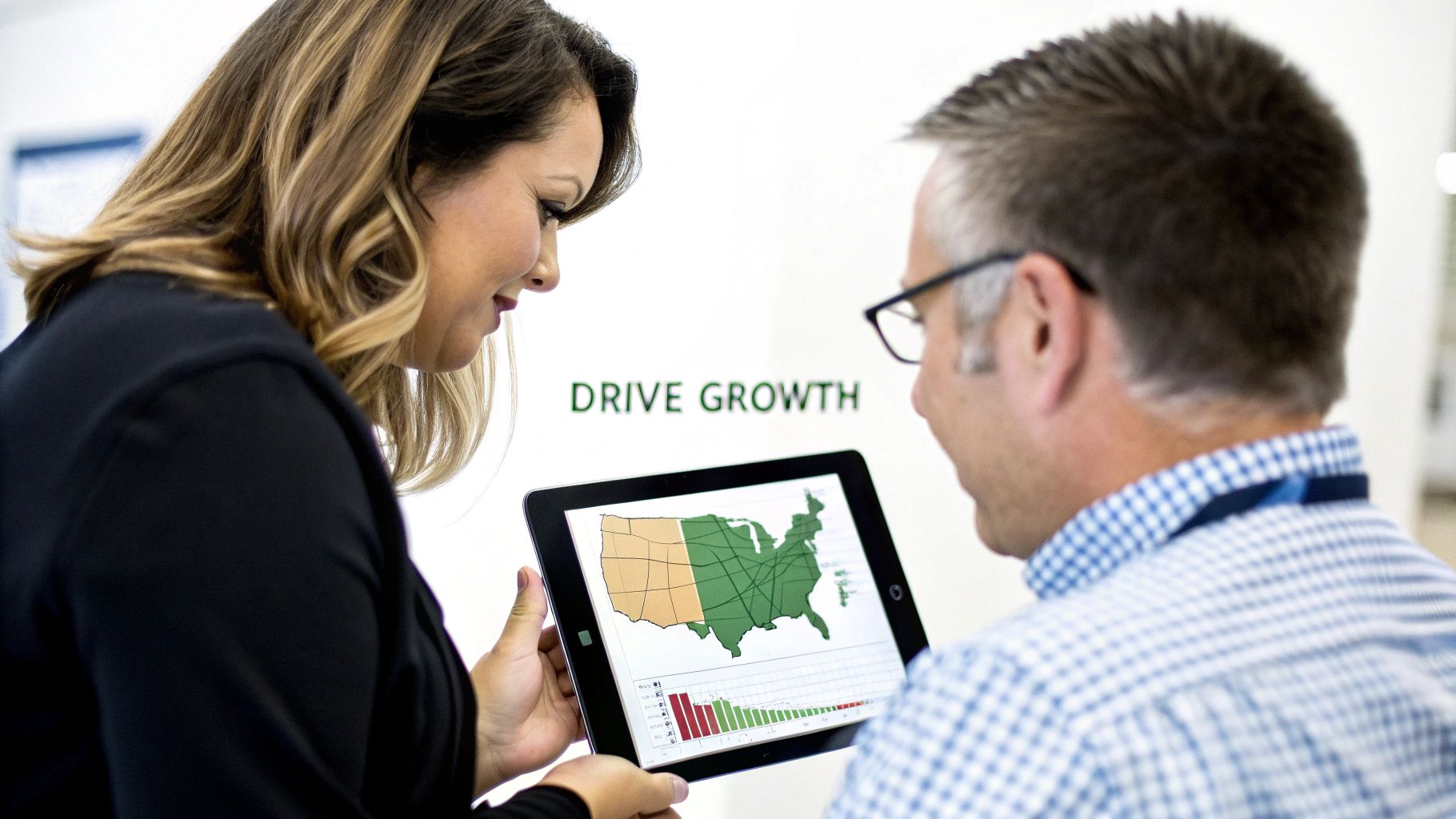
It’s one thing to know what ed data services are, but it’s another to see them in action. For K-12 vendors, this data isn't just a spreadsheet full of information—it’s the engine for smarter, faster, and more effective growth.
When you move past guesswork, you can stop throwing spaghetti at the wall and start running precision-guided campaigns. Let's look at a couple of real-world scenarios where these services become the key to unlocking new business.
Identifying Underserved Markets with Intelligence
Imagine an edtech startup with a fantastic new reading tool for elementary schools. The market is packed with big players, and they need to find their opening. Instead of just targeting the largest, most obvious districts, they dig into a market intelligence platform.
The Problem: As a smaller company, they can't afford to go head-to-head with established giants in major cities. They need to find schools that desperately need their solution but are flying under the radar.
The Solution: Using an ed data service, they filter for very specific criteria:
- Districts with elementary schools showing below-average reading proficiency.
- Schools that recently received Title I funds earmarked for literacy programs.
- Regions where their main competitors have a weak presence.
Almost immediately, their search uncovers a cluster of rural districts in the Midwest that are a perfect fit. The data confirms not just the need and the funding, but also that these schools are actively looking for new ideas.
The Result: The startup aims all its marketing efforts at this specific, underserved niche. Their message hits home because it speaks directly to a known problem, leading to a 35% jump in qualified demo requests from that region and a much shorter sales cycle.
Pinpointing Key Decision-Makers for New Products
Now, think about a well-known publisher launching a new science curriculum for high school STEM academies. Their success hinges on getting it in front of the right people—the district curriculum directors and science department heads who actually have the authority to buy.
In the complex world of a school district, just finding the actual decision-maker can be the biggest challenge. A good contact database cuts right through the noise, making sure your message lands in the inbox of someone who can actually say "yes."
The Problem: The publisher’s old contact list is bloated and out of date. Their sales reps are wasting weeks navigating district phone trees and gatekeepers, only to discover the person they needed switched roles six months ago.
The Solution: The publisher taps into a premium contact database to build a laser-focused outreach list. They filter for titles like "Science Curriculum Coordinator" and "Head of Science Department" specifically in districts known for their STEM programs. The service provides verified emails and direct phone numbers, letting them bypass the usual runaround.
The Result: With this clean data, the sales team books meetings with key evaluators in their top 50 target districts within the first month. This direct line of communication speeds up the whole review process, contributing to a 20% faster adoption rate than their last product launch. This is what happens when a smart education marketing strategy is powered by precise data.
This strategic approach is crucial in such a massive market. The U.S. educational services market is expected to hit roughly $2.7 trillion in 2025, growing at a compound annual rate of 4.6% since 2020. The vendors who use data to navigate this landscape are the ones who will capture that growth.
These stories all point to one simple truth: ed data services aren't just another expense. They're an investment in efficiency, focus, and real growth, helping vendors work smarter and make a bigger impact in schools.
Navigating Data Quality and Compliance
When you invest in education data services, you’re buying more than just a list of contacts. You're buying confidence—confidence that the information is accurate and that using it won't create legal headaches down the road. For any vendor working in the K-12 space, these two things, data quality and legal compliance, are absolutely essential.
Let’s be honest: bad data is a huge waste of time and money. It's the reason for bounced emails, dead-end phone calls, and marketing campaigns that miss their mark entirely. On the flip side, high-quality data is the engine that drives effective outreach. Think of it as a tune-up for your sales process; it just makes everything run smoother.
At the same time, wading through the alphabet soup of privacy laws can feel daunting. But getting a handle on the basics is critical for protecting your business and building real trust with schools. Here, we’ll break down both of these areas so you can find a partner who takes accuracy and responsibility as seriously as you do.
The Foundation of Good Data Verification
Data quality isn’t a one-and-done deal. It’s a constant effort. The education world is always changing—staff turnover can top 30% a year for some positions—so a list that was accurate yesterday might be full of holes today. That’s why a top-tier data provider has to be obsessed with verification.
Their methods usually boil down to two key approaches:
- Automated Verification: This is the tech-driven side of things. Smart systems constantly scan for changes, flagging bounced emails, checking school websites for new staff lists, and identifying data that just doesn’t look right anymore. It’s the first line of defense against old, stale information.
- Human Verification: This is where the real magic happens. Real people—research teams—get involved to manually confirm details, double-check job titles by reaching out directly, and catch the subtle errors that automated systems miss. This human element is often what separates pretty good data from truly great data.
A provider’s commitment to a multi-layered verification process tells you everything you need to know about their data’s reliability. It’s the difference between a good guess and a confirmed fact, giving your outreach a solid foundation to build on.
Ultimately, you want to partner with providers who are open about how they verify their data and are willing to stand behind it with a guaranteed accuracy rate—look for 95% or higher. It shows they have real confidence in their product and gives you peace of mind.
Understanding Key Privacy Laws
Working in education means you have a responsibility to handle information with care. You don’t need a law degree, but you absolutely need to understand the big-picture principles of the major privacy regulations. A good data partner won't just follow these rules themselves; they'll help you stay compliant, too.
The main point of these laws is to protect student data and make sure personal information is used ethically. For vendors, this boils down to being thoughtful about how you get, keep, and use the contact information of school staff.
Here’s a quick primer on the regulations you’ll encounter most often when using education data services.
Key Privacy Regulations for Ed Data
A great data provider stays on top of these regulations so you don't have to. Here's a simplified look at the big three:
| Regulation | Geographic Scope | Core Principle for Vendors |
|---|---|---|
| FERPA | United States | Protects the privacy of student education records. Vendors must ensure any data they handle does not expose sensitive student information. |
| GDPR | European Union | Governs data protection and privacy for all individual citizens of the EU. It sets strict rules for data processing and user consent. |
| CCPA | California, USA | Gives consumers more control over the personal information that businesses collect about them. It includes rights to know, delete, and opt-out. |
Choosing a provider that lives and breathes this stuff is non-negotiable. It protects your business from major legal and financial risks, but just as importantly, it helps you earn the trust of the schools you want to work with. School districts are extremely careful about their partners' data practices, and showing you’re committed to privacy is a huge step in building a strong relationship. A solid partner handles the compliance burden for you, freeing you up to focus on what you do best.
A Checklist for Choosing Your Ed Data Partner

Picking a partner for your ed data services is a big deal. It’s a decision that will ripple through your sales and marketing efforts for years to come. You’re not just buying a list of names; you’re investing in a tool that should become a core part of your growth engine. With so many vendors out there, it’s easy to feel lost.
The key is to approach it systematically. Think of it like hiring a key team member. You wouldn't just glance at a resume; you’d dig in with a thorough interview to really understand their skills, their reliability, and whether they'll actually fit your company culture. This checklist is your interview guide, built around the essential questions you need to ask any potential provider.
Data Accuracy and Freshness
At the end of the day, everything hinges on the quality of the data. Bad, outdated information leads to bounced emails, wasted calls, frustrated teams, and deals that never happen. You need to get under the hood and see how a provider keeps their database clean.
- What is your guaranteed data accuracy rate? Look for a straight answer. A provider who can confidently stand behind a specific number, ideally 95% or higher, shows they're serious about quality.
- How often is the data updated and verified? The K-12 world changes constantly. People move, roles shift, and new schools open. A database updated weekly or daily is lightyears ahead of one that only gets a refresh every quarter.
- What is your verification process? Ask them to walk you through it. The best in the business use a hybrid model—combining automated technology with a real human research team to catch the subtle changes that software alone would miss.
Platform Usability and Integration
Even the most accurate data in the world is useless if your team can't get to it and put it to work. The platform itself should feel like an extension of your workflow, not another hurdle to jump over. If it's clunky and confusing, your team will simply stop using it.
A great platform should feel intuitive, turning complex data searches into a simple, straightforward task. If it requires extensive training just to perform a basic function, it will create a bottleneck instead of accelerating your outreach.
Beyond usability, the service has to play nice with the tools you already use. Seamless integration isn't a "nice-to-have"; it's a must for keeping your operations efficient and your data consistent.
- Can we get a live demo or a free trial? Don't just take their word for it. There’s no substitute for getting your hands dirty and letting your team test drive the platform’s search filters, export functions, and overall feel.
- Does your service integrate with our CRM? Make sure they offer solid, pre-built integrations for major platforms like Salesforce or HubSpot. This is what saves you from the nightmare of manual data entry and ensures everyone is working from the same playbook.
Support and Partnership
When you hit a snag or have a question, you need to know someone has your back. A provider's approach to customer support tells you everything you need to know about how much they actually value their clients. You’re looking for a genuine partner, not just another vendor.
A solid support system ensures you squeeze every drop of value out of your investment. With the global digital education market projected to more than double from $404 billion in 2025 to $850 billion by 2030, a responsive partner can be the key to claiming your piece of that pie. You can explore more about this expanding market's potential to see just how critical the right tools are becoming.
- What does your customer support model look like? Find out if you'll have a dedicated account manager you can call directly or if you’ll be tossed into a generic help desk queue.
- What are your typical response times for support requests? You need a partner who moves at the speed of your business, not one that leaves you waiting for days.
- Can you provide case studies or references from similar companies? Talking to current customers is the single best way to get an honest, unvarnished look at what it’s really like to work with them.
Common Questions About Ed Data Services
Even after you get the big picture of what ed data services are, the practical questions always start to bubble up. For K-12 vendors, these usually revolve around real-world concerns like how fresh the data is, whether it will complicate their workflow, and what the actual business impact will be. Getting straight answers is the only way to feel confident about your investment.
This section tackles the most common questions we hear from vendors weighing their options. We’ll give you direct, no-nonsense answers to help you navigate the final steps of your decision-making process.
How Often Is the Data Updated?
This is probably the most important question you can ask. The K-12 world is in constant motion, and a database that’s only updated quarterly or annually is stale the moment you get it. The best providers treat data as a living thing, not a static list.
Top-tier services are updating their information constantly. This isn't a once-in-a-while task; it's an always-on process blending smart technology with real human oversight. Automated systems are always scanning for changes, while dedicated verification teams follow up to confirm new hires, personnel moves, and shifting job titles.
Think of it this way: a quality service isn't just selling you a list; they're providing a live feed of the education market. This continuous flow of verified information is what separates a reliable tool from a frustrating waste of time.
When you're talking to a provider, really press them on their process. A multi-layered approach that uses automated sweeps and manual confirmation is the gold standard. That’s how you get to a reliable accuracy rate of 95% or higher.
Can I Integrate These Services with My CRM?
Yes, and you absolutely should. This is a non-negotiable. The whole point of using ed data services is to make your team’s life easier, not to add another clunky step to their day. The leading providers design their platforms to plug right into the sales and marketing tools you already use.
Most offer seamless, pre-built integrations with major CRMs like Salesforce, HubSpot, and Zoho. This is crucial. It lets your team access fresh, accurate school data right inside the software they use every single day. That connection gets rid of tedious copy-pasting, slashes the risk of human error, and makes sure everyone is working from the same true source of information.
Before you commit, you have to confirm they have a solid, reliable integration for your specific CRM. If a pre-built connector isn't on the menu, ask if they offer a flexible API that your tech team can use to build a custom bridge. Without that link, you're just creating data silos and missing out on the biggest efficiency gains.
What Is the Typical ROI for Using Ed Data Services?
While the exact return on investment (ROI) depends on your business and how you use the data, vendors almost always see a payoff in three key areas:
- Massive Efficiency Gains: Your sales team stops wasting hours on grunt work like prospecting and data cleanup. That frees them up to focus on what actually moves the needle: building relationships and having smart conversations. Naturally, sales cycles get shorter.
- Smarter Targeting: Marketing campaigns become incredibly effective when they're hitting the right people with the right message. This kind of precision leads directly to better leads and a much healthier pipeline.
- Higher Conversion Rates: When your outreach is built on accurate data and aimed at actual decision-makers, conversion rates climb. You’re no longer burning time and money on contacts who can't sign a check.
Many companies track their ROI by measuring the drop in time spent on research, the rise in qualified meetings booked, and the overall growth in their sales pipeline. Any good provider should be able to share case studies or examples of how K-12 vendors like you have seen a strong, positive return.
Is It Better to Build an In-House List or Use a Service?
Trying to build your own contact list might look like a way to save money at first, but it comes with huge hidden costs that most people underestimate. The single biggest problem? Maintenance. School staff change jobs at a dizzying pace—some roles see an annual turnover rate of over 30%.
That means your internal list is out of date almost as soon as you finish it. Keeping it accurate requires a massive, ongoing investment of someone’s time to make calls, do research, and verify every detail. It’s a full-time job that pulls your people away from what they should be doing.
In contrast, specialized ed data services are built to handle this churn at scale. They have the technology and the large research teams to do one thing exceptionally well: keep K-12 data fresh and accurate. For the vast majority of vendors, it's far more efficient and cost-effective to partner with a professional service. It lets your team focus on selling and marketing, not on becoming data management experts.
Ready to stop guessing and start connecting with the right people in K-12 education? Schooleads provides a premium, verified database of school and district contacts, backed by a 98% accuracy guarantee. Filter by role, budget, school type, and more to build your perfect prospect list in minutes.
Discover how Schooleads can build your sales pipeline today.