Dual Credit Classes A Guide to Earning College Credit Sooner
Discover how dual credit classes can save you time and money. Our guide explains the benefits, risks, and how to enroll to fast-track your college degree.
Dual credit classes are a fantastic "two-for-one" deal for your education. They let you earn both high school and college credit at the same time from a single course. It's a smart way for motivated students to get a real head start on their college career, saving a ton of time and money in the process.
What Are Dual Credit Classes and How Do They Work?

At its heart, a dual credit program is a partnership between a high school and a college or university. This collaboration allows high school students to take actual college-level courses that count toward their high school graduation while also building up an official college transcript.
Here’s a simple way to think about it: imagine you need to take English IV to graduate. Instead of taking the standard high school class, you could enroll in a college-level Composition 101 course. You'd still satisfy your high school English requirement, but you'd also walk away with three college credits before you even set foot on a college campus as a freshman.
The Rise of Early College Credit
This way of learning has absolutely exploded in popularity. Participation in dual credit programs across the U.S. has skyrocketed over the last two decades, jumping from around 300,000 students in the early 2000s to nearly 2.5 million in the 2022–23 school year. That's a staggering increase of over 700%.
Community colleges are the backbone of this movement, enrolling about 1.78 million of these students. If you're curious, you can explore more data on dual enrollment trends to see just how massive this shift has been.
This boom isn't surprising when you look at the clear benefits. These programs give students a genuine taste of college academics, helping them build essential skills like time management and critical thinking while they're still in the supportive environment of their high school.
The goal is simple: to provide a bridge between high school and higher education. These programs are designed to ease the academic transition, reduce college costs, and accelerate a student's path to a degree.
Key Terminology You Should Know
The language around early college credit can get a little confusing because you'll hear a few different terms thrown around. "Dual credit" and "dual enrollment" are often used to mean the same thing, but there can be subtle differences depending on your state or district.
- Dual Credit: This is the most specific term. It means one class earns you credit at both your high school and a college. It's the classic "two-for-one" deal.
- Dual Enrollment: This is a broader term. It simply means a high school student is enrolled in a college course. Most of the time it also provides dual credit, but not always.
- Concurrent Enrollment: This is another common synonym you'll hear. It just describes students being enrolled in high school and college courses at the same time.
In the end, all these terms describe programs that let you get a jump on college. The most important thing you can do is talk to your school counselor to understand exactly how the credits will count toward both your high school diploma and your future college degree. Getting that clarity is the first step to making the most of these amazing opportunities.
The Benefits of Earning College Credit Early

Taking dual credit classes is more than just getting a head start—it’s a strategic move that pays off in big ways. Think of it as an investment in your future that yields returns in time, money, and confidence. These programs offer a powerful combination of benefits that pave a smoother, more affordable path to a college degree.
For most students and their families, the first thing they notice is the impact on their wallet. Every credit earned in high school is one less they have to pay for at a university's steep tuition rate. The difference can be staggering.
Substantial Financial Advantages
The math behind dual credit is compelling. High schools often partner with local colleges to offer these courses for free or at a huge discount. That means you can rack up a semester's worth of college credits—or more—for a tiny fraction of what they would cost down the road.
This isn't just about saving on a few classes. It creates a domino effect. Knocking out enough credits might mean graduating a semester or even a full year early. That’s thousands of dollars saved on tuition, room, and board. Less time in school also means less student loan debt, which is a massive advantage when starting a career.
By completing general education requirements early, students not only save money on tuition but also gain the flexibility to pursue a double major, study abroad, or take on valuable internships without delaying their graduation date.
Gaining a Real Academic Edge
Beyond the bottom line, dual credit gives you a serious academic leg up. It’s one thing to be told college classes are harder; it's another to actually experience one with the familiar support of your high school teachers and counselors still around. It pulls back the curtain on what college is really like.
Students who’ve taken dual credit courses know what to expect from a college syllabus, the reading load, and the level of critical thinking required. This hands-on experience pays off. Research consistently shows that dual credit students tend to earn higher GPAs their freshman year and are more likely to stick with it and graduate.
- Smoother Transition: You'll walk onto campus on day one already understanding the rhythm and expectations of college coursework, avoiding the shock many first-year students feel.
- Improved Study Habits: The challenge pushes you to build the kind of time management and study skills that are absolutely essential for surviving and thriving in college.
- Strengthened College Applications: Admissions officers see dual credit on a transcript and know you’re a motivated student who is ready for the next level.
Fostering Personal Growth and Confidence
Finally, don't underestimate the personal growth that comes from tackling and succeeding in these courses. They demand a higher level of responsibility. You're treated more like a college student, and that means you have to own your learning and manage your time effectively.
Successfully navigating that challenge is a huge confidence booster. You prove to yourself that you can handle college-level work, which makes the actual transition to a college campus feel much less daunting. This early dose of independence prepares you for everything college throws your way—learning to talk to professors, advocate for yourself, and juggle a heavier workload are skills for life, not just for school.
Looking at the Risks and Challenges Head-On
Dual credit classes offer a fantastic head start, but it's crucial to go in with your eyes wide open. Think of it less like a risk-free bonus and more like an investment—if you manage it well, the payoff is huge, but if you're not careful, you could face some real setbacks. Knowing the potential pitfalls ahead of time isn't about scaring you off; it's about preparing you to succeed.
The biggest thing to wrap your head around is that your grade in a dual credit class is permanently recorded on your official college transcript. This isn't a practice round. It's the real thing.
That single fact changes everything. A poor grade won't just vanish when you get your high school diploma. It follows you, potentially dragging down your future college GPA and affecting your eligibility for academic honors or even competitive graduate schools years from now. You're creating a permanent record before you've even officially started college.
The Credit Transfer Maze
Another common headache is making sure the credits you worked so hard for will actually count where you want them to. Credit transferability isn't a given, especially when you're looking at schools outside your local system.
It’s a scenario I’ve seen play out too many times: a student aces a year's worth of dual credit courses, only to discover their dream school out-of-state won't take them. While public universities within the same state often have clear articulation agreements, private and out-of-state colleges play by their own rules.
To avoid that gut-wrenching discovery, you have to be your own advocate. Before you sign up for any dual credit classes, you need to do some legwork:
- Call the Admissions Office: Get in touch with the colleges on your radar. Don't just ask if they accept dual credit; ask for their specific transfer policies in writing.
- Use State Transfer Guides: Most states have online resources, sometimes called transfer portals, that show exactly how credits move between their public institutions.
- Confirm How it Transfers: It's not just about getting the credit, but what it counts for. Will your "Intro to Psychology" class fulfill a core requirement, or will it just be a generic elective? The difference matters.
The bottom line is this: Never assume credits will transfer. Always get confirmation directly from the colleges you’re serious about.
Juggling College-Level Rigor and Avoiding Burnout
Let’s be clear: dual credit courses are real college classes. The academic expectations are set by college professors, not high school teachers. The jump in difficulty can be a shock, especially for students who are used to coasting.
You're going to face longer reading assignments, more demanding research papers, and grading that feels a lot tougher than you’re used to. When you pile that on top of your regular high school classes, sports, clubs, and a social life, it can be a recipe for burnout.
Success here is all about balance and knowing your limits. It's often smart to start with just one dual credit course to test the waters. This gives you a chance to figure out new study habits and time management strategies without feeling like you're drowning. It's far better to earn an A in one challenging class than to struggle to pass three. And remember, asking for help from a counselor or teacher isn't a sign of weakness—it's a sign you're serious about your future.
Navigating Enrollment and Finding the Right Program
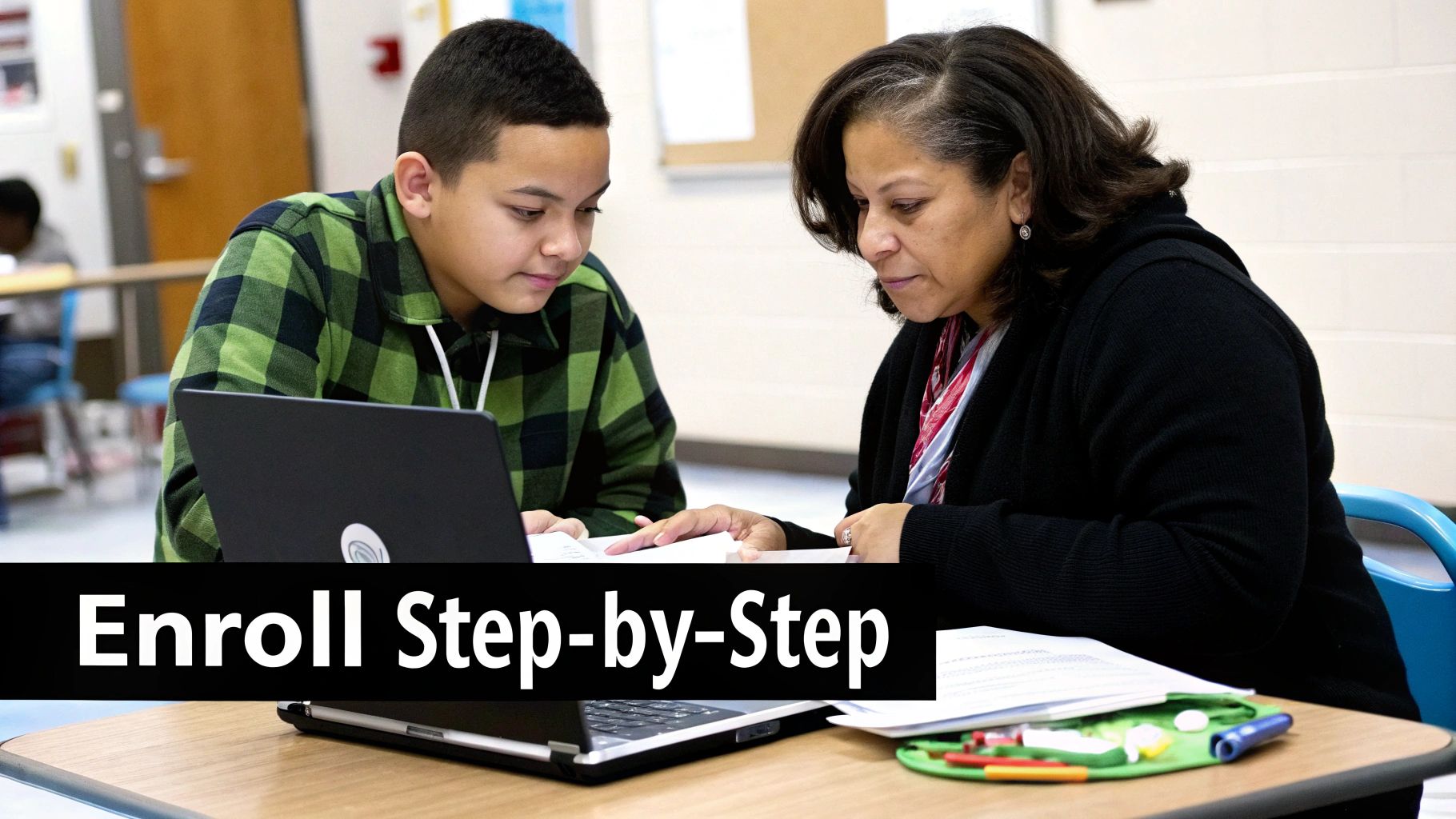
Jumping into dual credit classes might seem complicated, but the process is usually more straightforward than you'd expect. Your journey starts right inside your own high school. The first step is figuring out who your go-to person is for the program's specific rules and requirements.
Nine times out of ten, that person is your high school counselor. They are your best resource for everything dual credit—from which colleges your school works with to the exact application deadlines you can't afford to miss. Set up a meeting with them to get the ball rolling.
Your First Steps and Key Questions
When you sit down with your counselor, it pays to be prepared. This first chat is all about gathering the intel you need to make smart decisions, so a little planning will help you get the most out of the experience.
Your main goal is to get a clear map of the opportunities available to you. To do that, be sure to ask about these key things:
- Available Courses: What specific dual credit classes can I actually take? Do they cover core subjects like English and math, or are there interesting electives too?
- College Partners: Which colleges or universities does our school team up with for these courses?
- Application Deadlines: What are the drop-dead dates for applying? Missing a deadline can mean waiting a whole semester, or even a year, to get started.
It's crucial to treat this process like you're applying for a real college course—because that's exactly what it is. Paying close attention to deadlines and paperwork right from the start sets you up for success.
Meeting the Eligibility Requirements
Not every student can jump straight into a dual credit class. Colleges and high schools have academic standards in place to make sure students are truly ready for the challenge of college-level work. Think of these prerequisites as a way to help you succeed, not hold you back.
While the specifics change from one program to another, most look at a few common factors. You should be ready to talk about these with your counselor:
- Minimum GPA: Many programs require students to have a certain GPA, often a 3.0 or higher, just to show they can handle their current high school courses.
- Standardized Test Scores: Some programs will look at your scores on the SAT, ACT, or a college placement test to confirm you're ready for college-level reading, writing, and math.
- Grade Level: Dual credit is typically an option for juniors and seniors, though some schools might open it up to exceptional sophomores.
Knowing these requirements upfront helps you figure out if you qualify right now or what you might need to work on to get there.
Choosing Courses with a Purpose
Once you've confirmed you're eligible, the fun part begins: choosing your classes. It can be tempting to just pick whatever sounds easiest, but a little strategy here will pay off big time down the road. Try to think about what you might want to major in or what career fields interest you.
Choosing dual credit classes that line up with those goals is a game-changer.
For example, if you think you want to study business, taking a dual credit Microeconomics course is a much smarter move than signing up for a random elective. Earning relevant credits can let you skip introductory classes in college, which saves you both time and money. It also lets you jump into your major-specific courses that much sooner. If you're still figuring things out, you might want to use a school search to explore different programs and career paths. This kind of planning makes sure all your hard work is pushing you toward your future goals.
How Program Models and Locations Differ
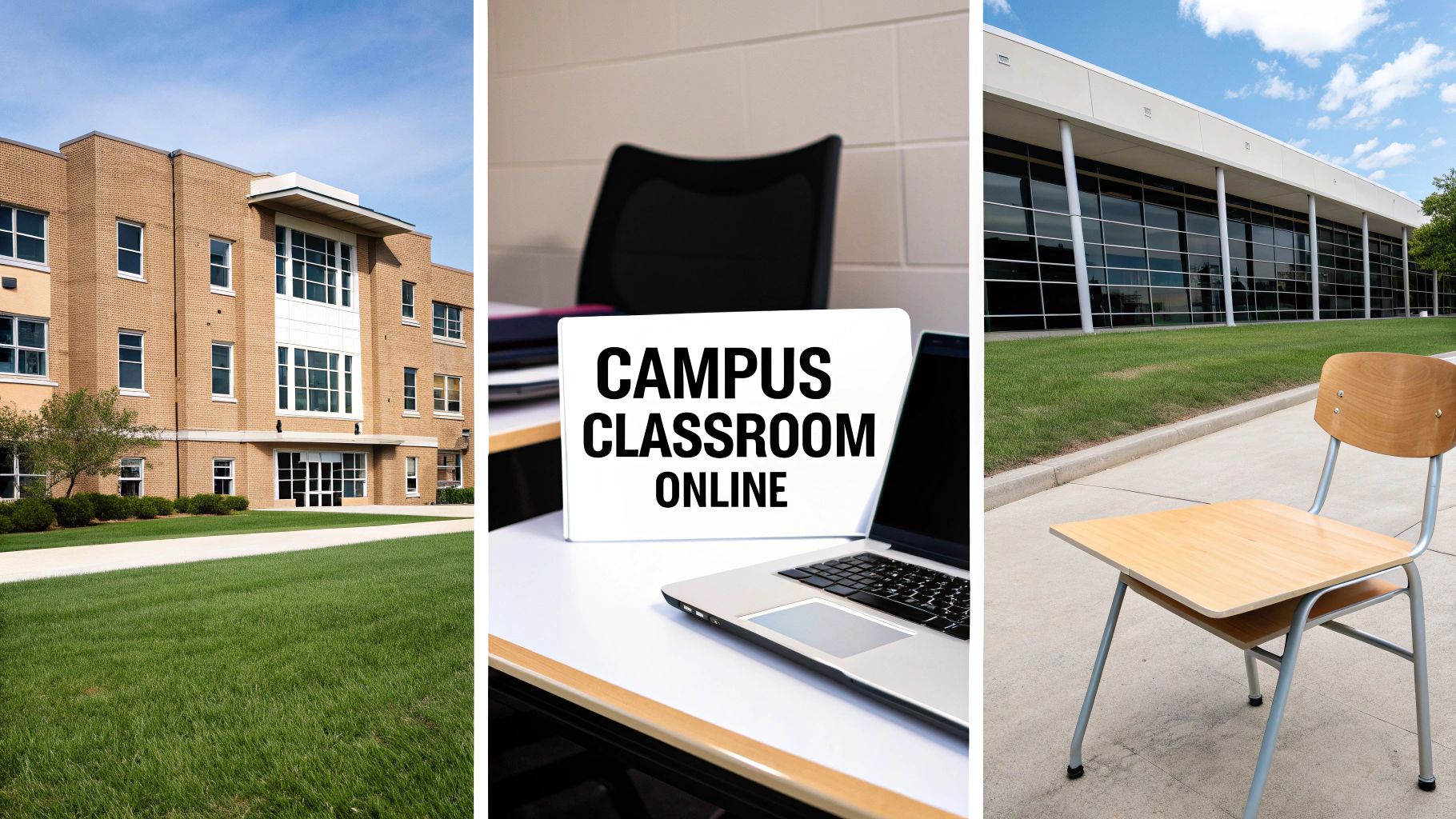
When we talk about dual credit classes, it’s not a one-size-fits-all situation. The way a program is set up—from where you learn to who’s teaching—can completely change the experience. Getting a handle on these differences is the first step to finding a path that clicks with your goals and learning style.
Think of it like choosing a car. Do you need a rugged truck for heavy lifting, a practical sedan for daily commutes, or a sporty convertible for weekend fun? Each one gets you where you’re going, but the ride is totally different. The same is true for the three main ways dual credit programs are delivered.
The On-Campus Immersion Model
This is the full college sneak peek. You physically go to a local college campus, sit in a real lecture hall next to university students, and learn straight from a college professor. It’s about as authentic a taste of college life as you can get while still in high school.
This model is a fantastic fit for students who are ready to dive headfirst into a university environment. You’re not just taking a class; you're gaining access to college libraries, science labs, and student centers. It does, however, ask more of you. You'll need to sort out your own transportation and learn to navigate a much bigger, more independent setting.
The biggest upside? The sheer variety of courses. You can explore subjects way beyond what your high school offers. Plus, you get a real feel for the pace and expectations of college, which can make the official transition down the road feel like old hat.
The High School Classroom Model
This is probably the most common setup you'll find, and for good reason—it’s incredibly convenient. You take the college-level course right inside your own high school, taught by one of your high school teachers who’s been specially credentialed by the partner college.
It’s the best of both worlds. You get the challenge of a college-level curriculum but in a comfortable, familiar place with a teacher you might already know. There's no travel required, and the class just slots right into your normal school day, which makes scheduling a breeze.
This model excels at easing students into college-level rigor. It provides the academic challenge of a college course within the supportive and familiar structure of the high school environment.
The only potential drawback is that course selection depends entirely on which of your teachers are certified to teach college-level subjects. Even so, it’s an excellent way to dip your toes into higher education without shaking up your daily routine.
The Flexible Online Model
For students juggling a packed schedule or those who just work best on their own, online dual credit classes are a game-changer. You access the course through a college’s online learning system, letting you study and complete assignments from anywhere you have an internet connection.
This path is perfect for disciplined, self-motivated students. You’ll still interact with a professor and classmates, but it’ll be through discussion boards, video lectures, and digital submissions. It also blows the doors wide open on course availability, connecting you with colleges you couldn't otherwise reach.
Of course, this freedom comes with a trade-off: it demands a ton of self-discipline. You’re the one in charge of hitting deadlines and keeping up with the material. But succeeding here sends a powerful message—it proves you have the independent study skills every college student needs.
Ultimately, the options available to you will depend on the partnerships your local schools have forged. To see what's offered in your area, it's worth exploring information about school districts and their higher-ed collaborators.
Equity and Access in Dual Credit: Who Gets Left Behind?
The idea behind dual credit is simple and powerful, but the reality is that the opportunity isn't always distributed fairly. For these programs to truly work, every student who's ready for the challenge needs a real shot at participating.
Unfortunately, a closer look shows that access to dual credit classes often hinges on a student's background, where they live, or what their family can afford. This isn't just a small wrinkle in the system; it's a major roadblock for many students. If we're building a bridge to college, but only some students are allowed to cross, we risk making the educational divide even wider.
What's Standing in the Way?
So, what's actually stopping motivated students from signing up? It's usually not about academic ability. More often, the hurdles are practical, real-world problems that hit students from low-income families and underrepresented groups the hardest.
Schools and districts have to get real about identifying these barriers if they want to build programs that serve everyone. Here are some of the most common ones:
- The Hidden Costs: Even with free or reduced tuition, the cost of textbooks, lab fees, or transportation can be a deal-breaker for a family on a tight budget.
- A Simple Lack of Information: In some schools, dual credit is like a well-kept secret. If students and their parents don't know it exists or don't understand the benefits, they can't even consider it.
- The Transportation Trap: When classes are only held on a college campus, students without a car or a reliable bus route are simply out of luck.
- "Gatekeeping" and Low Expectations: This one is subtle but powerful. Sometimes, well-meaning educators steer certain students away from tough courses, wrongly assuming they aren't "college material."
At its heart, educational equity means a student's potential shouldn't be limited by their zip code or their parents' income. Making sure dual credit is accessible to everyone is putting that principle into action.
The Participation Gaps Are Real
The data tells a pretty clear story. When you break it down, you see that students from different backgrounds are enrolling in dual credit at very different rates.
Consider this: among students whose parents never finished high school, only about 26% earn dual credit. That number shoots up to 42% for students whose parents have a bachelor's degree or higher.
We see similar gaps along racial and ethnic lines. One national study found that 38% of White students had earned dual credit, while only 27% of Black students had. State-level policies make a huge difference here. States like California, Texas, and Florida have managed to enroll the largest numbers of Hispanic students in dual credit, proving that focused effort can move the needle. You can discover more insights on dual enrollment equity and see just how much policy shapes these numbers.
How We Can Start Closing the Gaps
The good news is that this isn't an unsolvable problem. Many districts and states are already rolling up their sleeves and proving that with intentional work, dual credit can be a powerful tool for equity.
The most effective strategies usually mix policy changes with financial support and much better communication. By tackling the root causes of the disparity, these programs are opening doors that used to be locked shut.
Here are a few of the most successful approaches:
- Make It Truly Free: Many states are now covering all costs—tuition, fees, and even textbooks—to remove any financial burden from students and their families.
- Bring the College to the High School: Offering dual credit courses right on the high school campus, often taught by trained high school teachers, completely eliminates the transportation issue.
- Be Proactive with Outreach: Instead of waiting for students to sign up, successful programs actively recruit students from underrepresented groups to make sure they know about the opportunity and feel welcome.
- Wrap Students in Support: It's not enough to just enroll students. Providing tutoring, mentoring, and other academic support ensures they have what they need to succeed in their dual credit classes once they're in them.
Your Top Dual Credit Questions, Answered
As you start looking into dual credit programs, you're bound to have questions. Getting clear on the details is the best way to feel confident about the path you choose. Let's walk through some of the most common questions we hear from students and parents.
Do Dual Credit Grades Affect My College GPA?
Yes, they absolutely do. This is probably the single most important thing to understand about dual credit classes.
The grade you earn isn't just for your high school report card; it's the start of your permanent college transcript. That means your performance in a dual credit course directly impacts your college GPA before you even set foot on campus as a freshman. Unlike a one-and-done AP exam, that semester-long grade sticks with you and can influence everything from future academic standing to financial aid.
How Do I Know if My Credits Will Transfer?
This is a big one, and the short answer is: you have to do your homework. Credit transfer isn't a given.
While credits from a public college often transfer smoothly to other public schools in the same state, private and out-of-state universities play by their own rules. To avoid any nasty surprises down the road, you need to be proactive.
- Call the Admissions Office: Get in touch with the colleges you're seriously considering. Don't be shy—ask them for their dual credit transfer policy, and see if you can get it in writing.
- Use State Transfer Guides: Many states have online tools that show exactly how courses transfer between their public colleges and universities. These are your best friend.
- Ask How Credits Apply: It’s not just about whether the credit transfers, but how. Will it knock out a core requirement for your major, or will it just count as a general elective? That distinction can make a huge difference in your degree plan.
If there's one piece of advice to take away, it's this: never assume your credits will transfer. Always, always verify with the specific colleges you want to attend.
Are Dual Credit Classes Much Harder Than AP Classes?
They're just different kinds of hard. A dual credit class is a real-deal college course. The workload, the pacing, the grading—it's all set by a college professor. You're getting the authentic college experience, for better or worse.
AP, on the other hand, is a high school course built to prep you for one big, high-stakes exam in May. Many students I've talked to find that the steady, semester-long grind of a dual credit course is actually better preparation for college, helping them build the kind of study habits they'll need to succeed later on.
Connecting with the right school decision-makers is essential for growing your business. Schooleads provides a premium, verified database of K-12 contacts, helping you target the right administrators and department heads to support programs like dual credit. Find out how we can streamline your outreach.