Understanding Common Core Standards Washington State
A clear guide to the Common Core Standards Washington State. We break down the WA Learning Standards, SBAC tests, and what they mean for educators and parents.
If you're looking for information on common core standards washington state, you'll quickly discover they go by another name. Washington officially calls them the Washington State Learning Standards. While they grew from the Common Core initiative, the state has put its own stamp on these K-12 academic goals.
What Are Washington's Learning Standards
Let’s clear up the terminology right away. While "Common Core" is the term most people recognize nationally, in Washington's public schools, the official name is the Washington State Learning Standards. These standards create a clear and consistent set of expectations for what students should learn in each grade.
It's helpful to think of the standards as a destination on a map, not the specific route to get there. They define the essential skills and knowledge a student needs by the end of the year, but the curriculum—the day-to-day lesson plans and materials—is chosen by local school districts. This gives every student in the state a common set of high-level academic goals.
The Core Subjects and Their Purpose
The standards zero in on two critical subjects: English Language Arts (ELA) and Mathematics. Why these two? Because they are the bedrock skills needed for nearly any path a student takes after high school, whether it's college, a technical program, or jumping straight into a career.
The main goals are straightforward and practical:
- Create Consistency: Ensure that a fourth grader in Seattle is learning the same core concepts as a fourth grader in Spokane.
- Build Critical Thinking: Move beyond rote memorization to help students develop real analytical and problem-solving abilities.
- Prepare for the Future: Make sure K-12 learning directly connects to the skills students will actually need after graduation.
The Washington State Learning Standards are designed to be robust and relevant to the real world, reflecting the knowledge and skills that young people need for success in both college and careers.
Ultimately, the standards give teachers, parents, and students a shared understanding of what success looks like at every grade level. They answer the simple but crucial question, "What does my child need to know by June?" By setting this clear benchmark, Washington aims to boost academic achievement for every student. This guide will walk you through their history, how they're assessed, and what they look like in the classroom.
How Washington Adopted Its Learning Standards
The move to what we now call the Washington State Learning Standards didn't happen overnight. It was a careful, years-long journey that started back in the early 2010s. The driving force was a simple, powerful idea: create more consistency and set a higher bar for students, no matter where in the state they lived.
This wasn't just about swapping out one set of rules for another. It was a fundamental shift in thinking about how to get every student truly ready for college, a career, and life after high school.
Before this change, what a student learned could differ wildly from one school district to the next. By adopting the common core standards washington state framework, the Office of Superintendent of Public Instruction (OSPI) aimed to make sure a diploma from any high school in Washington meant the same thing—that the student was prepared for their next step.
A Measured, Step-by-Step Rollout
Instead of flipping a switch and demanding immediate change, Washington's education leaders chose a more practical path: a phased-in approach. They knew that a lasting transition needed time, good training, and a lot of coordination.
The state’s official plan, laid out in December 2011, mapped out a five-phase journey. It started with simply exploring the standards in 2010-11, then moved to building awareness and getting educators up to speed through 2012. The final steps involved piloting new tests before the full statewide assessments went live in the 2014-15 school year. You can dig into the details in Washington's comprehensive CCSS implementation plan.
This gradual rollout was all about giving teachers and administrators the runway they needed to adjust. It gave districts time to align their curriculum and made space for the kind of professional development that helps new ideas stick.
The goal was evolution, not revolution. Washington focused on building a strong foundation with training and thoughtful planning, ensuring the new standards would actually improve learning instead of just adding more paperwork.
Knowing this backstory is important. It shows that these standards weren't just dropped into place; they were woven into the state's education system with care. This methodical approach set the stage for the assessments and classroom practices that are common in Washington's schools today. It was a forward-thinking commitment to helping students develop the critical thinking and problem-solving skills they need to succeed.
How ELA and Math Look Different in the Classroom
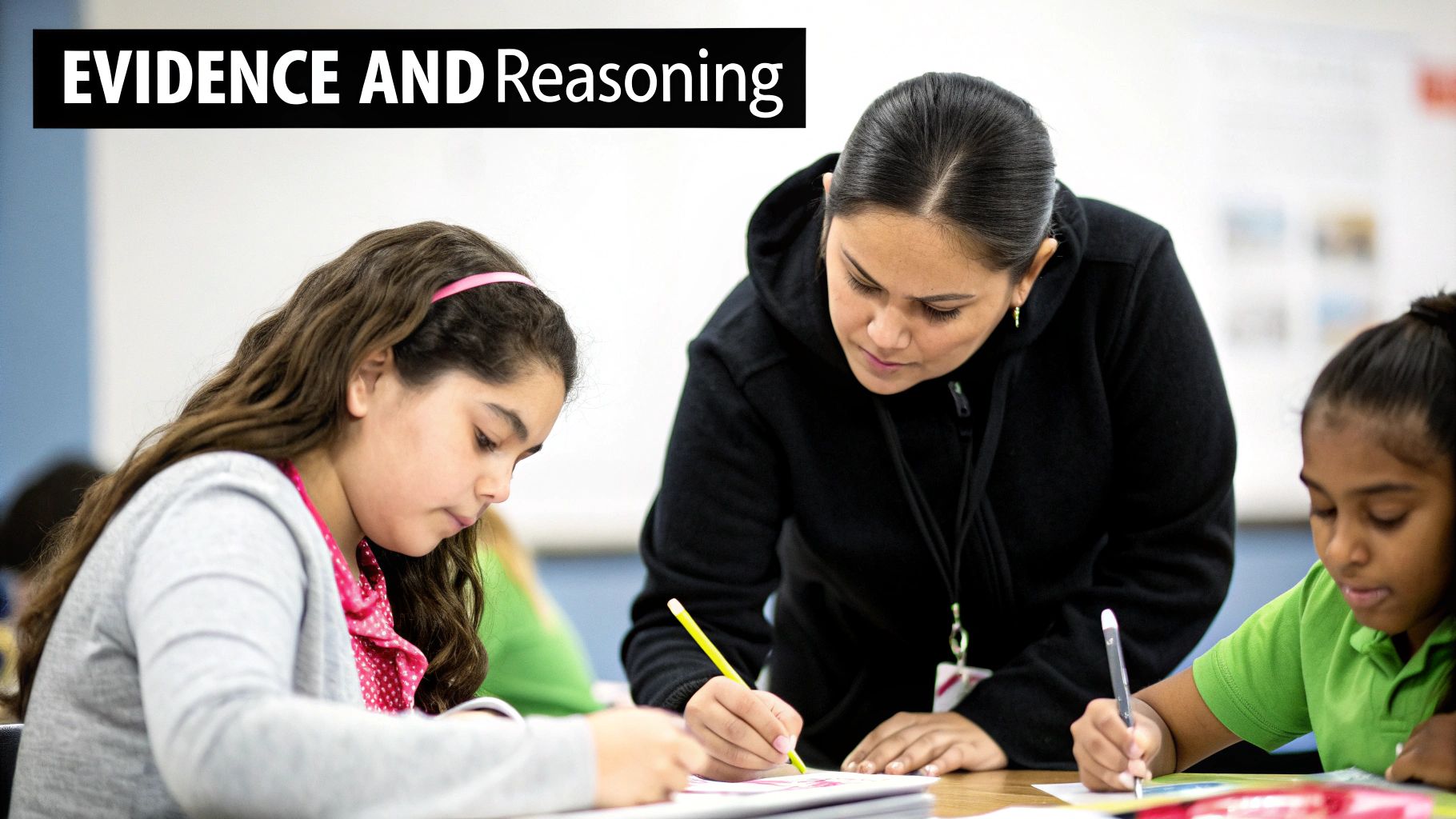
Adopting the Washington State Learning Standards wasn't just about shuffling papers at the state level; it genuinely changed how teaching and learning feel inside the classroom. The focus pivoted from simply knowing facts to deeply understanding how to apply them. This is especially clear in English Language Arts (ELA) and Math.
Think of it this way: the old approach was like a history quiz where you just had to spit back dates. The new approach asks you to act like a historian—to use evidence and explain why those dates matter. It’s a move from rote memorization to real-world thinking.
This means students are now expected to be active drivers of their own learning. They're constructing arguments, justifying their reasoning, and connecting different ideas to tackle messy, complex problems.
The Shift in English Language Arts
In ELA, the most significant change is the laser focus on evidence-based reading and writing. It's no longer enough for a student to share their opinion on a story. Now, they have to point to specific sentences or paragraphs in the text to back up their claims.
It’s the difference between a student saying, "I think the character was brave," and them proving it with direct quotes and examples from the book. This skill is built up over time through a few key practices:
- Reading Rich, Complex Texts: Students now read a healthy mix of fiction and challenging nonfiction, from historical documents to scientific articles. This builds their vocabulary and background knowledge.
- Finding Textual Evidence: Every analysis or argument must be anchored in what the text actually says. This teaches students to become careful, precise readers.
- Writing with a Clear Purpose: Assignments are now geared toward building arguments or explaining information, which directly mirrors the communication skills needed for college and careers.
New Approaches in Mathematics
Math instruction has also moved on from the old "drill and kill" worksheets. Under the common core standards washington state framework, the goal is to build a much deeper, more flexible understanding of concepts. Students don't just learn how to get the answer; they learn why the method works in the first place.
Imagine a math problem is a destination. The old method gave students one specific road to follow, and they memorized the turns. The new approach teaches them how to read the whole map, allowing them to find multiple routes and explain why one might be better than another.
The goal in mathematics is no longer just finding the right answer, but also being able to articulate the process and reasoning behind it. This builds true problem-solving fluency.
This focus on deeper understanding is crucial. It means a student learning fractions doesn't just memorize the steps to add them. They grasp what a fraction is, can visualize it, and can use that knowledge to solve real-world problems involving recipes or data. It’s the kind of foundation that makes learning advanced math possible down the road.
To see these changes side-by-side, here’s a quick breakdown of the instructional shifts.
Key Instructional Shifts Under Washington's Standards
This table offers a practical look at how teaching methods have evolved with the Washington State Learning Standards.
| Subject Area | Traditional Approach | Current Washington Standards Focus |
|---|---|---|
| English Language Arts | Reading a story and sharing personal feelings or opinions about it. | Reading a story and using specific quotes from the text to support an argument or analysis. |
| English Language Arts | Writing assignments often focused on personal narrative or creative expression. | Writing assignments are balanced, with a strong emphasis on writing to inform and persuade using evidence. |
| Mathematics | Memorizing formulas and procedures (the "how"). | Understanding the concepts behind the formulas (the "why") and applying them flexibly. |
| Mathematics | Students work alone to find the single correct answer. | Students often work together, explaining their thinking and exploring multiple ways to solve a problem. |
These shifts represent a move toward preparing students for a world where critical thinking and adaptability are far more valuable than memorization.
Measuring Progress with the Smarter Balanced System
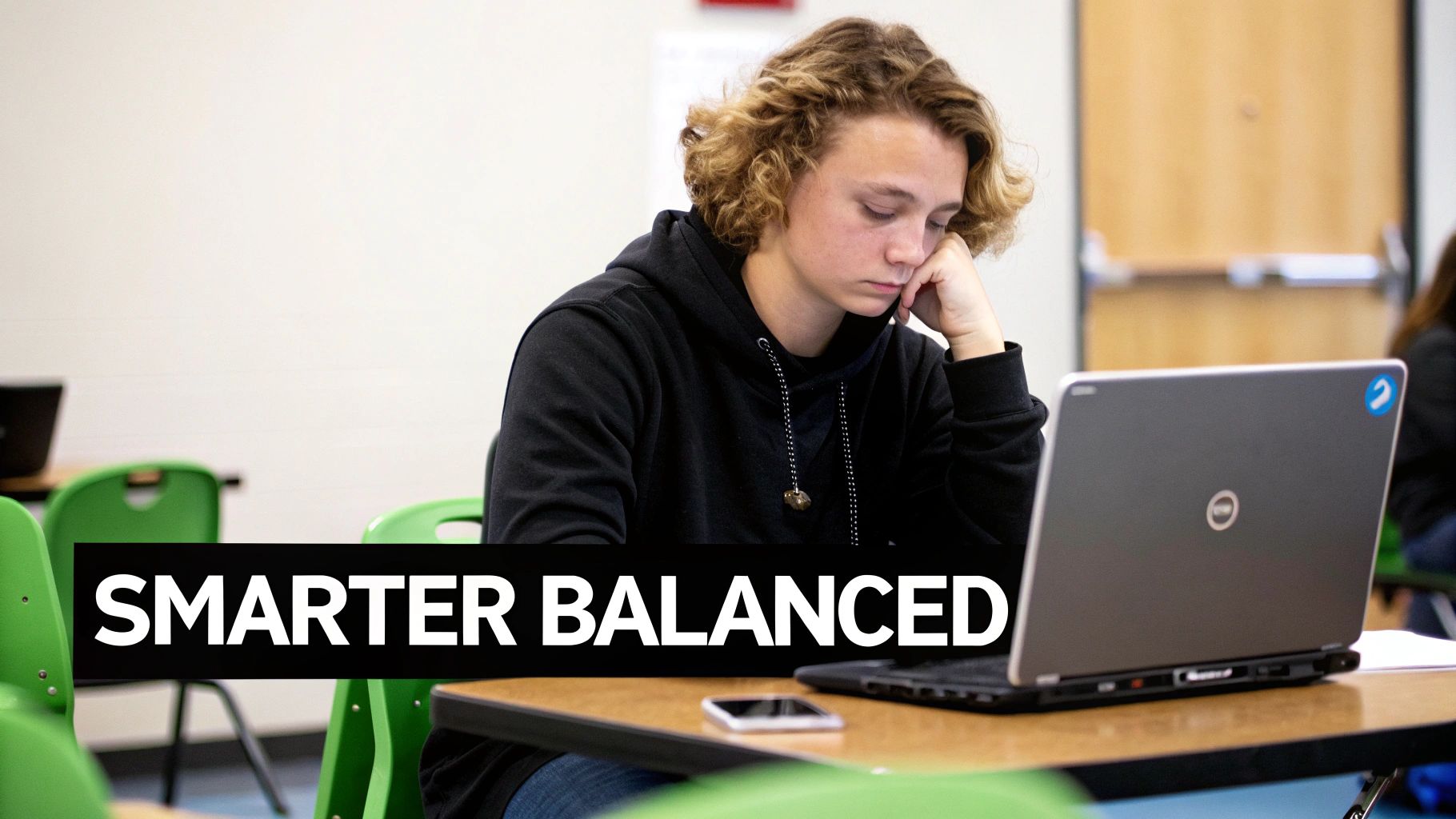
So, with new standards in place, the big question became: how would Washington know if students were actually hitting these new benchmarks? The state needed a way to measure the deeper thinking and problem-solving skills at the heart of the new standards. The old fill-in-the-bubble tests just weren't going to cut it.
The answer was the Smarter Balanced Assessment Consortium (SBAC) test. Washington became a governing member of the SBAC, joining a group of states working together to build a new generation of assessments. This decision teed up statewide testing to kick off in the 2014–15 school year, making the SBAC the official tool to measure its new academic goals. You can get a broader view of the nationwide implementation of Common Core assessments on Wikipedia.
This wasn't just a simple swap for a new test. The Smarter Balanced system marked a complete rethinking of how we measure what students can do, shifting the focus from memorization to applying complex skills in real-world scenarios.
A Test That Adapts to Each Student
One of the most powerful aspects of the SBAC is its computer-adaptive format. Think of it as a test that gets smarter as a student works through it. When a student answers a question correctly, the next one gets a little tougher. If they struggle with a question, the test adjusts and offers a slightly easier one to better zero in on their specific learning level.
This responsive approach gives teachers a much more accurate and personalized picture of a student’s strengths and weaknesses than a static, one-size-fits-all paper test ever could. It helps pinpoint not just what a student knows, but to what depth.
Beyond Multiple Choice: Performance Tasks
The real game-changer with Smarter Balanced, though, is the use of performance tasks. These aren't your typical test questions. They are multi-step projects that challenge students to apply a range of skills to solve a complex problem, much like they would in the real world.
Here’s a simple way to think about the difference:
- A traditional test question might ask a student to solve a single math equation.
- A performance task, on the other hand, might present a student with a budget and ask them to plan a class trip. This requires them to apply math skills, interpret charts, and write a clear explanation defending their choices.
Performance tasks are built to measure the very skills that multiple-choice questions can't touch. They show whether a student can think critically, solve problems, and clearly communicate their reasoning—the core goals of the common core standards washington state is aiming for.
By including these tasks, the SBAC gives a much richer and more authentic look at student learning. It’s a direct link back to the standards, assessing whether students can actually use their English and math skills to tackle the kind of challenges they’ll face in college and their careers.
A Guide for EdTech Companies and School Partners
If you're an EdTech company hoping to make an impact in Washington, knowing the state's educational landscape is everything. It’s not enough to just have a fantastic product; you have to show how it solves the specific problems and meets the goals laid out by the Washington State Learning Standards.
Your product needs to speak directly to the state’s academic priorities. This means you have to demonstrate, with real-world examples, how your tool helps students develop the critical thinking and evidence-based reasoning skills that are central to the standards. Generic claims about "improving learning outcomes" won't get you very far.
Instead, get specific. Your pitch should clearly show how your platform supports the big instructional shifts in ELA and Math. Can you prove it helps a student build a solid argument using textual evidence? Or explain the logic behind their math solution? That’s the kind of language that gets a Washington educator’s attention.
Speaking the Language of Washington Educators
When you’re talking to schools, your strongest asset is showing how your product aligns with the Smarter Balanced Assessment Consortium (SBAC) tests. District leaders, principals, and curriculum directors live and breathe these scores—it’s how their performance is often measured.
Your tool isn't just a neat piece of tech; it's a direct line to improving student results on the state’s most important accountability measure. Frame every feature you have in the context of SBAC success.
- Data Dashboards: Don't just show data. Show how your analytics pinpoint the exact standards where students are struggling—the same standards that carry a lot of weight on the SBAC.
- Content Libraries: Emphasize any resources that feel like the complex performance tasks on the SBAC. This gives students the practice they desperately need.
- Reporting Tools: Make sure your reports use language that mirrors SBAC reporting categories, so administrators can easily track progress toward their proficiency goals.
Making that direct connection shows you've done your homework. It proves you understand their world and have built something to help them win.
Think of it this way: to unlock partnerships, you need to position your product as an essential tool for mastering the Smarter Balanced assessments. These tests are the ultimate measure of how well the common core standards washington state adopted are being taught.
Navigating District Procurement and Timelines
Unlike some states with top-down adoption, Washington puts purchasing power in the hands of its local districts. Each of the state’s 295 school districts runs its own show, with unique procurement rules, budget cycles, and key players.
To succeed, you have to figure out who actually holds the purse strings. It might be a curriculum director, an assistant superintendent, or even a committee of teachers. Our guide on how to identify key purchase decision-makers in schools is a great starting point for mapping out who you need to talk to.
Timing is also critical. Most districts lock in their budgets in the spring for the next school year. That means your outreach, demos, and conversations need to happen in the fall and winter. If you wait until April or May, you’re probably too late—the money has already been spoken for. By lining up your sales cycle with these local realities, you give yourself a much better shot at building strong, lasting partnerships across the state.
Finding Official Resources and Support
When you need to understand the specifics of Washington's learning standards, it’s best to go straight to the source. Third-party sites can be helpful, but nothing beats the official documents for getting the facts straight about what’s expected in the classroom.
The central hub for all this information is the Washington Office of Superintendent of Public Instruction (OSPI). Their website is the ground truth for everything related to the Washington State Learning Standards, which is the state's official name for its Common Core-aligned standards.
Key Official Websites
If you’re a parent, educator, or EdTech provider, these are the sites you’ll want to bookmark. They offer the most direct and reliable information.
- OSPI Learning Standards Hub: This is your one-stop shop for the complete ELA and Math standards for every grade. It lays out exactly what students are expected to learn from kindergarten all the way through 12th grade.
- Smarter Balanced Assessment Portal: Ever wonder what the state tests actually look like? This site pulls back the curtain, offering practice tests, sample questions, and detailed scoring guides so you can see firsthand how student learning is measured.
- Ready Washington Coalition: This is a fantastic resource, especially for parents and families. It breaks down the standards into easy-to-understand, grade-by-grade guides and provides toolkits to help you support your child’s learning at home.
By sticking to these official sources, you'll be able to track learning goals with confidence, make sense of test results, and have more productive conversations with teachers about student progress.
These resources are all about transparency. They give you the tools you need to be an informed and effective advocate. If you want to see how these standards play out at the local level, you can explore this detailed list of Washington school districts to understand district-specific priorities and leadership.
A Few Common Questions
Diving into Washington's learning standards can bring up a few questions. Let's tackle some of the most common ones we hear from parents, teachers, and partners.
Are Common Core Standards Still Used in Washington State?
Yes, they are, but you'll almost always hear them called the Washington State Learning Standards. Washington adopted the core ideas back in 2011, and they remain the foundation for K-12 English Language Arts and Math.
While the "Common Core" name has faded, the standards themselves are very much alive. They're the blueprint for what students learn and what the annual Smarter Balanced (SBAC) tests measure.
How Can I Tell if My Child's School Is Following These Standards?
The best way is to simply ask your child's teacher. A quick conversation can tell you a lot about how their classroom work and curriculum are built around the state standards for their grade.
For a more detailed look, you can check the official parent guides on the Office of Superintendent of Public Instruction (OSPI) website. These resources break down the specific skills students should be mastering each year, giving you a great reference point.
What Makes the Smarter Balanced Test Different from Older State Tests?
The big shift is from rote memorization to real-world thinking. The Smarter Balanced test, or SBAC, isn't a simple bubble sheet; it’s a computer-adaptive assessment. This means the test gets easier or harder in real-time based on how a student is answering, which gives a much more accurate picture of their skills.
The most unique part is the "performance tasks." These are complex, multi-step problems that ask students to use what they know to solve a realistic challenge. It's less about remembering a formula and more about showing you can actually use it to figure something out.
This approach gives a far better sense of a student's problem-solving and analytical abilities, which is exactly what the common core standards washington state aims to build.
Who Decides the Curriculum Used to Teach the Standards?
This is where local control really comes into play. The state sets the learning goals—the "what" students need to know. But the "how" is left up to each of Washington's 295 school districts.
Individual districts are the ones who select the specific textbooks, software, and teaching programs to get their students to those state-mandated goals. This is why you'll see different materials in a Seattle classroom than you might in a Spokane one, even though both are teaching to the same standards.
Reaching the right people in those 295 districts is essential for any EdTech company looking to make an impact in Washington. Schooleads takes the guesswork out of it with a verified K-12 database, connecting you directly with the leaders who make curriculum decisions. You can start building those crucial relationships today.