Common Core Math 6th Grade: common core math 6th grade Guide for Parents
Struggling with common core math 6th grade? Our guide demystifies the five core domains from ratios to statistics with clear examples for parents and teachers.
For many of us, 6th grade math was about memorizing formulas and crunching numbers. Common Core Math 6th Grade flips that script. It’s less about getting the right answer quickly and more about understanding why the math works in the first place. The real goal here is to build students into critical thinkers and confident problem-solvers.
Understanding the Shift in 6th Grade Math
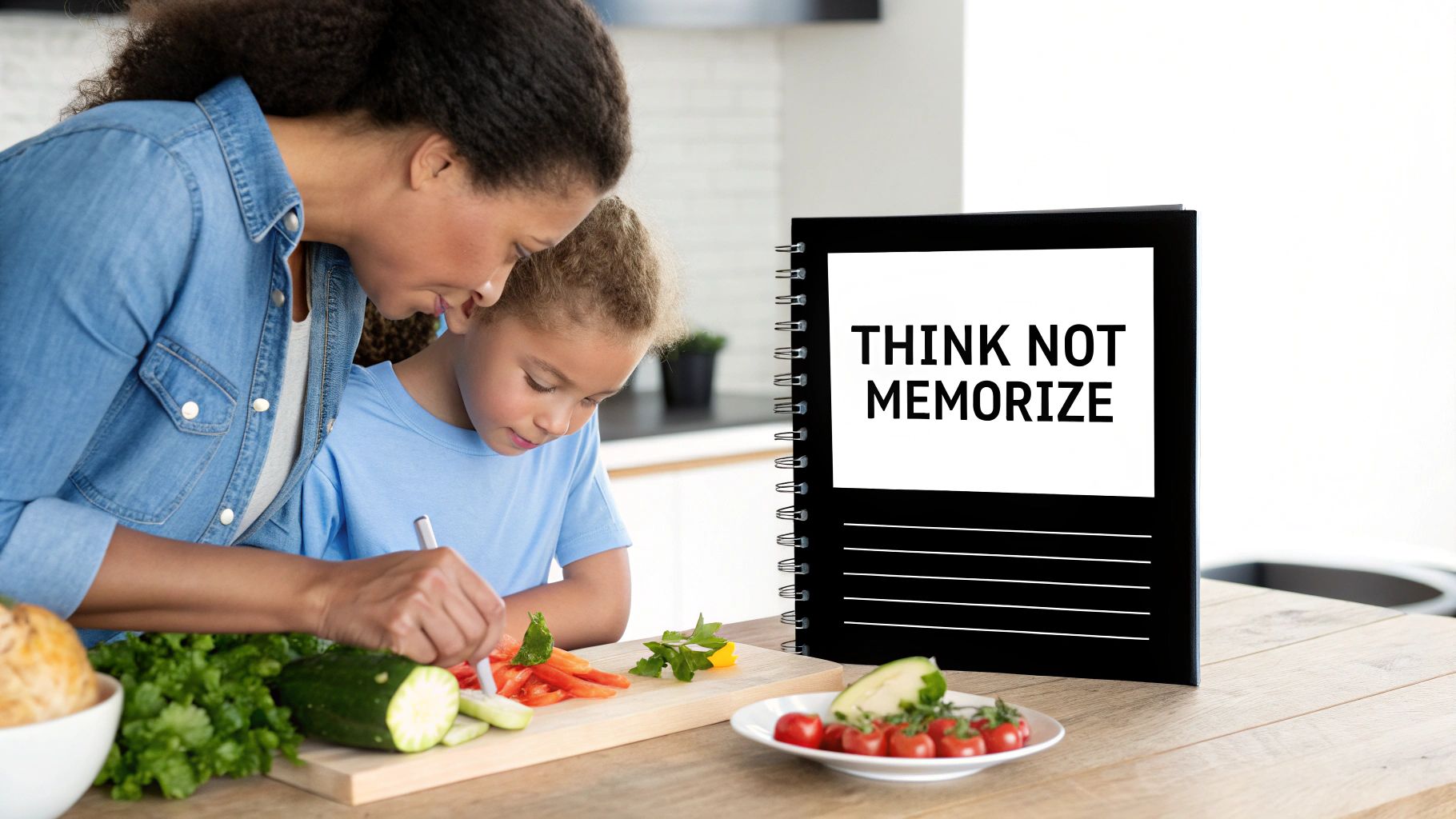
If your own math education was built on rote memorization, the Common Core approach can feel a little foreign. The core idea is to shift students from being passive rule-followers to active mathematical thinkers. It’s like the difference between following a recipe step-by-step and actually understanding how different ingredients work together.
A student who just follows a recipe can make that one dish. But the student who understands the science of cooking—why salt brings out flavor or how heat transforms food—can improvise, experiment, and create something entirely new. That's the heart of Common Core math: giving kids the foundational logic to solve problems they’ve never encountered before.
From Memorization to Meaningful Understanding
The old way often produced students who could ace a worksheet full of identical problems but froze when faced with a real-world puzzle that didn't fit the mold. The standards were designed to fix that by building a strong conceptual foundation first.
This new way of thinking involves a few key changes:
- Diving deeper into fewer topics to ensure students truly master them.
- Building a coherent story by connecting ideas from one grade level to the next.
- Requiring students to explain their work and justify their answers, which promotes critical thinking.
It's all about developing true mathematical fluency, not just speed. The aim is to get students thinking like mathematicians, using reasoning to navigate their way to a solution.
Why This Approach Matters for Students
This teaching style sets students up for success in higher-level math and future careers. They aren't just calculating; they're learning to analyze data, model complex situations, and clearly explain their thought process. They begin to see math as a practical tool for making sense of the world around them.
The ultimate aim is to cultivate students who are not just 'good at math' but are also good thinkers. They learn to persevere through challenging problems and view mistakes as learning opportunities, building resilience alongside their academic skills.
Despite early debates, the core principles of these standards have stuck around in many states. Why? Because educators widely agree that depth is more valuable than breadth. You can learn more about how different states have adopted these math standards.
For any EdTech company creating new tools, grasping this philosophical shift is non-negotiable. Your products need to align with what modern classrooms are actually doing and help school district administrators meet their educational goals.
The Five Building Blocks of 6th Grade Math

The leap from elementary to 6th-grade math is a big one. Students move beyond basic arithmetic into more abstract and complex territory. To make this transition feel less like a jump and more like a steady climb, the Common Core math 6th grade standards are broken down into five distinct but deeply connected areas, or "domains."
Think of these domains as the foundational pillars holding up the entire year's curriculum. While each focuses on a specific set of skills, they are designed to work in concert. A student’s breakthrough in one area often unlocks a new way of solving problems in another, helping them see math as a cohesive, powerful way of thinking, not just a list of rules to memorize.
Let’s take a closer look at each of these five critical building blocks.
Ratios and Proportional Relationships
For many 6th graders, this is the biggest "a-ha!" moment of the year. It's where they learn to think multiplicatively, comparing quantities in a whole new way. It’s all about understanding how things relate to each other.
If a recipe calls for 2 cups of flour for every 1 cup of sugar, that's a ratio. Students learn to use this relationship to solve practical problems. What if you only have half a cup of sugar? How much flour do you need? This kind of thinking is everywhere in real life, from calculating the best deal at the store (unit price) to reading the scale on a map.
The Number System
Students have been working with numbers for years, but 6th grade blows the doors wide open. The biggest development here is the introduction of negative numbers. Kids learn to place them on a number line, grasp their value, and apply them to real-world ideas like debt or temperatures below zero.
This domain also pushes for total fluency with fractions and decimals. The main event? Mastering the division of fractions. It's a notoriously tricky concept, so the focus is on building a deep, conceptual understanding—using visual models to see why the "invert and multiply" rule actually works, rather than just memorizing a procedure.
Expressions and Equations
Here's where students take their first real steps into the world of algebra. This domain is the bridge from the concrete world of arithmetic to the abstract power of symbols. Kids learn to work with variables—those letters that stand in for unknown numbers.
They’ll practice writing and reading mathematical phrases (expressions) like “5x + 3” and solving simple equations like “2y = 10.” The goal isn't just to find the answer but to get comfortable with the language of algebra, laying a solid foundation for everything that comes in 7th grade and beyond.
Think of it this way: Learning expressions and equations is like learning the grammar of mathematics. It provides the structure students need to build complex mathematical sentences and arguments.
Geometry
In 6th grade, geometry moves past simply identifying shapes. The focus shifts to analyzing their properties and measurements to solve real-world problems involving area, surface area, and volume.
Students will learn to find the area of complex shapes by breaking them down into familiar rectangles and triangles. They'll also calculate the volume of 3D figures like rectangular prisms, a skill that connects directly to practical tasks like figuring out how much a moving box can hold.
Statistics and Probability
This final domain gives students the tools to make sense of the data-filled world around them. It’s about so much more than making a quick bar graph; it's about developing true statistical thinking. Students learn how to ask smart questions about data, organize it, and interpret what it’s telling them.
Key ideas include measures of center (mean, median, and mode) and measures of variability (like range). By learning to summarize and display data in plots, students can tell a clear story with numbers—an essential skill for becoming a critical thinker and informed citizen.
To pull this all together, the table below gives a snapshot of how these domains work.
Overview of 6th Grade Common Core Math Domains
| Domain | Core Concept | Key Skills and Examples |
|---|---|---|
| Ratios & Proportional Relationships | Comparing quantities multiplicatively. | Calculating unit rates (e.g., miles per hour), finding percentages, and scaling recipes up or down. |
| The Number System | Expanding number sense to include all rational numbers. | Dividing fractions, performing all operations with decimals, and understanding negative numbers on a number line. |
| Expressions & Equations | Using symbols to represent and solve problems. | Writing algebraic expressions (e.g., 3n - 4), solving one-step equations, and understanding variables. |
| Geometry | Solving problems involving area, surface area, and volume. | Finding the area of triangles and complex polygons, and calculating the volume of rectangular prisms. |
| Statistics & Probability | Developing an understanding of data variability and distributions. | Calculating mean and median, creating dot plots and box plots, and describing the overall shape of a dataset. |
As you can see, each domain builds specific skills, but they all contribute to the larger goal: developing students who are flexible, confident, and capable mathematical thinkers.
Getting to Grips with Ratios and Proportional Thinking
For many 6th graders, the Ratios and Proportional Relationships domain is where math really starts to change. This is the moment they begin to pivot from the additive thinking of elementary school ("how much more?") to the multiplicative thinking ("how many times greater?") that truly opens the door to algebra.
This isn't just about crunching numbers on a page; it’s about understanding the world through comparisons. A ratio is simply a way of comparing two quantities. When a recipe calls for 3 cups of flour for every 1 cup of sugar, that's a 3:1 ratio. This one simple idea is the key to solving an endless variety of real-world puzzles.
Students get comfortable expressing these relationships in different formats (3 to 1, 3:1, or 3/1). More importantly, they learn how to use them. If you suddenly need to bake a much larger cake, how much sugar do you need for 9 cups of flour? Answering that question is the heart of proportional thinking.
From Simple Comparisons to Unit Rates
One of the most practical skills in this domain is finding the unit rate. Think of it as the "how much for just one?" value. It's the kind of math you do instinctively at the grocery store when comparing a 16-ounce box of pasta for $4.00 to a 20-ounce box for $4.60. To find the better deal, you have to figure out the price per ounce.
- Box 1: $4.00 / 16 ounces = $0.25 per ounce
- Box 2: $4.60 / 20 ounces = $0.23 per ounce
By calculating the unit rate, a student can make a smart decision. It turns an abstract math problem into a powerful life skill. They'll use this exact same logic to calculate miles per hour, price per pound, or words typed per minute.
You really can't overstate how foundational this domain is. Most classroom pacing guides dedicate a huge chunk of time—often around 20–30% of the school year—to getting this right. It’s all by design. These concepts are the bridge from concrete arithmetic to the abstract reasoning needed for algebra. If you want to see the big picture, you can learn more about how 6th grade math is sequenced in many districts.
Visualizing Ratios to Make Them Stick
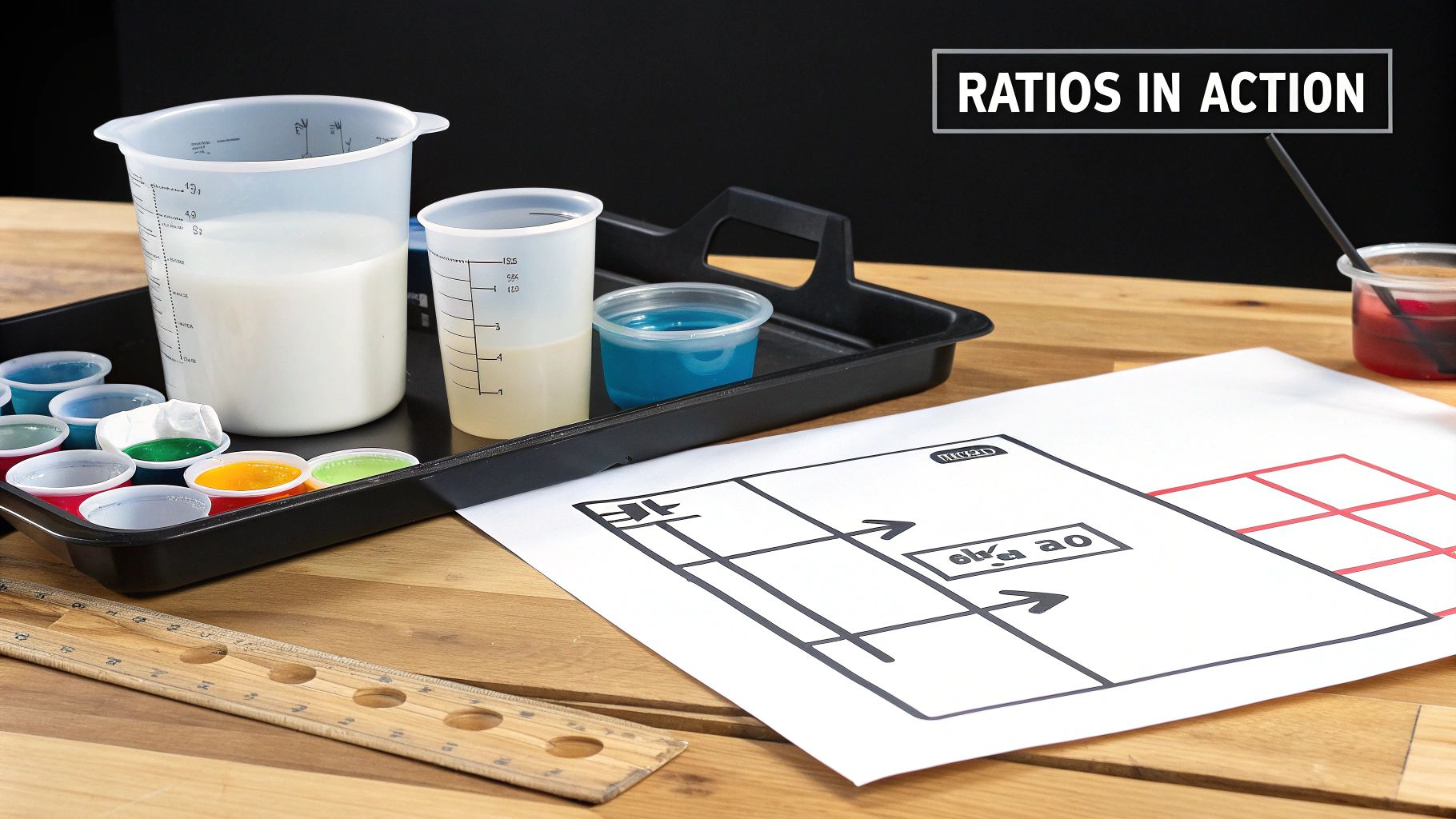
To make sure students truly get it, common core math 6th grade puts a big emphasis on visual models. Instead of just memorizing steps, students are taught to actually see the relationship.
A key takeaway for educators and parents is that visual tools are not a crutch; they are a bridge to conceptual understanding. They help students internalize the logic of proportions before moving on to more abstract algebraic methods.
One of the best tools for the job is the tape diagram.
Let's say you have a problem like this: "The ratio of apples to oranges in a basket is 2 to 3. If there are 20 fruits total, how many are apples?"
A student can sketch a simple tape diagram:
- Draw 2 equal boxes to represent the apples.
- Draw 3 equal boxes right next to them for the oranges.
Right away, they see 5 boxes in total, which represent all 20 fruits. From there, it’s a quick hop to figuring out that each box must stand for 4 fruits (20 ÷ 5 = 4). With that "aha!" moment, the answer is clear: there are 8 apples (2 boxes × 4) and 12 oranges (3 boxes × 4). This visual method makes the problem feel intuitive and cements the proportional relationship in a way that just writing down numbers can't.
Building the Bridge from Numbers to Algebra
Once students get the hang of ratios, their mathematical world really starts to open up. The next two big areas, The Number System and Expressions & Equations, work together to connect the dots between the concrete arithmetic of elementary school and the more abstract world of algebra. This is where kids stop just doing math and start using math to build arguments and solve really interesting problems.
Frankly, these two domains are where the common core math 6th grade standards push students to develop true numerical fluency. It's not about memorizing another set of rules. It’s about gaining a much deeper, more intuitive feel for what numbers are and how they interact. This foundational work is absolutely critical for them to succeed in algebra down the road.
The Number System Grows Up
Up until now, students have lived in a pretty comfortable world of whole numbers and basic fractions. In 6th grade, that world blows wide open to include the entire rational number system. And the biggest new players on the field? Negative numbers.
Instead of just being some fuzzy concept, students learn to plot negative numbers on a number line. They see where they live in relation to zero and their positive opposites. This isn't just theory; it clicks when they see it in real life.
- Temperature: What happens when the temperature drops from a chilly 5°F to a frigid -8°F?
- Money: How do you show a debt of $50 in a bank account?
- Elevation: What's the distance between Death Valley (282 feet below sea level) and a mountain peak nearby?
Grounding negative numbers in these everyday scenarios makes them tangible and useful. This domain also requires students to become masters of fractions and decimals. The peak of this climb is mastering the division of fractions—a concept that, let's be honest, has tripped up students (and adults!) for generations. The Common Core approach is to build understanding first with visual models, so kids see why the "invert and multiply" trick works instead of just memorizing a procedure they'll forget by next Tuesday.
Expressions and Equations: The Language of Algebra
With a solid grasp of this bigger number system, students are finally ready to learn the language of algebra. The Expressions & Equations domain introduces them to one of the most powerful tools in all of math: the variable.
A variable is just a letter, like x or y, that holds the place for a number we don't know yet. It's a simple idea, but it’s the key that unlocks our ability to turn a real-world problem into a mathematical sentence we can actually solve.
Learning to work with expressions and equations is like learning a new grammar. It gives students the structure needed to move from "What's the answer?" to "How can I model this situation to find any possible answer?"
Students start small by learning to read and write expressions. Something like "five less than twice a number" becomes 2x - 5. From there, they move on to solving one-variable equations, which are essentially puzzles with a single unknown piece.
Think about a classic 6th-grade problem: "Mariah bought three identical notebooks and used a $2 coupon. She spent a total of $10. How much did each notebook cost?"
A student learns to translate this story into an equation: 3n - 2 = 10.
By using inverse operations, they can logically work backward to figure out what n must be. This whole process teaches them that an equation is like a balanced scale; whatever you do to one side, you have to do to the other. It's a fundamental principle of algebraic thinking. This stage of common core math 6th grade is what gets them ready for the much more complex, multi-step equations they’ll see in 7th and 8th grade. It's the moment math truly shifts from being about calculation to being about logic and structure.
How to Make Sense of Data and Statistics
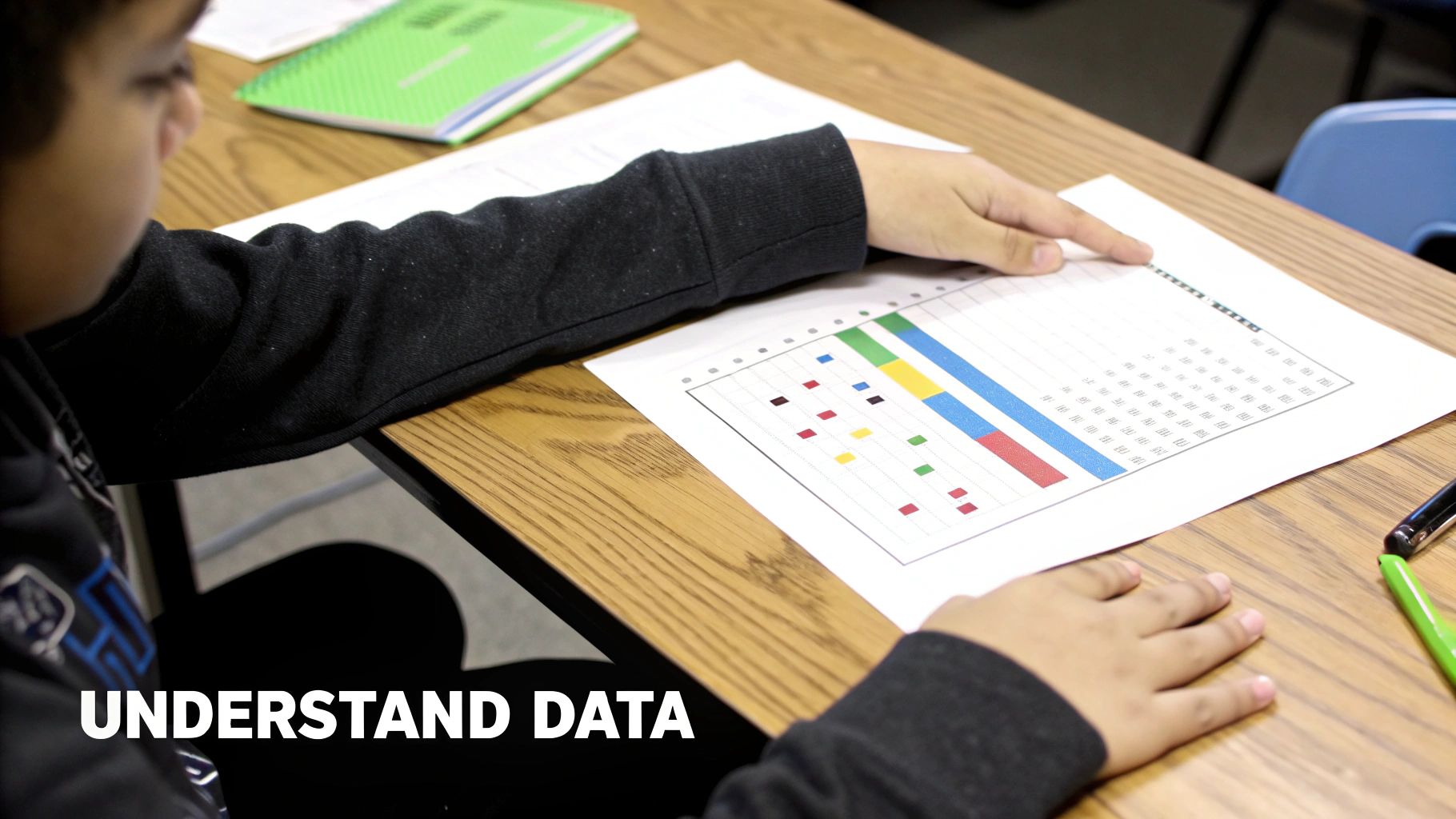
We live in a world overflowing with information, and being able to make sense of it all is less of a niche skill and more of a life essential. The Statistics & Probability domain in 6th grade Common Core math gives students their first real toolkit for statistical thinking.
This isn't just about making bar graphs anymore. The goal is to get kids to ask smart questions, dig into data sets, and actually use evidence to back up what they're saying. It’s about teaching them that numbers tell a story. Data has a shape, a center, and a spread, and understanding this is the first step toward making informed decisions—whether in a future science class or just when reading the news.
Understanding the Center of Data
So, how do you find the "heartbeat" of a pile of numbers? The first step is to locate its "center," or a typical value.
Let's say a class gets the following scores on a 10-point quiz: 7, 8, 8, 8, 9, 9, 10, 10, 10, 10. The curriculum introduces three key ways to find the center, and each tells a slightly different part of the story.
- Mean: This is the one most people know as the "average." Just add up all the scores and divide by how many there are. For our quiz scores, the mean is 8.9.
- Median: This is the middle value once you line up all the numbers in order. With our ten scores, the two middle numbers are both 9, making the median 9.
- Mode: This one's easy—it's just the number that pops up most often. Here, the score of 10 appears four times, more than any other number.
Learning when to use the mean versus the median is a huge part of developing real statistical sense.
Visualizing How Data is Spread Out
Finding the center is a great start, but it's only half the picture. The next big idea is variability—how spread out or clumped together are the numbers? This is where students learn to create visuals that make patterns jump off the page.
The real goal here is to help students see that data has a personality. Is it symmetric and predictable, or is it skewed with a few outliers? These visual tools are the language they use to describe that personality.
Here are the go-to tools for the job:
- Dot Plots: Simple and effective. You just put a dot above a number line for each piece of data. It gives you a quick, honest look at the shape of the data and where the clusters are.
- Histograms: Think of a bar graph, but for groups of numbers. A histogram sorts data into ranges (or "bins") to show how frequently values fall within each interval. It’s perfect for getting the big-picture view of a larger data set.
- Box Plots: You might know this as a box-and-whisker plot. This little visual powerhouse shows the median, quartiles, and the full range of the data all in one compact image. It’s an incredibly efficient way to summarize a data set or compare a few of them side-by-side.
The Common Core State Standards for 6th grade officially mark this as a critical area of study. The curriculum requires students to truly get a feel for statistical variability and learn to describe data using both measures of center and these key visual plots. If you want to dive deeper, you can read more about these specific grade 6 standards. This foundational work paves the way for much more advanced statistics down the road.
Common Questions About 6th Grade Common Core Math
It's completely normal to have questions about 6th grade Common Core math. For many parents—and even some veteran teachers—it looks worlds away from the math we grew up with. The shift from rote memorization to a deeper, more conceptual understanding is deliberate, but it can feel a little jarring at first.
Let's walk through some of the most common questions we hear from families and educators. The goal here is to cut through the jargon, clear up a few myths, and give you the confidence to support your 6th grader on their math journey.
How Is Common Core Different from How I Learned Math?
The biggest difference is really a shift in philosophy. Most of us learned math by focusing on the "how"—you memorized a specific set of steps or an algorithm to get the right answer. Common Core, on the other hand, is all about the "why." It's about understanding the concepts behind the numbers so you can solve a problem in more than one way.
Take dividing fractions, for example. You were probably taught to "invert and multiply." It works, but did you ever know why? A 6th grader today will start by using visual models, like a diagram or a number line, to actually see what 1/2 ÷ 1/4 is asking. They learn that the question is really, "How many one-fourths can fit inside one-half?" Once they grasp that concept visually, the algorithm makes so much more sense.
The whole point is to build flexible, resilient mathematical thinkers. When a student truly gets the 'why,' they can take what they know and apply it to new or unfamiliar problems instead of just freezing up because it doesn't look exactly like the worksheet.
This approach aims for a much deeper, stickier understanding of math. It's about giving students problem-solving skills they can carry with them through high school, college, and their careers—not just to the next quiz.
What Are the Toughest Topics for 6th Graders?
Every student is unique, of course, but a few areas in the 6th grade Common Core math curriculum tend to be consistent hurdles. Looking at teacher feedback and student performance, two domains usually demand the most attention.
The first big challenge is Ratios & Proportional Relationships. This is often the first time students have to think multiplicatively in an abstract way, which is a major cognitive jump from the additive thinking ("how much more?") that they've been using for years. Seeing and describing the relationship between different quantities is a brand-new skill.
The second tricky area is mastering operations within The Number System, especially:
- Dividing fractions fluently: Even with the visual models, moving to the standard algorithm and applying it consistently takes a lot of practice.
- Working with multi-digit decimals: Juggling decimal points through addition, subtraction, multiplication, and division requires real precision and a solid sense of numbers.
- Understanding negative numbers: The idea of numbers being less than zero and placing them on a number line can feel pretty abstract and confusing at first.
These topics aren't tough just for the sake of it; they are the absolute foundation for algebra. A shaky understanding here can cause real problems in 7th grade and beyond. If you're looking for ways to support students in these areas, you can research various school programs with a comprehensive school search and information tool to see what resources are out there.
How Can I Help My Child with This Math at Home?
You don't need to be a math whiz to help. Honestly, the most powerful thing you can do is model a positive, curious attitude about problem-solving. It’s about focusing on the process, not just getting the right answer.
Here are a few simple strategies you can start using right away:
- Make it real. Look for math in your everyday life. When you're cooking from a recipe, ask them to double it or cut it in half (ratios!). At the store, have them calculate the unit price to see which brand is the better deal.
- Ask good questions. Instead of just asking, "Did you get the answer right?" try asking things like, "How did you figure that out?" or "That's interesting, can you show me another way to solve it?" This gets them to explain their thinking, which is a huge part of the Common Core approach.
- Embrace mistakes. Frame wrong answers as learning opportunities. An error isn't a failure; it's a clue that helps you figure out where the logic went off track. Praise their effort and persistence more than anything else.
- Get visual. If they're stuck, encourage them to draw a picture, sketch a chart, or grab objects to model the problem. Making an abstract concept concrete is a game-changer.
When you create a low-stress space where it's safe to explore and ask questions, you're giving them the best support possible. You’re helping them build the confidence they need to become capable and creative problem-solvers.
At Schooleads, we know that connecting with the right people is key for EdTech companies hoping to support today's learning standards. Our database gives you the verified contact info you need to reach curriculum directors, math department heads, and district leaders who are looking for tools that align with Common Core. Start building those important relationships today by visiting https://schooleads.com.