A Complete Guide to Budgets for Schools and How They Work
Unlock the secrets of K–12 budgets for schools. Learn about funding sources, spending cycles, and how to connect with key decision-makers.
School budgets can feel like a tangled web of financial jargon, but at their core, they're just detailed plans showing how a school or district will spend its money. Think of it less as one giant pot of cash and more as a series of labeled buckets, each filled with funds for specific things like teacher salaries, new textbooks, or keeping the lights on. If you want to partner with schools, understanding how these buckets work is the first and most important step.
Decoding the Dollars Behind School Budgets

For anyone trying to sell into the education market, the biggest mistake is assuming a school's budget is a single, flexible bank account. It’s just not true.
A much better analogy is a household budget. You have separate envelopes for groceries, the mortgage, and car repairs. You can’t just grab cash from the mortgage envelope to fix a flat tire—at least, not without causing major problems. School finance works the exact same way.
This separation of funds is the key concept. Money earmarked for building a new science wing is locked in for that purpose; it can't be used to buy a new software subscription. Likewise, the funds set aside for teacher salaries can't be diverted to upgrade the football field's bleachers. Every dollar usually has a string attached, tied to a specific source with its own rules.
The Three Streams of School Funding
So, where does all this money come from? School budgets are fed by three main sources, and the mix changes quite a bit depending on the state and even the specific district.
Here’s a quick breakdown of how funding typically flows into U.S. public schools:
Primary Sources of K–12 School Funding in the U.S.
| Funding Source | Typical Percentage of Total Budget | What It Generally Covers |
|---|---|---|
| Local Funding | 45-50% | The largest piece of the pie, mostly from local property taxes. Covers day-to-day operations, staff salaries, and district-led initiatives. |
| State Funding | 40-45% | A major contributor, often allocated using formulas based on student numbers. Typically funds core instructional programs and teacher salaries. |
| Federal Funding | 8–10% | The smallest portion, highly targeted for specific student groups like those from low-income families (Title I) or students with disabilities. |
As you can see, local and state governments do the heavy lifting, which means most spending decisions are made closer to home.
A school budget isn't just a financial document; it's a statement of priorities. Understanding where the money comes from—and the rules attached to it—is the key to aligning your solution with a district's goals and needs.
This funding blend creates a huge range of financial realities for schools across the country. In the last two decades, the average spending per student has climbed to between $15,000 and $25,000, but that number can vary wildly from one state to the next.
For vendors, this is critical information. A district in a high-spending state might have double the per-pupil budget of one in a lower-spending state, which completely changes what they can afford and when they buy. You can dig deeper into the details of U.S. education spending statistics to see just how different these realities can be.
Getting a handle on this financial map is the first step to success. It helps you avoid common blunders, like pitching a big capital project to a curriculum director who only controls instructional funds. When you understand the flow of money, you can find the right decision-maker, time your outreach perfectly, and talk to the person who actually holds the purse strings.
The Two Main Types of School Budgets Explained
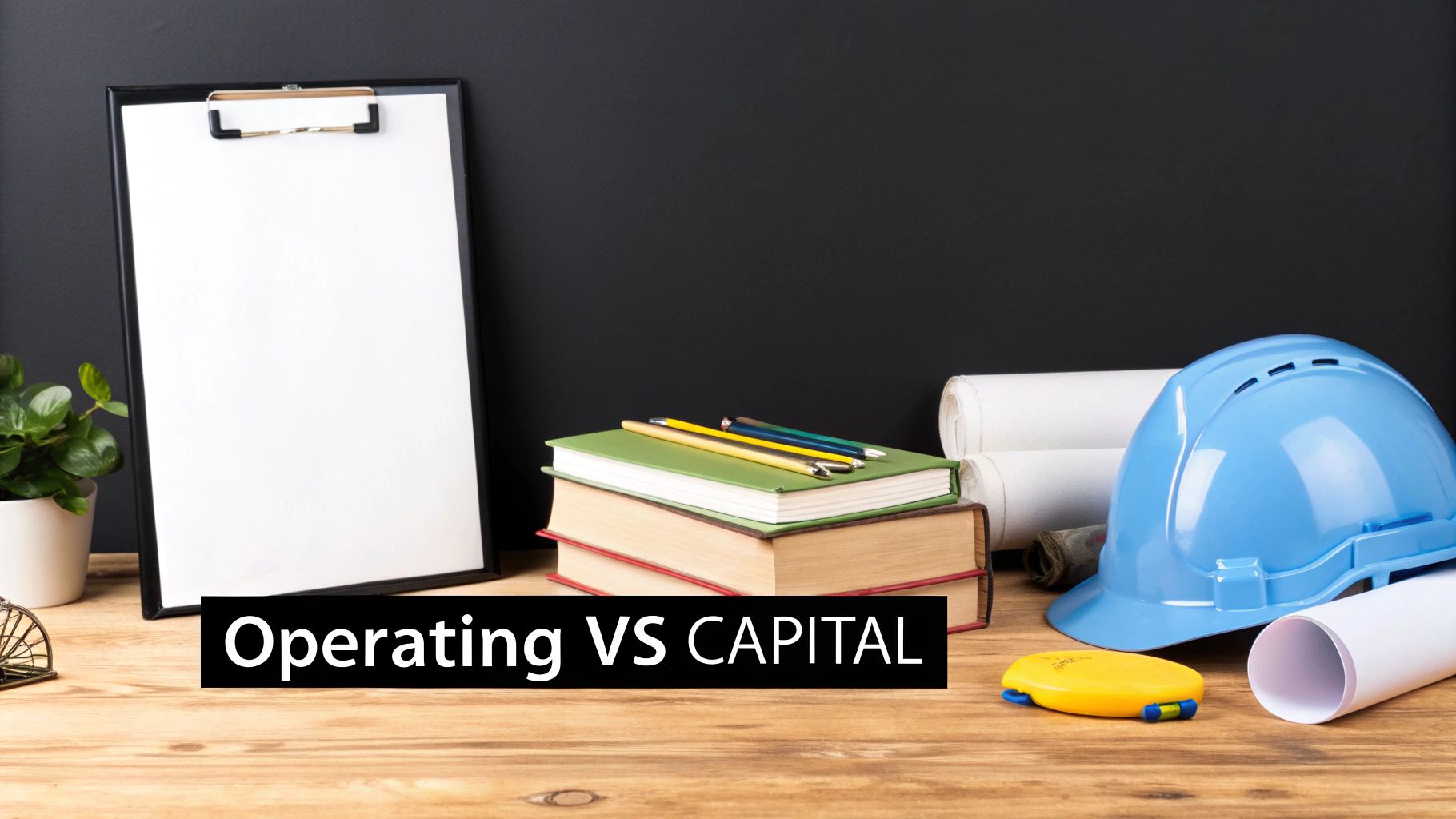
If you want to sell to schools, you have to get one thing straight: not all money is the same. A district’s entire financial world is split into two major buckets, and mixing them up is one of the quickest ways to get a hard "no." These two buckets are the operating budget and the capital budget.
The easiest way to think about it is to compare it to your own household finances. Your operating budget is for all your regular, day-to-day expenses—things like groceries, your electric bill, and filling up your car with gas. On the other hand, the capital budget is for huge, long-term investments, like finally remodeling that outdated kitchen or buying a new home.
Just like you wouldn’t raid your mortgage payment to buy a week's worth of groceries, a school district can't dip into its building fund to pay for new reading software. The rules are incredibly strict, and the money is kept in completely separate accounts.
The Operating Budget: Keeping the Lights On
The operating budget is the lifeblood of a school district. It's the financial engine that keeps the lights on, the buses running, and the learning happening every single day. This budget covers all the predictable, recurring costs required to run a school or district for one fiscal year.
This is where the money for people, programs, and supplies comes from. It's where the vast majority of a district's annual spending takes place.
Common things you’ll find in an operating budget include:
- Salaries and Benefits: This is almost always the biggest chunk, paying for every teacher, principal, and support staff member.
- Instructional Materials: Think textbooks, classroom supplies, science lab equipment, and art materials.
- Software and Subscriptions: This covers annual licenses for learning platforms, educational apps, and administrative tools.
- Professional Development: Funds set aside for training teachers and staff on new curricula or technology.
- Utilities and Maintenance: The basic costs of electricity, heating, water, and routine building upkeep.
Because this budget is renewed year after year, it’s the right place for most products and services that schools use on a regular basis.
The Capital Budget: Building for the Future
The capital budget is built for something else entirely. It funds the massive, expensive projects that are meant to last for decades. Think big, think expensive, and think infrequent.
These aren't everyday purchases. They are major investments in a district's physical infrastructure and long-term assets. The money for these projects is usually secured through special means, like voter-approved bonds, not the typical annual tax revenue.
A good rule of thumb: If someone needs to wear a hard hat, it’s probably a capital expense. If it gets used up within a school year, it’s an operating expense. This simple distinction is key to finding the right buyer and the right funding source.
Capital budgets are used to pay for projects like:
- New School Construction: Building a brand-new elementary or high school from the ground up.
- Major Renovations: Gutting and modernizing an old building, adding a new science wing, or replacing an entire roof.
- Large-Scale Tech Infrastructure: Projects like overhauling the district-wide Wi-Fi network or installing new data servers.
- Major Equipment Purchases: Buying a whole new fleet of school buses or replacing the HVAC systems across multiple buildings.
Pitching an annual software subscription to a capital projects manager is a guaranteed dead end. Their budget is legally walled off for these huge construction and infrastructure projects. They simply don’t have the authority—or the funds—to buy classroom materials.
Getting this fundamental split in budgets for schools is non-negotiable. It helps you position your product correctly, target the right person, and align your pitch with the right pot of money, which will dramatically boost your chances of making the sale.
Navigating the Annual School Budget Cycle

When it comes to selling to schools, timing isn't just important—it's everything. Showing up with a groundbreaking new reading program in August is almost always a waste of time. Why? Because those decisions were likely locked in months ago. To have any real success, you have to align your sales efforts with the school's internal financial clock.
Most school districts don't run on a standard calendar year. They follow a fiscal year, which for the vast majority runs from July 1 to June 30. This calendar dictates a surprisingly predictable, year-long cycle of planning, approving, and spending money.
Learning this cycle is like getting a roadmap to a district's purchasing priorities. It tells you exactly when to plant the seeds for a new idea, when to make your big pitch, and when to ask for the signature on a purchase order.
The Planning Phase (Fall)
The entire budget process kicks off in the fall with a heavy focus on planning and figuring out what’s needed for the next school year. This is where the foundation for future spending is laid.
During these months, principals and department heads are deep in evaluation mode. They're looking at current programs, analyzing student data, and putting together wish lists of materials, software, and training they believe will help them hit their academic goals.
For vendors, this is the absolute best time to build awareness and relationships. Decision-makers are actively exploring new ideas and are far more open to a conversation.
- September–October: District leaders set the big-picture budget goals and pass them down to individual schools.
- November–December: Principals and department heads turn in their initial budget proposals and needs assessments to the central office.
Your goal here isn't to close a sale. It’s to get your solution on their radar. Think free trials, case studies, and informational webinars—not hard-sell demos.
The Approval Phase (Winter and Spring)
Once all the requests are in, the district's central office starts the complicated job of piecing everything together into a single, cohesive budget. This is where the tough choices happen.
The superintendent and business manager will scrutinize every single request, trying to balance the district’s wish list against the reality of projected revenue. This draft budget then goes to the school board for review, public hearings, and, eventually, a final vote.
The budget approval process is the moment of truth. If your solution makes it into the final, board-approved budget, it's officially greenlit for purchase. If it doesn't, finding the money later becomes an uphill battle.
This period is make-or-break for vendors. You should be providing quotes, running demos, and giving your internal champions the information they need to advocate for your product. The final budget is usually approved between March and May, which sets the stage for purchasing to begin.
The Spending Phase (Spring and Summer)
With a freshly approved budget in hand, the real action begins. From late spring through the summer, administrators start cutting purchase orders for all the items they fought to get funded.
This is the main buying season for the upcoming school year. It’s when districts lock in curriculum purchases, sign new software contracts, and book professional development. If you did your homework in the fall and winter, this is when you close the deal.
There’s also a unique little window of opportunity here: "use-it-or-lose-it" funds. As the current fiscal year draws to a close on June 30, some departments may have unspent money that will disappear if they don't use it. This creates a last-minute scramble to spend down remaining funds, often on smaller, one-time buys.
The sheer size of the K-12 market makes understanding these cycles essential. Globally, governments contribute 60–70% of a market valued at around $7.6 trillion, and K-12 education is a huge piece of that pie. Knowing these procurement calendars is your key to tapping into it. You can learn more about the global education market's size and shape from industry experts at HolonIQ.
To make this even clearer, here's a simplified timeline that maps out the key activities and the best sales actions for each phase.
The K–12 School Budget and Procurement Timeline
This table breaks down the typical school fiscal year, showing you where the district is in its process and what your team should be doing to align with it.
| Phase (Season) | Key Budget Activities | Vendor Sales & Marketing Actions |
|---|---|---|
| Q1: Planning (Fall) | Needs assessments, initial budget requests from schools, setting district-wide priorities for the next fiscal year. | Focus on awareness and education. Run top-of-funnel campaigns, share case studies, offer free resources, and build relationships. |
| Q2: Development (Winter) | Central office consolidates requests, drafts the master budget, and begins presenting it to the school board. | Nurture leads and support internal champions. Provide demos, custom quotes, and data to help them justify the purchase to higher-ups. |
| Q3: Approval (Spring) | Public hearings, school board reviews, revisions, and final budget approval (typically between March and May). | Follow up consistently. Stay in close contact with your key prospects and prepare for the procurement process to kick off. |
| Q4: Spending (Summer) | Purchase orders are issued for the new school year. End-of-year "use-it-or-lose-it" spending rush for the current year. | This is prime time for closing deals. Focus on finalizing contracts and look for last-minute opportunities with year-end funds. |
By syncing your outreach to this rhythm, you stop selling at schools and start working with them, presenting the right solution at the exact moment they're ready to listen.
Who Decides What to Buy and When

Getting a handle on the different pots of money and the annual budget cycle is a massive step forward. But just as important is knowing who actually controls those funds. In the K-12 world, a single purchase is almost never a one-person decision. It’s a team sport.
Think of it this way: a teacher might find a brilliant new math app and become its biggest champion, but they rarely have the power to sign the check. Their enthusiasm is just the first domino in a long, complex chain of command.
This is where so many vendors get tripped up. You might win over the end-user, but if you don't convince the curriculum director managing that budget and the IT director who has to green-light the tech, the sale goes nowhere. Pitching to someone with passion but no purchasing power is a common and costly mistake.
The Key Players in School Purchasing
To succeed, you have to learn the purchasing hierarchy. While exact titles can vary from one district to the next, the core roles and responsibilities are remarkably consistent. Think of it as a cast of characters, each with a specific part to play in how budgets for schools get spent.
Here are the people you'll almost always run into:
- Superintendent: The district's CEO. They're focused on the big picture and give the final nod to the overall budget. They won't weigh in on small classroom purchases but will absolutely sign off on major, district-wide initiatives.
- Chief Academic Officer / Curriculum Director: This person is in charge of what gets taught and how. They are the key decision-maker for new textbooks, core curriculum software, and assessment tools.
- Chief Information Officer / Technology Director: The gatekeeper for all things tech. They evaluate every new tool for security, data privacy, and whether it plays nice with the district's existing systems. Nothing gets bought without their approval.
- Business Manager / CFO: The person holding the purse strings. They make sure every purchase aligns with the approved budget and follows strict procurement laws.
- Principal: The leader of a school building. They control a site-based budget for things like classroom supplies, professional development, and supplemental programs. For building-level sales, they are often your most important contact.
The secret to an effective sales strategy is identifying two people: the end-user who will champion your product and the administrator who has the authority to approve the funds. One without the other is a recipe for a stalled deal.
Knowing this landscape helps you tailor your message. A teacher cares about student engagement. A CIO is worried about network security. A business manager is focused on ROI. A great pitch speaks to all of them. For a closer look, our guide on K-12 purchase decision-makers dives even deeper into these roles.
Understanding Procurement Rules and Thresholds
Beyond knowing who to talk to, you have to understand how they're allowed to buy things. School districts are public agencies spending taxpayer money, which means they operate under strict rules to keep things fair and transparent.
A small purchase, say a few classroom supplies under $1,000, might just need a principal’s signature on a purchase order. Simple enough. But as the price tag gets bigger, so does the red tape.
Districts establish specific purchasing thresholds that trigger more formal processes. A purchase over $10,000, for instance, might require them to get at least three competitive quotes. A larger investment, like anything over $50,000, will likely demand a formal Request for Proposal (RFP). This is a public, competitive bidding process where vendors submit detailed proposals that are scored against a strict set of criteria.
This can all feel slow and bureaucratic, but it's a non-negotiable part of the system. If you know a district's purchasing thresholds ahead of time, you can anticipate how long and complicated the sales cycle will be. By understanding both the people and the process, you can navigate the path from an initial conversation to a signed contract.
Finding Extra Funding: How Grants and Bonds Create Big Opportunities
The operating and capital budgets might be the financial heart of a school district, but they're not the only game in town. When a district has a big idea—maybe a groundbreaking literacy program or a massive technology upgrade—it often looks beyond the annual budget cycle. That's where two other major funding sources come into play: grants and bonds.
For any company selling to schools, these are more than just line items; they represent huge, often untapped, opportunities. Getting a handle on how they work is the first step to becoming a true partner in a district's growth, not just another vendor knocking on the door.
Here’s a simple way to think about it: grants are like scholarships for specific projects, while bonds are like a mortgage for a major campus expansion. Both bring in a lot of cash, but their purpose and process are completely different.
Tapping Into Grant Funding
Grants are basically cash awards from an outside organization—like the federal government or a private foundation—to help a school accomplish a very specific goal. This money comes with strings attached and has to be spent exactly as intended.
A perfect example of this is the federal Title I program, a massive, multi-billion dollar fund that supports schools with a high percentage of students from low-income families. In fact, over 60% of public schools in the U.S. qualify for this funding. They can use it for all sorts of things, from hiring reading specialists to buying supplemental learning tools.
Grant money flows from a few key places:
- Federal Government: Think big, national programs like Title I that target equity or specific student needs.
- State Governments: States often offer grants to push their own educational priorities, like boosting STEM programs or early childhood literacy.
- Private Foundations: These can be anything from local community foundations to large corporate charities looking to fund innovative teaching ideas.
The real trick for vendors is to connect your solution to a relevant grant. If you sell a reading intervention platform, you could be the key to helping a district write a winning Title I application. Suddenly, you're not just selling a product; you're helping them find the money to buy it. It's a game-changer.
Understanding School Bonds
Bonds are a whole different beast. Essentially, a school bond is a big loan that a district asks the local community to approve in an election. If the voters say "yes," the district can then sell bonds to investors to raise a huge chunk of money for major, long-term capital projects.
Bonds are how communities invest in their schools' futures. They fund the big, transformative projects—like new buildings and district-wide tech upgrades—that are just too expensive for the annual operating budget to cover.
This is how districts pay for things like:
- Building a brand-new high school from the ground up.
- Adding a state-of-the-art science wing to an existing campus.
- Overhauling the Wi-Fi infrastructure in every single school.
- Funding a 1:1 initiative to put a device in every student's hands.
For vendors who sell big-ticket items, keeping an eye on local bond measures is a brilliant move. When a community passes a $50 million technology bond, that's a clear signal that a massive, multi-year spending spree is about to begin. If you can get in on those conversations early, you can position your company as a foundational part of the district's vision.
It's also worth noting that on a global scale, external funding can be even more crucial. In many developing nations, international aid makes up a huge slice of the education budget. But as recent education financing trends from UNESCO show, that support has been shrinking, creating serious funding gaps and pushing schools everywhere to find more efficient and effective solutions.
Using Budget Data to Prioritize Your Sales Efforts
Knowing the ins and outs of school budgets is one thing, but actually using that knowledge to drive your sales strategy is a whole different ballgame. It's where the real magic happens. Instead of just casting a wide, inefficient net, you can use financial data to zero in on the schools and districts that are a perfect fit for what you offer.
This simple shift turns your sales process from a guessing game into a data-driven machine. It all boils down to a fundamental truth: not all school districts are created equal, especially when it comes to their spending power and priorities.
Segmenting Prospects with Budget Filters
The key is to slice up your target list based on financial capacity. A district's total budget size and its per-pupil expenditure are two of the most powerful indicators you can find. These numbers tell a story, quickly revealing whether a district is a high-potential lead or probably a dead end.
For instance, if you’re selling a premium, high-ticket technology suite, chasing districts with tiny budgets is a recipe for frustration. You'll want to focus your energy almost exclusively on districts with larger budgets and higher-than-average per-pupil spending. They’re simply far more likely to have the funds for a major investment.
On the other hand, a company with a cost-effective supplemental resource might find its sweet spot with smaller districts. These schools are constantly on the lookout for affordable solutions that deliver a big impact without breaking the bank. By targeting this segment, you align your product's value proposition directly with their financial reality.
The goal isn't just to find districts that need your product. It's to find the ones that can actually afford it. Using budget data as your first filter ensures your sales team spends its time on conversations that can realistically end in a "yes."
Platforms like Schooleads are designed to make this kind of strategic targeting incredibly simple. You can apply filters to instantly pull lists of prospects that match your ideal financial profile.
The screenshot above shows just how easy it is to use Schooleads to apply specific filters—like district budget size or student enrollment—to turn a massive database into a focused list of high-quality leads. This is the engine that drives a smarter, more effective sales motion.
Creating Tiered Sales Strategies
Once you’ve segmented your prospects, you can build a tiered outreach plan. This ensures you’re dedicating your most valuable resource—your team's time—to the leads with the highest potential. A solid plan might look something like this:
Tier 1 (High-Priority): These are your whales—the largest districts with the highest per-pupil spending. They get the white-glove treatment with personalized outreach, one-on-one demos, and custom proposals.
Tier 2 (Mid-Priority): These are solid, mid-sized districts with healthy budgets. Your approach here could involve targeted email campaigns and invitations to group webinars.
Tier 3 (Low-Priority): Smaller districts with limited funds fall into this group. You can still engage them effectively by nurturing them with automated email sequences and high-value free resources.
This tiered strategy, all informed by the smart use of budgets for schools, gets your team away from a one-size-fits-all approach. When you match your effort to the opportunity, you can boost your conversion rates and build a much stronger sales pipeline. To learn more, check out our complete guide to building a successful education marketing strategy.
Your Top Questions About School Budgets, Answered
Let's be honest: trying to make sense of school budgets can feel like a maze. Even when you think you have the basics down, you hit a wall. Here are some straightforward answers to the questions we hear from vendors all the time.
Why Does It Take So Long to Get a "Yes"?
The slow pace of school purchasing can be a real source of frustration. But there's a good reason for it: accountability. Remember, schools are spending taxpayer money, and that comes with a lot of oversight.
Think of it like a series of checks and balances. A single purchase isn't just one person's decision. It might have to go from a teacher to the principal, then to the curriculum director, over to the business office, and finally get a stamp of approval from the school board. Each step is designed to prevent misuse of funds and make sure every dollar is spent wisely. It's slow, but it's intentional.
Where Can I Actually See a School District's Budget?
This is easier than you might think. Since they're public funds, budgets are public records. Your first and best bet is always the district's official website.
Poke around the site for pages like "Business Office," "Finance," or "Board of Directors." That’s usually where you'll find the most recent budget documents, often posted right after the school board votes to approve them.
If you strike out on the website, just pick up the phone. A polite call or email to the district's business manager can usually get you pointed in the right direction. Getting your hands on these documents is like finding a treasure map—it shows you exactly what their priorities are.
Pro Tip: When you talk to administrators, don't just sell a product. Frame your solution as a direct answer to a goal you saw in their public budget or school improvement plan. This shows you've done your homework and immediately aligns you with their mission.
How Do I Even Bring Up Money with an Administrator?
This is where a lot of sales conversations go wrong. You need to switch your approach from "pitching a price" to "helping them solve a funding puzzle." School leaders are masters at stretching every last dollar to meet their goals.
Instead of asking the classic, "Do you have the budget for this?" try a more collaborative approach.
Here are a couple of lines that work well:
- "What funding stream do you normally tap into for projects like this?" This question shows you get that money isn't just one big pot and helps you figure out where your solution fits.
- "We've helped districts similar to yours use their Title I funds for our reading program. Is that an avenue you've considered?" This instantly positions you as a helpful partner who understands their world, not just another vendor with their hand out.
When you come at it from a place of genuine curiosity and a desire to help them piece together the funding, you build trust. That kind of partnership is infinitely more powerful than a hard sell.
Ready to stop guessing and start targeting the right schools with the right message? Schooleads provides the verified contact data and advanced budget filters you need to connect with K-12 decision-makers who can actually say "yes." Find your ideal prospects and build a stronger sales pipeline.