
A Guide to Agile Education Marketing
Transform your school's outreach with agile education marketing. Learn how to use sprints, data, and rapid testing to boost enrollment and engagement.
Agile education marketing is all about being responsive and iterative. Instead of locking into a rigid, year-long plan, your team works in short cycles—we call them "sprints"—to quickly launch, test, and adapt campaigns. It’s a flexible framework that’s built on making data-driven decisions and constantly improving to hit your enrollment goals.
Why Agile Education Marketing Is Essential Today

Let's be honest: the old marketing playbook for schools just doesn't work anymore. Those annual plans, set in stone months ahead of time, can't keep up. Parent expectations are always changing, new digital channels pop up overnight, and competition from other schools and EdTech platforms is tougher than ever.
This new reality demands a more nimble and responsive strategy. Agile marketing isn't just a buzzword; it's a practical way for your school to not just survive, but thrive. By breaking down huge campaigns into small, manageable tasks that you tackle in short sprints, your team can build momentum and see results much faster.
The Shift from Static Plans to Dynamic Sprints
Forget the monolithic annual plan. An agile approach means working in focused two- to four-week cycles. Each sprint is dedicated to a specific, measurable goal, like boosting open house sign-ups or getting more inquiries from a key demographic. This iterative cycle lets your team learn from real performance data—not assumptions—and pivot quickly.
This change brings some serious advantages for school marketers:
- Faster Campaign Launches: You can get new ideas out the door in weeks instead of months, letting you jump on timely opportunities.
- Improved Alignment: Sprints make sure your marketing efforts are always directly tied to current enrollment and admissions priorities.
- Reduced Risk: Small, frequent experiments mean you can test an idea without blowing your whole budget on something that might not work.
- Better Team Morale: When your team is empowered to make decisions and see the immediate impact of their work, you get a much more engaged and motivated group.
An agile framework transforms marketing from a cost center into a strategic growth engine. It’s about building a system that continuously learns from your audience and improves its outreach with every sprint.
Adapting to a Competitive Landscape
The need for this kind of flexibility is clear when you look at the data. The 8th Annual State of Agile Marketing Report found that a massive 96% of marketers in the education sector had a positive experience with agile frameworks. Even more telling, fully Agile teams were three times more likely to succeed with AI-driven initiatives.
Here’s a quick look at how the two approaches stack up.
Traditional vs Agile Marketing in Education
| Aspect | Traditional Marketing Approach | Agile Marketing Approach |
|---|---|---|
| Planning | Annual, rigid, and detailed upfront. | Short-term sprints (2-4 weeks), flexible and adaptive. |
| Execution | Follows a pre-set plan with little deviation. | Iterative; campaigns are launched, tested, and refined. |
| Decision-Making | Based on assumptions and historical data. | Driven by real-time performance data and audience feedback. |
| Team Structure | Siloed departments, top-down direction. | Collaborative, cross-functional teams with shared ownership. |
| Risk | High risk; large budget committed to unproven campaigns. | Low risk; small, controlled experiments minimize losses. |
| Outcome Focus | Completing the campaign as planned. | Achieving measurable results and continuous improvement. |
Ultimately, agile education marketing is about swapping guesswork for evidence. It gives your school the power to make smarter decisions, use your resources more effectively, and connect with prospective families in a way that truly resonates. It’s how modern schools win.
Building Your School's Agile Foundation

Before your school’s marketing team can really hit the ground running with its first sprint, you need to build a solid launchpad. This isn’t about shelling out for expensive software or doubling your budget. It’s about being intentional and setting up the right tools, roles, and data flows that make a fast, iterative workflow possible.
Think of this prep phase as the difference between successful agile marketing and just plain chaotic, reactive tactics. Getting this foundation right creates a system where speed, teamwork, and data-driven decisions feel natural, not forced. Skip this step, and you’ll find yourself struggling to gain any real momentum.
Choosing Your Agile Toolkit
Your project management tool is going to be your team's command center. The name of the game here is simplicity and visibility—everyone needs to see what’s on the docket, who’s handling it, and how far along it is at a glance.
For most school marketing teams I’ve worked with, tools like Trello or Asana are a perfect fit. They’re visual, easy to pick up, and you can bend them to your will for marketing sprints.
- Trello: This is a fantastic choice if your team thinks visually. You can set up a simple board with columns like "Backlog," "This Sprint's To-Do," "In Progress," and "Done." Each task is a card you can literally drag and drop across the board.
- Asana: If you need a bit more structure, Asana is great. It offers task dependencies and timeline views, which can be a lifesaver if your campaigns have lots of sequential steps or involve coordinating with admissions.
Whichever you land on, set it up specifically for your marketing sprints. Create a dedicated project or board where you can build your backlog and manage sprint tasks. The most important thing is to pick one tool and get everyone to actually use it.
Defining Roles for a Lean Team
You don't need a huge department to go agile. Even a solo marketer or a tiny team of two can adopt these roles to keep everyone accountable and focused. These aren't new job titles; they’re just different hats team members wear during a sprint.
Key Agile Roles (Adapted for Schools)
| Role | Responsibility | Who It Could Be |
|---|---|---|
| Scrum Master | Runs the sprint meetings, clears roadblocks, and keeps the team on track. | The Marketing Director or a savvy project manager. |
| Product Owner | Is the voice of your "customer" (prospective families) and prioritizes the backlog. | The Director of Admissions or Head of Enrollment often fits perfectly here. |
| Team Member | Does the work—writes the email copy, designs the ads, manages social media. | Your marketing coordinators, specialists, and creatives. |
In a small school, one person might wear multiple hats. It’s common for the Marketing Director to be both the Scrum Master and a Team Member. Just be sure to clearly define who is responsible for what to avoid confusion and make sure every part of the agile process is covered.
Connecting Your Data Sources
Agile marketing is fueled by data. Your ability to come up with smart hypotheses and run meaningful experiments hinges on having clean, integrated information at your fingertips. So, before you start sprinting, get your key data sources connected.
The most powerful agile teams are those that can quickly pull insights from their data to inform their next move. Your CRM isn't just a database; it's the fuel for your entire marketing engine.
This means making sure your Customer Relationship Management (CRM) system or Student Information System (SIS) can talk to your marketing tools. You need to be able to segment audiences based on real information, like where an inquiry came from, a family's zip code, or their child's academic interests. This is where a high-quality K-12 contact database like the one from Schooleads becomes incredibly valuable for precise segmentation.
Creating Your First Marketing Backlog
The marketing backlog is essentially your team's prioritized wishlist. It's a living, breathing document that holds every single campaign idea, content piece, and experiment you want to try. It’s not a rigid to-do list but a dynamic queue you'll pull work from for each sprint.
Start by brainstorming with your team and key stakeholders. Get all the ideas out there:
- Email campaigns to re-engage families who inquired last year.
- Social media ad variations targeting different parent personas.
- A/B tests for your "Request Information" landing page.
- New blog posts or video content ideas.
Every item in the backlog should be a distinct task that clearly answers what needs to be done and why it's valuable. This kind of strategic thinking is catching on; 20% of marketing teams in general have adopted agile principles to improve collaboration and focus on real results. You can learn more about these agile adoption trends.
Once you have this foundation in place—your project board, defined roles, connected data, and a healthy backlog—you’re officially ready to start sprinting.
Running Your First Marketing Sprint
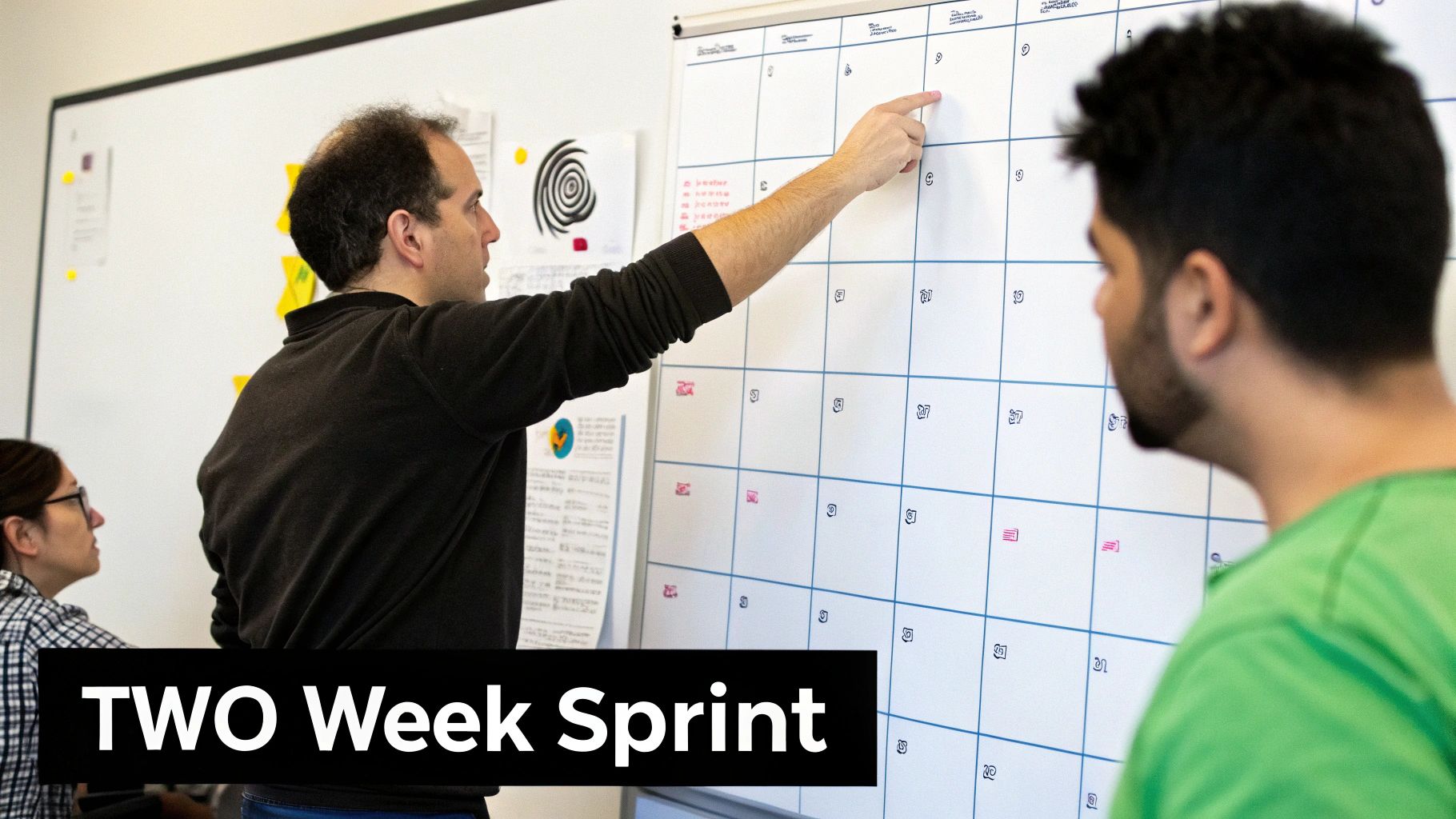
Alright, this is where the theory behind agile education marketing gets real. A "sprint" isn’t just a fancy term for working hard. It's a focused, time-bound push where your team zeroes in on a handful of high-impact tasks. For most school marketing teams, a two-week sprint is the perfect cadence.
This short timeframe forces you to get ruthless with your priorities and keeps the energy high. It turns your marketing efforts from a long, disconnected slog into a predictable rhythm of getting things done, learning fast, and then doing it all over again, but better.
Kickstarting the Sprint with a Planning Meeting
Every single sprint kicks off with a Sprint Planning meeting. Honestly, this is probably the most important meeting you'll have in the whole agile process. It's a one- to two-hour session where the team gets together and decides what they can actually get done in the next two weeks.
Your "Product Owner"—maybe the Director of Admissions or Head of Marketing—will bring the top priorities from the marketing backlog. From there, it's a team discussion. Everyone chimes in, asks questions, and collectively decides what to pull into the sprint. This isn't about a manager handing down orders; it's a negotiation.
Let's say your big goal is to drive more attendance for an upcoming open house. Your backlog might look something like this:
- Targeted email campaign to families in specific zip codes.
- Run three different Facebook ad variations.
- Update the open house landing page with new parent testimonials.
- Write a blog post on the school's unique science program.
After talking it over, the team might agree to tackle the email campaign and the landing page update. But the Facebook ads and blog post? They’ll have to wait for the next sprint. This creates a focused to-do list that everyone has bought into. What you walk away with is the sprint backlog—your team's definitive game plan for the next two weeks.
A great sprint starts with a realistic plan. The point of Sprint Planning isn't to see how much you can cram in. It's about making a focused commitment the team feels confident they can deliver on. Overcommitting is the quickest way to burn everyone out and fall short of your goals.
Maintaining Momentum with Daily Stand-ups
Once the sprint is off and running, the team huddles up for a Daily Stand-up. Think of it as a quick, 15-minute check-in to sync up, not a drawn-out status report. The whole point is to keep communication flowing and nip problems in the bud.
Each person quickly answers three questions:
- What did I get done yesterday?
- What am I working on today?
- Is anything getting in my way?
This simple habit keeps small hiccups from turning into major roadblocks. If the designer is stuck waiting for copy for that new landing page, it comes out right here. The person acting as Scrum Master can then jump in to help clear that path and keep the sprint on track. These daily huddles are the heartbeat of an effective agile education marketing team.
Wrapping Up with Review and Retrospective
When the two weeks are up, the sprint closes out with two final, crucial meetings: the Sprint Review and the Sprint Retrospective.
First, the Sprint Review. This meeting is all about the what. Here, the team shows off the work they completed to stakeholders, like the admissions director or head of school. Sticking with our open house example, they’d demo the new landing page and share the results from the email campaign—open rates, clicks, and, most importantly, how many new families registered.
Maybe your hypothesis was: "*Personalized emails to specific zip codes will increase registrations by 15%.*" The review is where you show the data. Did you hit that number? Crush it? Miss it completely? This isn’t about passing or failing; it’s about learning what actually works.
Next up is the Sprint Retrospective. This one is about the how. It's a private, candid meeting just for the marketing team to reflect on the sprint itself. What went well? Where did we struggle? What should we change next time? Maybe the approval process for email copy was a bottleneck, or the team felt they didn't have the right data for segmentation.
This is your team's chance to get better together. You should walk out of the retrospective with one or two concrete process improvements to try in the very next sprint. This ensures that every two weeks, your team isn't just shipping marketing campaigns—it's getting smarter and more efficient.
Using Data and Rapid Experiments to Drive Enrollment

Agile marketing isn’t about guesswork; it's about making smart, evidence-based decisions. Forget pouring your entire budget into one massive, unproven campaign. Instead, the agile approach is built on a cycle of small, fast experiments that let you learn directly from your audience.
The goal is to move from big bets to a series of low-risk tests. Each experiment is designed to answer one specific question about what really motivates prospective families. The insights you gather are the fuel for your enrollment engine, making every marketing dollar you spend work harder than the last.
From Broad Strokes to Hyper-Targeted Segments
Effective experiments start with knowing exactly who you're talking to. One-size-fits-all messaging just doesn't cut it anymore. Your school's internal data, whether it’s in your CRM or Student Information System, is an absolute goldmine for creating precise audience segments.
Start slicing your data in ways that actually matter. Instead of blasting the same email to every lead, you can create distinct groups to test different messages.
- Segment by Lead Source: Do families who found you through a local blog respond better to messages about community? Do those from a Google Ad want to see data on academic outcomes? Test it.
- Segment by Geographic Location: Carve out a segment for families in a specific high-value zip code. You could test a campaign highlighting convenient bus routes or local partnerships that matter to them.
- Segment by Program of Interest: A family looking at your STEM program needs to hear a very different story than one interested in your arts curriculum.
This kind of detail transforms your marketing from a megaphone into a personal conversation. And as you gather and use this data, it's crucial to stay compliant with all regulations. You can review our commitment to data protection in the Schooleads privacy policy.
Designing and Launching Your Experiments
Once you have your segments, it’s time to form a hypothesis. A hypothesis is really just an educated guess you want to prove or disprove. For instance: "We believe using a student testimonial in our social media ad will generate a 20% higher click-through rate among parents of middle schoolers than an ad featuring our campus."
With a clear hypothesis in hand, designing a simple A/B test becomes straightforward.
The goal isn't to find a single "perfect" message. It's to build a system of continuous learning where every experiment, whether it succeeds or fails, makes your next campaign smarter.
Here are a few practical A/B tests you can easily run within a single two-week sprint:
- Email Subject Lines: Test a straightforward subject line ("Upcoming Open House Details") against a more benefit-driven one ("See How Our Students Thrive at Our Open House").
- Website CTAs: On your admissions page, does the button copy "Schedule a Tour" perform better than "Visit Our Campus"?
- Social Media Ad Creative: Run two identical ads with different images—one of your high-tech science lab and another of a lively classroom discussion. See which one drives more inquiries.
The growth of the global EdTech market, which hit $297 billion in 2022, shows just how important these agile approaches are for staying competitive. In fact, a recent report found that 91% of fully Agile teams in education believe this method will help them reach their 2025 goals, with 55% saying it's even more critical in the current economic climate.
Sample K-12 Marketing Experiment Ideas
To get you started, here's a table with a few concrete hypotheses your team could tackle in an upcoming sprint. Think of these as templates to inspire your own tests.
| Hypothesis | Metrics to Track | Target Segment (Example) |
|---|---|---|
| A personalized email from the Head of School will generate more tour bookings than a generic admissions email. | Email Open Rate, Click-Through Rate, Tour Booking Conversions | High-value leads in the inquiry stage |
| Social media ads featuring current parents will achieve a lower Cost Per Inquiry than ads showing only facilities. | Cost Per Inquiry (CPI), Click-Through Rate (CTR), Ad Engagement | Parents of elementary students on Facebook |
| Adding a "Tuition & Aid" video to our website will increase application start rates by 15%. | Video Views, Time on Page, Application Start Rate | Website visitors on the admissions page |
| A postcard mailer about our new arts program will drive more open house registrations than a digital-only campaign. | Unique URL Visits, QR Code Scans, Open House Registrations from specific source | Families living within a 5-mile radius |
Remember, the key is to isolate one variable and measure its impact. This focused approach is what gives you clean, actionable data to build on for the next sprint.
Tracking the KPIs That Actually Matter
Running experiments is a waste of time if you aren't tracking the right metrics. In agile marketing for schools, we have to look past vanity metrics like social media likes and focus on KPIs directly tied to enrollment.
Here are a few key metrics to keep your eye on:
- Inquiry-to-Application Rate: Of the families who ask for information, what percentage actually starts an application? This tells you how well your initial follow-up is working.
- Cost Per Application: How much marketing money are you spending to generate one completed application? This is your bottom line.
- Event Attendance Rate: For your open houses or virtual tours, what percentage of the people who register actually show up?
These numbers tell the real story. If an experiment makes your inquiry-to-application rate jump, you’ve found a winning tactic. If it drops, you’ve learned what doesn’t work—an equally valuable lesson that saves you from wasting more money. Use these results in your Sprint Review to decide what to scale up and what to test next.
How to Scale Your Agile Marketing Efforts
So, you’ve run a few successful sprints. Your team has found its groove, the results are rolling in, and you’re starting to see what this agile thing is all about. Great. Now what?
The natural next step is to scale up. But be careful—scaling isn’t about just doing more. It’s about growing smarter and embedding these practices across your entire marketing function without creating a chaotic mess. The goal is to evolve from a single agile team into a fully agile marketing organization.
This takes a real plan. You need a roadmap for managing multiple projects, keeping other departments in the loop, and building a collective brain from all your experiment learnings. Winging it will only create new silos and undermine the very agility you've worked so hard to build.
Managing Multiple Sprints and Teams
Once you get going, you'll likely have multiple sprints running at once. It's easy to imagine: one team might be deep in a two-week sprint to drum up lower school applications, while another team is focused on a month-long push to re-engage alumni for the annual fund.
This is where a "scrum of scrums" meeting becomes your best friend. Think of it as a quick, regular check-in where a designated person from each sprint team gets together. They aren't there to rehash daily tasks. Their job is to look at the bigger picture—where projects overlap and where one team might be about to hit a roadblock caused by another.
This simple addition to your routine helps in a few key ways:
- You spot cross-team dependencies early. If the admissions campaign team needs a new video from the content team, that gets flagged right away, not the day before launch.
- Your messaging stays consistent. Nothing looks worse than two different teams sending conflicting messages to the same group of parents on the same day.
- You allocate resources wisely. Leadership gets a bird's-eye view of what everyone is working on, making it easier to shift priorities and support where needed.
Aligning Marketing with Admissions and Beyond
Your marketing team doesn't exist on an island. To be truly agile, your sprints have to be directly tied to the goals of other departments, especially admissions. This is why the "Product Owner" role is so critical. In a school setting, this person should ideally be from the admissions office or work so closely with them they're practically part of the team.
This setup ensures the marketing backlog is constantly prioritized based on what's happening on the ground with enrollment. If admissions sees a sudden drop in inquiries from a key feeder school, the marketing team can react immediately, pulling an experiment that targets that specific area into the very next sprint.
Scaling agile means breaking down departmental walls. When marketing sprints are directly fueled by admissions data and goals, you create a powerful feedback loop that drives sustainable enrollment growth.
Building a Shared Knowledge Base
Every A/B test, every creative experiment, every landing page you launch generates valuable data. The biggest mistake you can make is letting those insights disappear into forgotten PowerPoint decks or buried email threads. As you grow, you have to build a central, easy-to-search knowledge base.
This doesn't need to be complicated. It could be a simple wiki, a well-organized Google Drive folder, or a dedicated channel in Slack.
For every single experiment, make sure you document three things:
- The Hypothesis: What did we think would happen?
- The Results: What actually happened? (Include the data!)
- The Learning: What does this tell us for future campaigns?
This repository becomes your team’s shared memory. A new team member can get up to speed in days, not months. When you’re planning a new campaign, you can instantly see what’s worked—and what’s bombed—in the past. It keeps you from making the same mistakes twice and dramatically accelerates your learning curve. This system is the foundation for scaling agile education marketing for the long haul.
Questions We Hear All the Time About Agile Education Marketing
Making the switch to an agile approach feels like a big deal, and it’s totally normal to have questions. This new rhythm of planning, doing, and learning in quick cycles is a game-changer, but it can feel a little strange for school marketing teams who are used to working off of a big, annual plan.
Let’s dig into some of the most common questions we get. We'll give you straight, simple answers to help you see how agile education marketing can really work for your school, no matter how big your team or budget is.
“Our Marketing Team is Tiny. How Can We Possibly Do This?”
Good news: you don't need a huge department to be agile. In fact, smaller teams often have the upper hand.
With fewer people, communication is faster, and you can make decisions without getting stuck in red tape. The trick is to keep it simple.
- Grab a simple tool. A free Trello board with columns for “Backlog,” “This Sprint,” “In Progress,” and “Done” is honestly all you need to start.
- Wear a few different hats. In a team of one or two, you might be the person setting the priority, doing the work, and clearing roadblocks all at once. That's fine! Just be clear in your own head about which role you're playing at any given moment.
- Keep meetings quick. Your daily check-in can be a five-minute huddle. It’s not about formality; it’s about staying accountable and flagging anything that’s holding you up.
Agile is a mindset, not a rigid set of corporate rules. For a small team, it's about creating a disciplined way to prioritize what matters most, knock it out in focused bursts, and learn from what happens.
“What Are the Most Important KPIs to Track?”
It’s so easy to get buried in data. With agile, you want to laser-focus on the key performance indicators (KPIs) that connect what you’re doing directly to enrollment. Forget vanity metrics like social media likes and get down to what really moves the needle.
These are the non-negotiables:
- Cost Per Inquiry (CPI): This tells you exactly how much money you’re spending to get a prospective family to raise their hand. It’s the ultimate measure of your efficiency.
- Inquiry-to-Application Rate: Of all the families that show interest, how many actually start an application? This is a huge indicator of lead quality and how well your initial follow-up works.
- Application-to-Enrollment Rate: This is the bottom line. It shows you how well your entire admissions and marketing funnel works together to turn interested families into enrolled students.
Agile marketing is all about clarity. When you track these core KPIs, you can prove the value of your experiments and show everyone exactly how your work is helping the school grow.
“How Do You Balance Long-Term Brand Building with Short Sprints?”
This is a fantastic and crucial question. A lot of marketers worry that the short-term nature of sprints means the bigger picture—the school’s brand—gets lost. But a healthy agile process actually strengthens the brand.
Think of your long-term brand strategy (your mission, your values, your core message) as your North Star. It should guide everything you add to your marketing backlog. Before you start any project, you ask a simple question: Does this reinforce who we are?
Sprints then become the engine that brings that brand to life in a way you can actually measure. So instead of a fuzzy goal like "increase brand awareness," an agile team might run a sprint to launch a video series that shows off the school's unique project-based learning. You're still building the brand, but you’re doing it with concrete actions that produce clear results.
“What’s the Biggest Mistake Schools Make When They Try Agile?”
The single biggest mistake we see is when teams treat agile like a strict, all-or-nothing system. They read about Scrum, get intimidated by the jargon—sprints, stand-ups, retrospectives—and try to implement every single rule perfectly right out of the gate. That’s a recipe for frustration.
Agile is a framework, not a straitjacket. The schools that succeed start small and adapt the principles to fit their own culture.
Forget about a perfect rollout and just focus on the core ideas:
- Work in short, repeatable cycles.
- Prioritize your work based on what will have the biggest impact.
- Talk to each other regularly about what’s working and what’s not.
- Use real data to get better over time.
Pick one small project to start. Try running a two-week sprint to improve your open house landing page. See how it feels. Learn from it, tweak your process, and then try another. A gradual, learn-as-you-go approach is so much more effective than trying to do everything at once.
Ready to stop guessing and start making data-driven decisions? Schooleads provides the verified K-12 contact data you need to build targeted segments and run smarter experiments. Find the right decision-makers for your next campaign at https://schooleads.com.